Voyage in the Adriatic Sea
« All Corinthian II cruise options


| Dates | Deck + Cabin Type | |||||||
| Cat E | Cat D | Cat C | Cat B | Cat A | Cat AA | Cat VS | Cat PHS | |
Please note: Cruise fare does not include fuel surcharges.
Day 1 Venice, Italy
Built on an archipelago of small islands in a lagoon, Venice rose to power and flourished, dominating for many years the affairs of the eastern Mediterranean. Upon arrival in this unique city, transfer to the pier to embark Corinthian II.
Day 2 Venice or Aquileia
Venice is unquestionably one of Europe’s most unusual and sublime cities, where water and light work a special magic on the ancient stones and canals. Today explore some of Venice’s main landmarks, including St. Mark’s Basilica, consecrated in 1094 and adorned with splendid marble and mosaics, and the Doge’s Palace, the seat of Venetian power. As an alternative, take an excursion to Basilica Santa Maria Gloriosa de Frari, with Titian’s and other masters’ magnificent paintings, and the Scuola Grande di San Rocco, housing paintings by Tintoretto. The afternoon will be at leisure. Alternatively, take a full-day excursion to Aquileia, which was founded by the Romans in 181 B.C. and grew to become the fourth largest city in Italy by the end of the Roman Empire. Aquileia contains superb remains of its glorious past. Sail in the evening for Slovenia.
Day 3 Piran, Slovenia or Porec, Croatia
Built on a narrow peninsula that projects into the sea, Slovenia’s Piran is one of the most delightful towns of the Adriatic. Possessed by Venice in 1283, Piran is rich in well-preserved Venetian-inspired architecture, its arched alleyways lined with exquisite homes, palaces, and churches. Highlights of your tour of Piran include the spacious marble-surfaced Tartini Square flanked by historic buildings; the temple-like Church of St. George, originally built in the 14th century; and the Sergej Masera Maritime Museum, housed in the elegant Gabrielli Palace. There will be free time to explore Piran’s maze of streets.
As an alternative, an excursion leads to Croatia’s Porec, a center of the Illyrians in 200 B.C., taken over by the Romans in 35 B.C. The outstanding building of Porec is the 6th-century Basilica of Euphrasius, which contains exquisite mosaics. Remains from the Roman period include the Temple of Mars. The Museum, housed in an 18th-century palace, contains archaeological objects.
Day 4 Split, Croatia
Originally a Greco-Illyrian settlement called Aspalathos, Split is an ancient city centered around the formidable Palace of Diocletian, built in A.D. 295. An extensive structure, much of which is well preserved, the palace contains within its walls Split’s medieval town, making it the only palace that has been continuously inhabited since Roman times. Spend the afternoon at leisure to explore Split on your own, or drive to nearby Salona, which was the capital of the Roman province of Illyria. The sprawling remains of the city include amphitheaters, temples, as well as basilicas and other buildings from the early Christian period. On the return to Split, stop at the Archaeological Museum, which contains artifacts from Salona and other sites.
Day 5 Dubrovnik
A tour of the once Venetian-ruled city of Dubrovnik includes the Rector’s Palace, the Gothic cloister, the garden of the Dominican Monastery, and the baroque cathedral, which contains works by Renaissance painters Titian and Andrea del Sarto.
Day 6 Kotor, Montenegro
A tour of the once Venetian-ruled city of Dubrovnik includes the Rector’s Palace, the Gothic cloister, the garden of the Dominican Monastery, and the baroque cathedral, which contains works by Renaissance painters Titian and Andrea del Sarto.
Day 8 Urbino or Gubbio, Italy
Arrive in Ancona, Italy’s principal port on the central Adriatic. Drive to Urbino, one of Italy’s best-preserved Renaissance towns, overlooking the glorious countryside of the Marches. Visit the famed Palazzo Ducale, a masterpiece of Renaissance architecture, which houses the National Gallery of the Marches. Also, see the Church of San Giovanni Battista, with its frescoes, and the house of native son Raphael, the great Renaissance master. Alternatively, drive to Gubbio, one of the most beautiful and best-preserved small medieval towns in Italy, whose narrow streets and alleyways are lined with old polished grey stone buildings.
Day 9 Ravenna
Today, Corinthian II enters the canal that leads to Ravenna and docks near the center of town. Ravenna is an ancient city that came to prominence in the early 5th century A.D., when it became the capital of the Western Roman Empire. Visit Ravenna’s famed Byzantine churches dating from the 5th and 6th centuries, including the Mausoleum of Galla Placidia, the Basilica of San Vitale, and the Basilica of San Apollinare in Classe, all decorated with luminous mosaics and other pieces of art.
Day 10 Venice / Disembark
Disembark this morning for your continued journey home.
Day 7 The Trulli Villages or Monopoli, Italy
The fishing town of Monopoli is dominated by its 1552 castle. From this port, explore the region’s unique trulli villages, with their curious whitewashed conical dwellings built without mortar. Focus on the main village of Alberobello, where trulli line the streets, and hilltop Ostuni, an ancient town enclosed within ramparts. Alternatively, visit Monopoli and tour the ancient Greco-Messapian town of Egnathia, whose remains date from the 4th century B.C. to the early Christian period. The Museum contains finds from the site.
Itinerary Notes
PROGRAM INCLUSIONS- 9-night cruise aboard the all-suite, 114-guest Corinthian II
- Complete program of tours and excursions
- Welcome and farewell cocktail receptions aboard ship
- All meals aboard ship, including house wine, beer, and soft drinks with lunch and dinner
- Open bar aboard ship throughout the cruise
- Enrichment program of lectures and discussions by accompanying study leaders
- Professional tour staff
- Complete pre-departure materials
- Baggage handling and transfers abroad on the designated program arrival and departure dates
- Port and embarkation taxes
- Gratuities to porters, guides, and drivers
NOT INCLUDED: Airfare; visa and passport fees (if applicable); luggage and trip cancellation insurance; meals, soft drinks, and alcoholic beverages other than those specified above; personal expenses such as laundry, telephone calls, faxes, and e-mail service; and gratuities to shipboard personnel
Deposit & Payment
Initial deposit is $1500, and most travelers will call our office and pay the deposit with a credit card. We accept Visa, Mastercard, AmEx, and Discover. Alternatively, you can send a check to our Missoula, Montana, office or register online at: https://www.adventure-life.com/forms/fourways.php
Final payment is due 100 days prior to departure.
Final payment by Visa, Mastercard, Discover or AmEx.
Booking last minute? No problem! Please contact one of our trip planners, and we can get you on your way if booking less than 100 days prior to departure.
Click here to see a copy of our Terms and Conditions.
Cancellation Policy
| Days Prior to departure | Fee |
|---|---|
| 91 days or more | $400 per person |
| 90-61 days | 55% trip cost |
| 60-0 days | 100% trip cost |
| For Itineraries with 19+ days | . |
| 91 days or more | $850 per person |
| 90-61 days | 55% trip cost |
| 60-0 days | 100% trip cost |
Corinthian II


- Ship Highlights
- Passengers : 114
- Luxury Expedition Ship
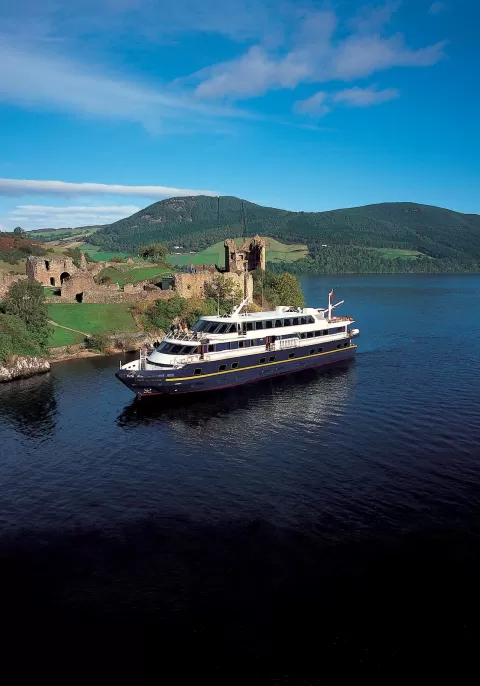
The distinguished 114-guest Corinthian II offers a classic yacht-like atmosphere and fine accommodations. Corinthian II is ice-strengthened for voyages into Antarctic waters, and is equipped with a fleet of Zodiac inflatable craft for forays ashore. Originally built in 1992 and refurbished in 2005, Corinthian II accommodates all guests in 57 outside suites, each affording sea views and elegantly appointed with a sitting area, TV, mini-refrigerator, safe, and other amenities as well as a marble bathroom. Several suites include private balconies accessed via sliding glass doors. Spacious and finely decorated public areas include a library stocked with books related to the itinerary and other volumes, and four computer terminals for e-mail access; an elegant lounge; and The Club, a space for convivial relaxation, with picture windows for panoramic views. The restaurant, serving fine cuisine prepared by European chefs, accommodates all guests at a single unassigned seating. The ship also includes a gym, beauty salon, a sun deck with Jacuzzi, and an outdoor café and bar, where meals may be served al fresco. Corinthian II is served by 70 experienced European officers and crew. There is also an elevator offering access to all decks.
Cabin Categories & Descriptions
All accommodations aboard Corinthian II are suites. They face outside, affording sea views, and several have balconies with sliding doors. All suites include a bedroom with twin or queen-size beds, sitting area, ample closet space, mini-refrigerator, TV, marble-appointed bathroom with shower, and other amenities.
| Cabins | |
|---|---|
![]() | Cat E Deluxe suites on Magellan Deck with portholes and sitting area. 225 sq. ft. Suites 250 - 252 |
![]() | Cat D Deluxe suites on Columbus Deck with window and sitting area. 225 sq. ft. Suites 329-332 |
![]() | Cat C Deluxe suites on Magellan Deck with portholes and sitting area. 235 sq. ft. Suites 254 - 262 |
![]() | Cat B Deluxe suites on Columbus Deck with window and sitting area. 235 sq. ft. Suites 333 - 348 |
![]() | Cat A Deluxe suites on Marco Polo Deck with window and sitting area. 235 sq. ft. Suites 416 - 428 |
![]() | Cat AA Deluxe suites on Marco Polo Deck with forward and side windows and sitting area. 265 sq. ft. Suites 414 - 415 |
![]() | Cat VS Deluxe Veranda Suites on Erickson Deck with private balcony and sitting area. 300 sq. ft. (including balcony) Suites 505 - 512 |
![]() | Cat PHS Deluxe Penthouse Suites on Explorer Deck with private balcony and sitting area. 400 sq. ft. (including balcony) Suites 601 - 604 |