East to the Arctic
« All One Ocean Navigator / Ioffe cruise options


- Day 1 Embark in St Johns, Newfoundland
- Day 2 L’Anse aux Meadows
- Day 3 Battle Harbour
- Day 4 Labrador Coast & Mealy Mountains National Park
- Day 5 Hopedale
- Day 6 Okak / Cape Mygford
- Day 7 Hebron / Torngat Mountains National Park
- Day 8 Nachvak Fjord
- Day 9 Button Islands
- Day 10 Akpatok Island
- Day 11 Hudson Strait / Lower Savage Islands
- Day 12 Monumental Island
- Day 13 Iqaluit, Nunavut
| Dates | Deck + Cabin Type | |||||
| Main Deck Triple | Twin Semi-Private | Twin Private | Superior | Shackleton Suite | One Ocean Suite | |
| Jul 11 '12 |
$6,990 | $8,190 | $9,590 | $10,590 | $11,990 | $12,990 |
| Optional Kayaking: $695 | ||||||
- Standard twin cabins are available for single occupancy at 1.5 times the shared price.
Day 1 Embark in St Johns, Newfoundland
In the afternoon your vessel, the One Ocean Navigator/Ioffe and set sail north along the coastline. As you sail out of St. John’s Harbour, Signal Hill will be on the port side, where Marconi received the first trans-Atlantic wireless transmission in 1901. On your starboard side, see Fort Amherst, built by the British to protect the entrance to the Narrows. As you clear the harbor, look to the southeast and see the lighthouse at Cape Spear that marks the easternmost point of the continent of North America. Leave this behind as you sail northwest around the Avalon Peninsula and on to the Great Northern Peninsula of Newfoundland.
Day 2 L’Anse aux Meadows
Arrive at L’Anse aux Meadows, a UNESCO World Heritage Site and go ashore in sturdy Zodiacs, landing on the beach, reminiscent of the ancient Norsemen. This will be the first of many experiences with the Zodiacs, a very safe and versatile craft invented by the famous Jacques Cousteau. L’Anse aux Meadows is a corruption of the original French L’Anse au Meduse meaning Jellyfish Creek. This is where Norseman, Leif Erikson, is thought to have founded “Vinland” in 1000 AD. As you explore the reconstructed sod huts and Norse ruins with the site’s archaeologist, witness evidence that the Vikings discovered North America five hundred years before Columbus arrived.
Day 3 Battle Harbour
Set sail for the coast of Labrador and cross the Strait of Belle Isle to arrive at Battle Harbour, one of the first British-based settlements in the east and home to the Church of St. James the Apostle, built in 1852. Explore the restored fishing, whaling, commercial and religious buildings of this remote community, amid the backdrop of breathtaking coastal views. On the way across the Strait be on the lookout for Humpback and Minke whales, along with seals and many species of pelagic birds. Dr. Wilfred Grenfell built one of the first hospitals in Labrador in Battle Harbour in 1893, with one doctor and one nurse on staff. Further along the coast arrive at Hawkes Harbour in the late afternoon for a visit to an abandoned whaling station built in 1933 and operated by the Newfoundland Whaling Co. Ltd.
Day 4 Labrador Coast & Mealy Mountains National Park
Today make your way along the wild and ruggedly beautiful coast of Labrador with some cliffs rising as sheer rock walls over 1500 meters. As you sail enjoy sea watching from the bridge and upper decks of the One Ocean Navigator/Ioffe looking for Humpback, Minke whales, White-beaked Dolphins and perhaps Orcas. Pass the site of the proposed new Mealy Mountains National Park. The Park represents 39 distinct Canadian ecosystems and has been home to Labrador Innu, Inuit, Métis, descendents of European settlers and Quebec Innu. Plan to explore the Wonderstrands, a spectacular length of beach on the Atlantic Coast. This long line of sand glints in the sunshine, sweeping in a graceful arc for over 40 kilometers. Signs of human habitation have been found here dating back some 7,000 years. This is also one of the best places in the entire national park system to spot wild timber wolves.
Day 5 Hopedale
The ancient rocks of the Canadian Shield cradling the hamlet of Hopedale, population approximately 620, will greet you as you rise this morning. After breakfast, go ashore by Zodiac visit the Hopedale Moravian Mission – built in 1782 and said to be the oldest building east of Quebec. Here you will learn about the influence of the Moravian missionaries on the Inuit people of Northern Labrador. Hope to visit the local museum and perhaps buy a carving or two from the local Inuit as you explore the town.
Day 6 Okak / Cape Mygford
Sail north to Okak Bay, and land at Okak, an abandoned community, former Moravian Mission and subsequent Hudson’s Bay Company trading post until 1956 when the Canadian government relocated the inhabitants to other communities in Labrador. This site offers lush sub-Arctic tundra walking on the open-rock barren lands of coastal Labrador. Explore this area and others farther north for the ancient camps of the early pre-Dorset people who occupied this barren landscape.
Your next stop will be Cape Mugford, one of the two sources along the coast of Labrador, of the stone, Ramah Chert – used for over 7000 years by the Paleo-Eskimo peoples and the Maritime Archaic Indians. It was preferred by many flint knappers (or stone workers) because the pattern with which the chert fractured was predictable, producing a better formed tool. There are only two known sources of high quality, flakeable chert along the entire Labrador coast. One is in the Cape Mugford region; the other is farther north in the area of Ramah Bay. This second source is found in an extremely limited area, as part of a sedimentary formation that runs from Saglek Bay north through Ramah Bay, ending at Nachvak Fiord. Hope to go ashore here to view this interesting rock formation and for further tundra exploration.
Day 7 Hebron / Torngat Mountains National Park
Today hope to visit Hebron, once the northernmost settlement in Labrador. Hebron was established by the Moravian missionaries in 1831. The Mission was closed and the Inuit families relocated in 1959 but the buildings still stand today. From here sail north and into Saglek Fjord. This is the southern gateway to the Torngat Mountains National Park Reserve, established in 2005.
The Torngat Mountains National Park Reserve covers 9,600 square kilometres in Northern Labrador, bordering Quebec on one side and the Labrador coast on the other. It is home to Canada’s highest mountains east of the Rockies, breathtaking fjords and stunning barren land viewscapes The Inuktitut word Torngait, means “place of spirits” and the Torngat Mountains have been home to Inuit and their predecessors for over 7500 years. The mountain peaks along the border with Quebec are the highest in mainland Canada east of the Rockies, and are dotted with remnant glaciers. Polar bears hunt seals along the coast, and both the Torngat Mountains and George River caribou herds cross paths as they migrate to and from their calving grounds. Today, Inuit continue to use this area for hunting, fishing, and traveling throughout the year. Go ashore and explore the area. Wildflowers are spectacular when in bloom and bears feast on the aptly named Bearberry and Crowberries, among the sedges and grasses, on the raised beaches along the shores of the fiords.
Day 8 Nachvak Fjord
Near Natchvak, the Torngats are a particularly beautiful range. It means “the place where the spirits live” and surely no one will disturb them in this eerie place. According to Inuit legend the area was once home to a form of giant Brown Bear that was even bigger than a Polar Bear and would attack humans on sight.
Nachvak Fjord is exceptionally beautiful. This deep and narrow Fjord is 22 kilometres long and all sorts of animals congregate in the fjord including whales, seals, Walrus, Arctic Fox and Polar bear. There are also great concentrations of sea birds including puffins and murres. Enjoy the abundance of wildlife and striking scenery by ship and Zodiac. Photographic and drawing opportunities abound!
Day 9 Button Islands
As you sail up the final stretch of coastal Labrador, attempt a visit to Martin Bay to view the site of the German automated weather station established in secrecy in October 1943 by a German U-Boat. This station remained undiscovered until the late 1970’s when a German historian came across a reference to it in the German naval archives. The equipment was collected by the Canadian Coast Guard in the early 1980’s and is on permanent display in the Canadian War Museum in Ottawa.
Later in the day, visit the Button Islands before sailing into Ungava Bay. Named after Thomas Button who explored the area in 1612, the islands are in the middle of the upwelling of nutrients of the edge of the continental shelf. These nutrients attract thousands of seabirds and other marine mammals.
Day 10 Akpatok Island
Start your day with a short walk up a narrow river valley to view archaeological sites on the eastern shore of Akpatok Island. During yet another of your excellent lunches, the ship will sail around to the bird cliffs on the northern shore of the island to launch the Zodiacs and cruise among this wildlife extravaganza. Named after the Akpat, the Inuktitut name for Thick-billed Murre, this limestone island is home to over 500,000 breeding pairs. The clamour of chicks demanding a feed, the arguing of parents over ledge space and the squawking of gulls on the hunt for an abandoned chick will provide a noisy background to the warm aroma of a seafood-based diet.
Day 11 Hudson Strait / Lower Savage Islands
Today sail across the Hudson Strait to the Lower Savage Islands. This strait is rich in sea life, providing the food for the large seabird colonies that line its shore. Cruise in zodiacs among the maze of channels that comprise the Lower Savage Islands, looking for Polar Bears and, where no bears are found, a place to go ashore. These rarely visited islands will be our first landfall on Baffin Island. Stroll among the wildflowers and dwarf birches and Arctic Willows that abound in this wild place and with your resource educator archaeologist, look for evidence of the early Paleo-Eskimos who may have called the islands home.
Day 12 Monumental Island
Today sail across the mouth of Frobisher Bay to visit Monumental Island, a small, steep-sided island off the Southeast coast of Baffin Island. Here you will be looking for the Polar bears and walrus that live around this island in an uneasy truce. While Polar bears have been known to attack and kill young Walrus, they are no match for a fully grown male walrus, especially in the water. This will be your last Zodiac cruise and tonight, on board the ship, enjoy the sumptuous fare at the captain’s dinner. During the night the ship will negotiate the narrow channels of Frobisher Bay on the way to your disembarkation point, Iqualuit, the capital city of Nunavut.
Day 13 Iqaluit, Nunavut
Disembark by Zodiac and, after a short tour of Iqaluit (if time and tides permit), transfer to the airport in time for the flight home.
Itinerary Notes
Please note:Included in the price is a transfer from the meeting point in St.John's to the ship, and transfer from the ship to the airport in Iqaluit.
Specific sites visited will depend on ice and weather conditions experienced and the itinerary will be updated throughout the voyage in order to take advantage of favorable conditions.
Deposit & Payment
Initial deposit is $1,600, and most travelers will call our office and pay the deposit with a credit card. We accept Visa, Mastercard, AmEx, and Discover. Alternatively, you can send a check to our Missoula, Montana, office or register online at: https://www.adventure-life.com/forms/fourways.php
Final payment is due 100 days prior to departure.
Final payment by bank transfer, check or Visa, Mastercard, Discover, or Amex. Credit Card payments subject to 3% convenience fee and maximum $15,000 charge.
Booking last minute? No problem! Please contact one of our trip planners, and we can get you on your way if booking less than 100 days prior to departure.
Click here to see a copy of our Terms and Conditions.
Cancellation Policy
| Days Prior to departure | Fee |
|---|---|
| 91 days or more | Deposit |
| 90 days or less | 100% trip cost |
One Ocean Navigator / Ioffe


- Ship Highlights
- Passengers : 96
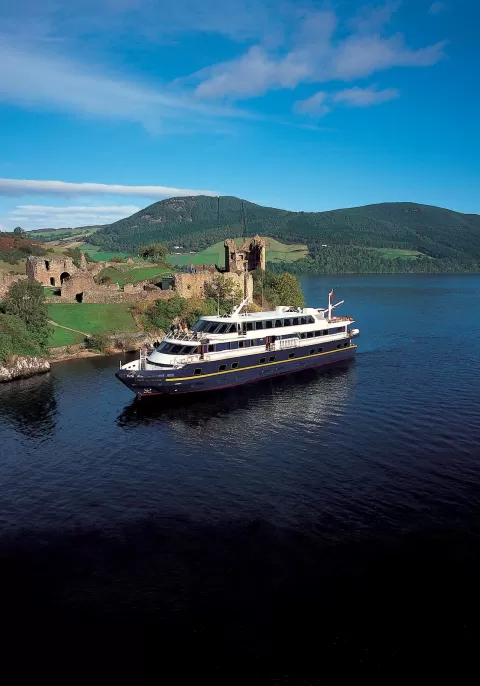
Designed for polar research, the One Ocean Navigator/Akademik Ioffe is modern, comfortable, safe and ice-strengthened. From small group sessions to briefings for all passengers, she has public spaces onboard ideally suited for each and every need. A separate bar and lounge, as well as a library provide ideal places to sit and relax or catch up on some reading. A selection of movies and documentaries can also be watched in the lounge. Enjoy the sumptuous meals prepared for you by the culinary team in the dining room, which can host all clients in a single seating.
Comfort and Stability
Designed and built as a scientific research vessel in Finland, the One Ocean Navigator/Ioffe is very stable, quiet and comfortable. Refitting and refurbishment over the last five years oriented towards her role as an expedition cruise vessel has improved the comfort and caliber of the facilities aboard the ship.
There is little if any ambient noise from engines or machinery and with most of the public spaces on a separate deck from the majority of the cabins there is little issue with passenger-generated noise.
Vessel stabilization is gained through a combination of external stabilizers on her hull and a built-in ballast trimming system. The rapid transfer of ballast between special trimming tanks reduces vessel motion and coupled with a modern hull design gives us a stable platform for science and exploration.
Cabin Accommodations
All cabins are comfortable and well appointed with private or semi-private facilities and a variety of beds (either bunks or double). All cabins have ample storage facilities and a writing desk and chair, as well as bathrobes. Suites feature upgraded linens/duvets, toiletry kits and arrival gift baskets.
Bar
Located aft of the lobby on the main deck and with a seating capacity of about 25 and/or sufficient standing room for many more, the bar becomes one of the activity hubs on the ship. With outside views through portholes and a door out onto the main deck, the bar is a comfortable place to enjoy a fresh fruit smoothie before breakfast, grab a bottle of water before an excursion or enjoy a cocktail before dinner. A stereo with MP3 player dock and a monitor showing live video footage of the view forward from the bridge at all times can be found in the bar.
Bridge
The ship’s bridge is located on Deck 6 and is open to passengers virtually 24-hours a day. The officer on watch and a helmsman can always be found on duty on the bridge and it is also the best place to meet the master of the vessel. The chart room is a fascinating place to visit and expedition staff or ship’s crew are often available to answer questions about the equipment and instruments found on the bridge.
In addition, the bridge is an excellent place to sightsee and view wildlife from. Binoculars and wildlife identification guidebooks can be found on the bridge and during much of the day, an expedition guide will be watching for wildlife from the bridge.
Dining Room
During select breakfasts during your voyage, join the dining room for an omelet bar. With buffet breakfasts, buffet and/or plated lunches and plated dinners, the dining room can seat all passengers in one sitting. Attractively lit and comfortably furnished, it is served by our ship’s stewards. A culinary team includes three chefs as well as up to three culinary students on each journey.
To keep up to date with the view from the bridge, live streaming video can be viewed on a television screen in the dining room during meals. A small lounge can be found in the forward part of the dining room along with a small bar used during meal service.
Other Amenities
Elevator
Gift Shop
Fitness Room
Infirmary
Library
Lounge
Mud Room
Presentation Room
Multimedia Room
Sauna and Polar Plunge Pool
Top Deck and Observatory
Technical Information
Registered name: Akademik Ioffe
Built: 1989, Rama, Finland
Length: 117 m
Breadth: 18.2 m
Draft: 6 m
Power: twin engine, 5,000Kw diesel, twin propeller
Maximum speed: 14.5 knots
Crew and staff: 56
Passengers: 86
| Cabins | |
|---|---|
![]() | Main Deck Triple Deck 3, bunk beds and a sofa bed. Shared facilities, in cabin washbasin, writing desk/chair, ample storage, bathrobes & porthole. |
![]() | Twin Semi-Private Deck 4, one lower berth and one sofa bed, a writing desk and ample storage. Semi-private facilities (one bathroom between two cabins). Opening window. |
![]() | Twin Private Deck 4 and 5. All cabins have two lower berths, a writing desk/chair and ample storage. Facilities are private and all cabins have a window. |
![]() | Superior Deck 6 these cabins have two lower berths, a sofa, a writing desk/chair and ample storage. Facilities are private and all cabins have a window. |
![]() | Shackleton Suite Deck 4 & 5, 1 double berth, 1 sofa bed, separate sleeping quarters, writing desk/chair, TV/DVD, IPod alarm clock. Private facilities, window & deluxe amenities. |
![]() | One Ocean Suite Deck 5, 1 double berth, 1 sofa bed & separate sleeping quarters, up-graded bedding, a writing desk/chair, TV/DVD, IPod station. Private facilities with tub. Windows overlooking the bow. Deluxe amenities. |