USA Today Logo New York Times Logo Outside Magazine Logo Conde Nast Traveler Logo National Geographic Traveler
Create your Trip Journal [click here]

Darwin Country

By : Kerry Wohlstein
Trip Begins April 30, 2010
Trip Ends May 12, 2010

Following in Charles Darwin's footsteps, I will be traveling to Ecuador, from Quito to the Galapagos Islands. I have my trusty backpack, my water shoes, my guide to Ecuador and of course, my camera. (Can't leave home without it). Buen viaje and vamos!
See my photos : Darwin Country

Want to go? Beagle: 10 Day Tour, A, Otavalo Market

I went to: Galapagos, Ecuador, Bartolome, Santa Cruz Island, Santa Fe, South Plaza, North Seymour, Espanola, Floreana, Bachas Beach, San Cristobal, Lobos, Chinese Hat, Black Turtle Cove, Dragon Hill, Charles Darwin Center, Quito, Otavalo, Hotel Eugenia
[enlarge map]
[reduce map]
April 30, 2010
Top

Quito, Ecuador- Finally, a dream come true!

Hotel Eugenia, Quito

Arriving at the airport in Miami always gives me pause. All those people going someplace! This time, I was one of the lucky ones. The flight was uneventful and I arrived in Quito earlier than expected. Quite a coup in this day and age! As I traveled by cab to the hotel, I couldn't help watching this huge city on the north side of the Pichincha Volcano. Arriving at the hotel, I noticed immediately that the staff was friendly and very accommodating. The Hotel Eugenia is a delightful oasis near the Mariscal quarter. It has inner courtyards and my room is away from the hustle and bustle of the city noises. It has a view of the interior courtyard and it is very appealing. At the hotel's quiet cafe I had my traditional glass of wine with dinner. The people of Ecuador are so friendly and it is a wonderful place to stay! I will be going to the Otavalo Market tomorrow driving through the Andes, as well as other small towns, about two hours out of town, to see the wares of the natives. It is a bit cool here, about 62 F, but it is a nice change from the heat of Miami. I have been speaking Spanish and at least people understand me! Buenas noches for now.

May 1, 2010
Top

Otavalo Market, and all around the Andes

Otavalo, Ecuador

Today began with a small breakfast of fruit and toast in the hotel's cafe. They had arranged for a bus to pick me up a couple of blocks away to go on my sojourn. From the moment I walked outside into the fresh air until I returned, I was in awe of the city, the countryside and the people.

First I went to Calderon, a town where women artisans make dough (masapan) figurines by hand and then paint them. It is a small town, but the work is exquisite. As we passed through the tiny streets, carcasses of pigs hung announcing the restaurants intentions.

Next, we went through the Andes to Guayllabamba Valley and the exquisite Emerald River Valley. There were many volcanoes and heavy clouds all day. It is a semi-arid area with limestone interspersed with acacia and eucalyptus trees. This was a beautiful sight with many twisty climbs and turns. We stopped at a shop that makes Panama hats, which were used to ward off the sun during the building of the Panama Canal. They are made in Ecuador, but everyone assumes they are made in Panama. Who knew?

Finally we arrived at Otavalo Market, where you can buy anything from linens, jewelry and brightly woven cloth to local delicacies. I walked through rows and rows of colorful textiles, elaborately woven ponchos, dresses, embroidered table cloths, and handmade jewelry. Street people were hawking their wares from fresh red strawberries, coco frio with straws to un-recognizable mystery meat. I breathed in the sights, sounds and smells of this fabulous outdoor bazaar. It was spectacular to see all this native merchandise in one place! And shop I did. Perhaps I need another suitcase to go home!

Our last stop of the day was Cotachachi, a town that thrives on the leather trade. We had lunch at a local restaurant and I sampled "locro", a soup made with potatoes, white cheese and slices of avocado on top. Que rico! After lunch and great conversation with some of the international people on the bus, we decided to go shopping, of course. The shop keepers were patient and answered our questions about their products, town and the leather making process. Many people tan and make the leather goods, like shoes and belts right in the shops for tourists to purchase. Some of them were real works of art.

The day was a wonderful look into the Ecuadorian culture and the artisans who make their wares as well as stunning vistas of the Andes and surrounding volcanoes, valleys and rivers. Arriving back at the hotel, I felt that I had found new friends and acquired a new found respect for Ecuador.

May 2, 2010
Top

Sunday and Colonial Quito is waiting!

Quito, Ecuador

As I was having a leisurely breakfast, I pondered where to go first in the city. I settled on the central square as I had read that there was a tour given by the local Metropolitan Police. I took a taxi, as it is recommended to take taxis everywhere because of security, and when I arrived in Colonial Quito, I realized I had forgotten my camera! I had to take a taxi back to the hotel and then into the city again. What a white knuckle ride! I was supposed to meet a friend, but I was too late, so I decided to check out the city by myself.

With its narrow streets, restored colonial architecture and lively plazas, Quito's Centro Histórico (the old town) is a great place to wander around. It was built centuries ago by indigenous artisans and laborers, and Quito's churches, convents, chapels and monasteries are cast in legend and steeped in history. At times, it's a hectic area, full of yelling street vendors, rambling pedestrians, tooting taxis, belching buses and whistle-blowing policemen trying to direct traffic in the narrow, congested one-way streets.

On Sundays, they close the streets around the two- acre Plaza de Independencia so there is a throng of people. There are many people in the square, musicians, families, street performers and, alas, pick pockets. The square’s tall central monument has a “liberty” figure on top and is dedicated to the men of the 10th of August 1809. Sucre, the hero of Ecuadorian independence, is buried in the Cathedral. There is a huge police presence with many branches of the police represented.

As I breathed in the scene, I saw clean, beautiful buildings surrounding the Plaza. There was the Archbishop's Palace, now a hotel with a cafe where locals come for coffee and food. In addition, there is the Cathedral, a spectacular church and the Governor's Palace, with very colorful guards on each side of the entrance. The Municipal building is mostly offices and an information area where I found out that the tour wouldn't start until later that day. As I had no time to lose, I left to explore the rest of the city on my own.

I walked up the hill a bit through narrow city streets that are nearly at a 90· angle. The shop keepers were friendly and there were many people headed in the same direction as I was - toward La Basilica!

When I arrived at La Basilica, which is a beautiful cathedral with wonderful spires and stairs leading to the bell tower, there were old women selling corn, ice cream and other foods out of baskets on the steps. To get to the top of the clock towers, the way is arduous. You have to climb three flights of winding stairs, traverse a wooden bridge, then climb 3 steep, steel ladders to reach the top. It is the best $2 I ever spent, as the views are spectacular!

I could see Panecillo Hill and the rest of Quito. I stayed up there a long time just looking at the fantastic sights as the day was warm and clear. After I came back down to ground level, I went to see La Campania, another cathedral. The inside is gold everywhere you look! The people are so poor that they beg on the steps of the cathedral and it is so sad to see it with all that opulence.

Finally, I took a taxi to the top of Panecillo Hill, (which seemed to go straight up to the sky) where the Virgin of Quito protects and overlooks the people of the city with wings 50 feet high. The views here are unbelievable and I left with a sense of awe for the city and its people.

May 3, 2010
Top

My last day in Quito

La Mitad del Mundo, Ecuador

Today, I hired a taxi for the entire day to see the sights around the PIchincha countryside. First, we went to La Midad del Mundo, or Middle of the World Monument. It is a geological monument where the equator separates the northern and southern hemispheres. My driver, Fanny and I walked all around and took pictures of the monument in the background with us straddling the equatorial line.

Next we went to Inti Ñan which is the "real" place where the equator slices through the earth. We took a great tour and the guide explained about the Quichua culture, Amazon rites with shrunken heads and many experiments to show how things are different at the equator, One such experiment was to stand a raw egg on the head of a nail and I actually saw some people do it! I, of course, you guessed it, couldn't.

Afterward, we went to TeleferiQo, which is a 15 minute cable car ride to Cruz Loma on the eastern face of the Pichincha Volcano and about 4,300 meters in an enclosed cable car. The view going up is spectacular because the city of Quito was in bright sunshine below and at the top, it is cold, rainy and cloudy. You can barely see your hand in front of your face. If you aren't careful, it is possible to get lost! As we descended, it began to rain in earnest.

We were fairly hungry, so we found a vegetarian restaurant near the hotel (Hey! I had to find one! lol) and concluded our tour, just as the rain beat down, at the Botanical Gardens of Carolina Park. This park houses a Vivarium with snakes and amphibians of all sizes, shapes and colors. It is one of the largest parks in South America. Unfortunately, you can´t walk around in it very safely at night. None the less, it was gorgeous. So many flowers and plants that you will only find in Ecuador. Even the rain didn't dampen my spirits.

As my time in Quito has come to an end, for now, I know that it is on to the Galapagos and more adventures tomorrow.

May 4, 2010
Top

Today is the day!

Santa Cruz Island, Galapagos

I was so excited I couldn't sleep! I awoke at dawn and when I arrived at the airport it was all fairly organized. I got my seat assignment and boarded the Tame plane that would wing its way about 600 miles (1,000 kilometers) to the Islands of the Galapagos. I arrived at Baltra and as I walked across the tarmac I nearly shouted with excitement. Daniel Sanchez, our guide for the next week, was waiting with a large sign to welcome us. As we took the short bus ride, my first impression of Baltra was one of wonder, not desolation, with flora in all shades of brown and green interspersed with gray. Then we took a short ferry ride across the Itabaca Channel with our luggage precariously balanced on the flat top. Next, we took a smaller bus to the top of Twin Craters passing through multiple vegetation zones finally placing us at the dock for my first glimpse of the HMS Beagle. She is a steel hulled, 105' motor schooner with room for 12 guests,(though we were only 8) 6 crew members and the guide. Luis, our panga driver smiled and I felt very welcome as we were helped from the panga to the ship. After a short briefing and boat drill, we checked out our accommodations. They were mighty spacious, two bunks, the bathroom (head in ship speak) and even a closet. I knew I would be in heaven for the next eight days.

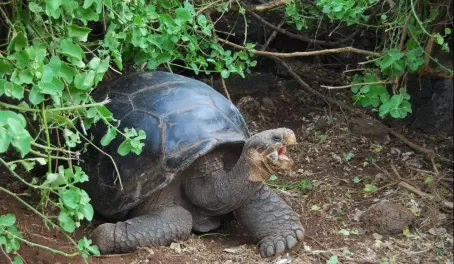
Soon we were on our way to the Darwin Research Station and National Park Headquarters where Daniel explained about the ongoing work they do including rearing pens for the 17 species of tortoise, eradication, breeding and relocation programs, and attempts to keep the islands safe as well as descriptions of the local flora and fauna. I saw my first blue footed boobie! In addition, I spotted Sally Lightfoot crabs and plenty of gray marine iguanas. We were up close and personal with the tortoises, esp. Lonesome George, sadly, the last of his species. He has been paired with a distance cousin, actually two, and they have produced eggs! We are keeping our fingers crossed. The hard work that they do at the Darwin Station is incredible.

Daniel, our guide, is very well versed in all things Galapagos. He is personable, knowledgeable and enthusiastic about his chosen career. He has a degree in Marine Biology and is always willing to talk. If all the guides are as passionate as Daniel, the Galapagos is in good hands!

We walked around Puerta Ayora, a town supporting about 15,000 people on the island of Santa Cruz. There were many stores as well as restaurants, and at the docks, the locals sell fish. We were told to get whatever we need as there wouldn't be any other opportunities to stock up. I bought sunscreen and a $6 sombrero to keep the sun off my face. What a bargain!

I watched the locals playing games at the public dock. Finally, Lucho, as he liked to be called, picked us up in our chariot and we settled on to the Beagle for the 5 hour motor sail to the next island, Floreana. We had an elegantly prepared dinner and got acquainted with the each other.

May 5, 2010
Top

Floreana

Floreana, Galapagos

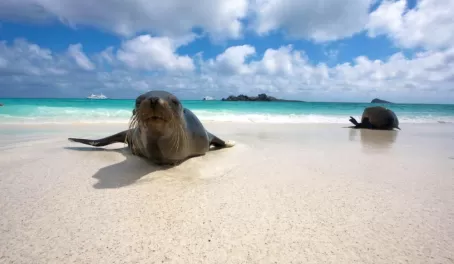
The island of Floreana, a 5 hour motor sail from Santa Cruz and Baltra, was breathtaking at dawn. We had a hardy breakfast at the communal table and watched the sea lions congregating peacefully on the boat next to us as they barked out their morning greetings. We had a dry landing at Puerta Valesco Ibarra and were greeted by some of the locals, sea lions and brown pelicans. This port was named after a former populist president, Valesco Ibarra. The island was used in the 1600's by whalers and pirates. Floreana was the first inhabited island in the Galapagos where in 1932 the government established a penal colony. We took an open bus, called a scivia, to the highlands, Asilo de la Paz, and the top of the extinct cinder cone.The Santos Paulo and Scalesia trees dotted the landscape along with plum, orange, banana and guayabana. Though all the islands are volcanic in origin, each island has its own unique flora and fauna.

As we walked among the trees on paths leading to caves and exquisite views of the bay, I saw a multitude of Darwin's Tree finches as they flitted from branch to branch singing their melodies as yellow warblers sang for their supper.

Though the tortoises are in captivity here, it is for their own good as they were hunted to near extinction a short time ago. The National Park protects these prehistoric creatures fiercely. Now there are about forty gentle giants on Floreana and it is amazing how close you can get to them! When I stooped near one and raised my hand to make him turn to the camera, he did! I am now called the "Tortoise Whisperer".

As we walked along and paused in one cave, Daniel regaled us with stories of early settlers, mystery, murder, mayhem and dentures. Oh, how I love a good story! I must admit though, it must have been extremely difficult for those first inhabitants. If not for the fresh water spring, still in use today, I think they all might have perished. As we retraced our steps back to the transport, I viewed a Galapagos hawk taking off, some locals cutting the grass, and packs of elephant ears wrapped in colorful cloth for local trade. When we returned to the panga, sea lions occupied nearly every available spot, as they are without predators on the islands. They are, quite simply, king.

We returned to the Beagle for a carefully prepared lunch and a much needed siesta. I would like to mention here specifics about the food on the Beagle. The chef, Big Pedro, as he is known, is a gourmet cook. All of the dishes are served family style by the steward, Tricky, and there is always plenty to go around. Pedro never scrimps on ingredients, using fresh herbs and sauces with fresh meats and fish. I am a vegetarian and he catered to my tastes, making a complete veggie meal at each sitting. All of it was beyond delicious and the portions were huge. No complaints here!

We finally went snorkeling from the panga at Cormorant Point and at Devil's Crown. The water was so clear you could see all the way to the bottom. I didn't have a wet suit, but the temperature was perfect. We saw brightly colored Moorish idol fish, chocolate chip starfish, angel fish, surgeon fish, parrot fish, a couple of reef sharks, a golden eagle ray and Captain Washington showed us an octopus under the rocks. Snorkeling is a great way to view the marine life. After returning to the ship, we changed and went on a wet shore excursion before dinner. We walked among blue footed bobbies nests, brown pelicans, a flock of pink Caribbean flamingos at a brackish lake rookery, American oyster catchers and of course, the requisite sea lion or ten. At the top of the cliffs I watched elegant red billed tropic birds with their wispy tails, lava gulls, herons, ani, sandpipers and frigate birds flying overhead. I caught sight of the baby birds hiding in the rocks, all fluffy down.

On the windward side of the island we saw magnificent frigate birds, nicknamed the pirates of the sea, soaring overhead and went to investigate. There were many green sea turtle nests in the sand. One curious, brave fellow tried to make it to the ocean. He was pulled into the undertow, then pushed back by the waves, then out again. We were cheering him on, when we saw that ultimately, he was scooped up by a frigate bird and eaten! So sad, but that's life.

We had the Captain's dinner tonight and met the crew. I held a short Memorial service for our dearly departed Floyd, the sea turtle who waged such a brave battle. I watched the stars for hours tonight. The Southern Cross was visible as was the Milky Way. I don't think I ever saw so many stars at one time. It was truly a gift for the eyes. I finally turned into my cabin and the sounds of the waves lapping on the sides of the boat lulled me to sleep.

May 6, 2010
Top

Espanola

Espanola, Galapagos

Espanola is a table top island, the oldest and easternmost in the archipelago chain with only a caldera of rock left. Millions of years ago it was a shield volcano which has basically fallen into the sea. Española's remote location helped make it a unique island with a large number of endemic creatures. Secluded from the other islands, wildlife on Española adapted to the environment and natural resources. Marine iguanas on Española are the only ones that change color during breeding season.

We saw this up close and personal when we dry landed at Punta Suarez and there were the resident sea lions, Sally Lightfoot crabs and colorful red and green marine iguanas. We hiked all over the island ending near the cliffs where we saw Blue Footed Boobies, Nasca boobies, Hood mockingbirds, red billed tropic birds, and the famous waved albatross. They were all nesting and the babies were full of down and fluff.

The waved albatross only nests on Espanola and at last count there were more than 10,000 pairs. I was standing apart from the other guests watching with awe as one pair of waved albatrosses actually laid an egg right in front of me! Her mate looked on with wonder as they clacked their yellow bills together. They mate for life and raise the chicks together. At the top of the cliff, the ungainly albatrosses waddle to the edge and soar away on a 8 foot wing span. The island's steep cliffs serve as the perfect runways for these large birds which take off for their ocean feeding grounds near the mainland of Ecuador abandoning the island between January and March. It was incredible to see this majestic bird winging away. (This one's for you Hayley!!)

The blowhole is a dramatic geological feature that had everyone oohing and aaahing as the glacial blue waves crashed on the jagged rocks below and shot up nearly 50-70 feet in the air. A very spectacular display. The abundance of animal life on Espanola is unlike anything I have ever seen. The animals show very little fear as the curious mockingbirds came over and landed on our heads and shoulders as if to say, "Whatz up?"

The highlight of the day came when we went snorkeling at Gardner Bay and a young sea lion came over to check me out. He pushed me in the tummy and then glided around. Then he came back and we were swimming together. If I went one way, he followed with turns and amazing agility. It went on for about 15 minutes. It was incredible. Though awkward on land, sea lions are masters of the water, diving and gliding and swimming. Here on the pristine white sands, hundreds of sea lions lie around like forgotten litter, nursing, playing, talking to each other and rolling around while the beach master keeps an eye on his harem.

We returned to the ship, put the sails up and set a course for San Cristobal. On the way, the crew yelled, "Ballenos!" (whales) and we got to see 3 gray whales and a pod of bottle nose dolphins swimming next to the boat. The seas were rough and the stars were extraordinary that evening. What a fabulous day!

May 7, 2010
Top

San Cristobal

San Cristobal, Galapagos

Sometime during the night the seas flattened out and it was smooth sailing toward San Cristobal. We arrived at Punta Pitt and the sunrise was exceptional. The island was silhouetted by the dawn and numerous birds floated effortlessly overhead. I took an early morning panga ride around the rocks to see sea lions cavorting in the water. Their graceful bodies surfed the waves along the shore. The red footed boobies nested in the cliffs along with other magnificent sea birds. This was only a taste of what was to come.

After breakfast, we made a wet landing on Punta Pitt. From there, it was an easy stroll through low trees and shrubs to Frigatebird Hill. Though we saw many Frigatebirds, the real charm was seeing Red Footed, Blue Footed and Masked Boobies all over the island in low bushes. As we walked, we viewed them courting, (the now famous Blue Footed Boobie Stomp a personal favorite), nesting and taking care of their families in the brush. Their colors are so vivid as they have adapted to the unique environment of few, if any, predators and do not need to hide.

This island and the dramatic cliffs are composed of an ancient tuff cone (compacted ash), eroded by the wind. Abundant red and green low plants dotted the landscape. The brilliant contrast between the earth and sea was as phenomenal as the view of the beaches and the harbor below.

As each day has been a surprise, I couldn't wait to see what was in store for me now. I certainly wasn't disappointed either! After returning to the Beagle, we motored toward Kicker Rock, navigating around Leon Dormido, or Sleeping Lion. This huge formation gets its name from the shape of the eroded 500' vertical cliffs and wind torn rocks. We went snorkeling with sea lions again, marine iguanas, saw sea stars, sponges and different hues coral. We also saw big eyed hog fish and schools of silvery calemas. As I was free diving, I could only stare at the vibrant colors underwater and wanted to remain their as long as my breath held out.

After lunch, Captain Washington took us to Islas Lobos, where we hoped to see the frigate birds inflate their red sacs to attract a mate. We were not disappointed! He pointed out the different types of Frigatebirds and told us about their peculiarities. I saw many nestled in the trees along the shore.

As we made our way back to the shore and the panga, the back side of the island was strewn with smooth, volcanic boulders from eons ago. This rich, tranquil landscape with its primitive beauty made me realize how interconnected everything is and I felt humbled in its presence.

May 8, 2010
Top

Santa Fe and South Plaza Islands

Santa Fe, Galapagos

The morning dawned crystal clear and I had a spectacular view of Santa Fe Island. The island was formed by an uplift, rather than a volcano, which gives it a table top shape. It was a wet landing at a sparkling turquoise cove, called Bahi Barrington, but the island was extremely hot and arid. We were advised to bring plenty of water to ward off dehydration.

The first part of the walk that morning was through a giant cactus forest. The Prickly Pear or Opuntia forest is named for the pear shaped fruit of the cactus. They are nearly twenty feet high in places. I suppose this adaptation was to ward off the land iguanas attacks. Though some of the spines were larger than my fingers, cactus finches managed to nest inside the trunk. I spied a nest with two babies and a mom who came to feed them. Que bonita!

A longer hike found us walking up the steep side of the cliffs through San Paulo and Scalesia trees as Daniel explained the geology of the area. Many tree finches sat in the Santos Paulo trees. Perhaps it was because the tree smelled faintly like incense. Here we saw the endemic Land Iguanas in and among the purslane munching the yellow flowers.These iguanas are the largest in the island chain and their golden color is similar to the cactus fruit they eat. Also on the path we watched mocking birds and their symbiotic relationship with the iguanas as they sat on their heads picking them clean of insects and other pests. The path continued past the iguanas to the top of the cliff where there was a breathtaking view of the cove below. We returned to the boat and went for a well earned snorkel and swim.

After lunch and a siesta in the quiet cove, we once again went by panga to an islet close by and South Plaza. This was a dry landing on a flat table top island where the largest colony of sea lions in the entire archipelago resides. The hike was about 1 km, but it wound past many land iguanas and swallowtail gulls nesting on or near the cliffs. The gulls tended to their fluffy babies among the rocks. Walking along the top of the cliffs, I watched sea birds diving for food and soaring across the sky in front of me.The red-billed tropic bird with its beautiful long white, elegant tail floated just out of reach above my head. At the far end of the rocks, with a steep path, I sat quietly as a lone male made his way up to the top. These males have either been beaten by a larger, more aggressive male for their harem and have come to lick their wounds, are adolescents, not ready for the fight yet or they are old and need some respect. They even had their own bachelor pad!

As we left there was always one more baby sea lion who wanted to be loved!

May 9, 2010
Top

North Seymour and Pinnacle Rock

North Seymour, Galapagos

North Seymour Island is a flat table top growing out of the Pacific Ocean. Tuff and basalt with a vein of limestone make the island seem like a lunar landscape. Great Frigate birds and Blue Footed Boobies nest in the low branches. The gular, or pouch, fills as the males look for mates. More than one male sits in the trees flapping their wings and shaking their inflated pouches. There were hundreds of Magnificent and Great Frigatebird males with these pouches, flying, courting, nesting and simply trying to attract a mate. When a white female happens by, the males would flap their wings, push out their pouches and exclaim, "I am here. Look at me!" Sometimes there were many males competing for a single female. Not much different from human males really. (lol)

Happy Mother's Day indeed! The young chicks call for their mother and each one has a distinct sound. I watched in awe as a female Frigatebird fed her growing baby by opening her beak as the youngster stuck its whole head down the throat for the predigested food. Ouch! Isn't nature wonderful?

In addition to the showy Frigates, the Blue Footed Boobies were in abundance as well, dancing for their partners. Boobies and Frigates share an interesting relationship. Sharing the same nesting area on North Seymour, Blue Footed Boobies nest on the ground making their nests from the twigs of the Palo Santos trees, while the Magnificent Frigatebird nests just above them in the salt bushes.

Frigatebirds on North Seymour rely on the fishing success of the Blue-Footed Booby for their survival. Blue-Footed Boobies are great at fishing. Hunting off-shore, the boobies dive from mid air into the sea in order to catch their fish. Successful, they return to the island with their prize to feed their young. Frigatebirds, named for the warships once used by pirates, are truly the pirates of Galapagos birds. In contrast to the Booby, Frigates do not excel at fishing. Their bodies produce very little oil for their wings and they are not waterproof. Unable to spend time in the water fishing they must rely on food stolen from other birds to feed themselves and their young. When a Booby or Red-Billed Tropicbird returns from a successful fishing trip, the Frigatebird will swoop down and molest the bird until it drops its catch. The Frigate then plucks the food from the air, feeding itself and its young from the stolen loot.

As I completed our route on the flat circular hike,I noticed brown noddy terns and lava gulls swooping over the crystal clear water. Once back on the panga, I also observed fur seals, which are smaller than their cousins, the sea lions, sunning themselves on the rocks. Galapagos penguins surfed in the clear waters as I watched, amazed that I could be this close! What a gift to see them in their natural habitat. These are warm water penguins, similar to their cousins who love the ice and cold.

After a satisfying lunch, we motored to Pinnacle Rock on Bartolome. This small island is located just off Sullivan Bay east of Santiago. Bartolome is a desolate island with few plants. The island consists of an extinct volcano and a variety of red, orange, green, and glistening black volcanic formations.

The best known of the island's formations is the Tuff Cone known as Pinnacle Rock. This large, black, partially eroded lava formation was created when magma was forced from the volcano and reached the sea. When the sea waters cooled the hot lava it caused an explosion. The exploded particles eventually fastened together forming a rock composed of thin layers.

Little vegetation grows in this barren place. Mangroves border the beach and the small shrub, Tiguilia grows in the volcanic sands. The seeds and tiny white flowers provide food for the island's finches. These plants are common to arid regions and are able to survive in these harsh volcanic conditions.

After the last eruption, lava tunnels, very fragile now, dotted the landscape. The lava rushed from the top of the crater, now extinct, and cooled into tunnels as they reached the sea. The long boardwalk and steps leading to the top of Pinnacle Rock were steep and better than any Stairmaster! The lunar landscape continued to astonish my senses. The view from the top of the lighthouse was incredible! We could see an extinct caldera, Chinese Hat and the bay far below.

Though there is little evidence of many forms of life in this harsh environment, the geology of the Galapagos fascinates me. Though it took many millions of years, the circle of hot magma cooling, volcanoes erupting, hot magma cooling, affirms that life begins anew.

At last, we took pictures of the motley crew, all together after our amazing hike to the top. Each day was an amazing adventure and today was no exception!

May 10, 2010
Top

Sombrero Chino and Dragon Hill

Dragon Hill, Galapagos

After a leisurely breakfast of granola, milk and fruit, I looked at the island we would be visiting today. It is only from far away that you can actually see the shape of the Chinese Hat (hence its comical name) As we landed on the shore it was amazing to see that this ancient, miniature volcano, though one of the youngest in the archipelago, has changed little since its discovery many centuries ago. When the volcano spewed out it's fire, spitting gas and lava, it raced to the sea. The fragile lava formations, tubes and pillows are still visible as far as the eye can see. The rock had been compressed to thousands of degrees, forming impressions found only at the base of volcanoes. The waves explode on black rocks that have fallen into the sea. It is a landscape like no other.

Here, at the water's edge, sea lions suckle their young, rest at the edge of the lava rocks, and the brave ones, as always, show their acrobatic moves in the punishing surf. There are seven species of crab, including the orange and blue Sally Lightfoot crab, and, along with ink black marine iguanas, scrabble for purchase among the smooth rocks. The tidal pools are abundant with the crabs and their eggs, waiting to hatch.

Lava tunnels are everywhere. In my mind I can imagine the boiling, hot lava flowing down the mountainside only to be supercooled to the core as the molten rock reaches the sea.The black and brown landscape supports small whitish bushes (tigilia), as well as yellow flowers and lava cactus struggling to grow and survive in the scarce soil. The surrounding vistas from this pahoe hoe boulder strewn land are wide reaching.

In the afternoon we snorkeled with aloof, white reef tipped sharks,saw multi-colored coral and the explosion of colorful fish and sea stars. The water is colder here because of the Humboldt current. As I didn't have a wet suit, the water was a bit uncomfortable for me and I didn't last as long as I wanted.

Our last stop for the day was Dragon Hill, a virtual plethora of tall Scalesia trees, shrubs and greenery in numbers that we hadn't seen the entire trip. This area gets more rain per year, so everything grows in this hot, windy and rainy climate. The gentle slope through the Scalesia forest to the top had wonderful vistas of the bay and surrounding areas.

It is named Dragon Hill as the first visitors saw many ugly dragons, i.e. land iguanas. Dragon Hill has become an important nesting site for iguanas reintroduced by the Charles Darwin Research Center. The success of the captive breeding program of the land iguana, is necessary because of the presence of introduced mammals, such as predators (cats, rats and dogs) and those that compete for the food supply (donkeys and goats) An eradication program is in effect for these non-native species.

Birds abound, especially the mocking bird, who is a very curious fellow. Sulfur and monarch butterflies flit from flower to flower drinking nectar. We walked past a hypersalinic (saltier than the ocean) lagoon where I noticed common stilts, pintail ducks and other species of birds. It is sultry and still in the interior of the island, but very windy and scorching hot at the top. Rich, organic red soil helps keep erosion to a minimum. We could see Santa Cruz in the distance.

The land iguanas look very fierce, with their yellow crowns and prehistoric skin. We watched many of the cold blooded reptiles cooling off in the shade and moving to protect themselves from other reptiles. They are silent, but watchful and I was in constant wonder that a relative from eons past could still exist here.

As we returned to the sea for our panga ride back to the boat, we saw many black marine iguanas as they evidently congregate on boulders and sand near the water's edge to stay cool.

Tonight we had a farewell dinner with Captain and the crew along with our ever present guide, Daniel. This has been a special trip and I will find it hard to say good-bye tomorrow. All the people who made this trip possible are to be commended for a job well done.

May 11, 2010
Top

Baltra

Santa Cruz Island, Galapagos

Watching the sun set over Baltra last night was heavenly. The stars were out in full force and I noticed the Southern Cross and Orion's belt as well as the North Star. I sat outside on the bow for hours just stargazing enveloped by a sense of peace.

Having anchored at Baltra, we took an early morning panga ride meandering through the red mangrove lagoon to see the animals one last time as the sun came up over the horizon. In the hushed stillness, we learned that Black Turtle Cove is primarily a nursery for black reef tipped sharks and spotted rays as well as black turtles, (hence the name) and other marine animals. The cove is only accessible by panga and is totally silent.

Large sea turtles slipped by soundlessly as noddy terns soared overhead only to end up sitting on a pelican's head and frigate birds watch for their chance to steal something, anything.

Silent golden eagle rays glide effortlessly through the still, clear water, tips raised. Pelicans and Blue Footed boobies roost in the mangroves and dive straight down to scoop up their early morning breakfast.

The scenery is reminiscent of South Florida, my other home and I realize my time has come to an end here in the Galapagos, for now. It is a still, quiet morning in Black Turtle Cove and though I would like to remain here all day in the solitude, we finally head back for the last look at our boat, and home.

As we disembark at the passenger wharf, even the sea lions are sad to see us go. We all practice the "Blue Footed Booby Stomp", which someone catches on camera for future memories. I find it difficult to say good bye to the new friends I have made and as I board the plane my eyes well up with tears. Where has the time gone? I am taking home more than just photographs. I have a healthy respect for all animal life and memories of new adventures with life time friends. This trip has been a dream come true and I know I will be back again, and soon.

May 12, 2010
Top

Quito and home to Miami

Miami, Florida

Like an old friend, the Eugenia Hotel and the staff greeted me with a smile. That evening I ate Locro soup at the Quito Hotel with a grand view of the setting sun and the lights blanketing the city. Some experiences are life affirming and I believe that my visit to Ecuador was such a trip. I loved the people, their culture, their cities and islands and I am going back to Miami a better person for having seen all of it. Buenas nochas and ciao.

Kerry

My Photo Album: Darwin Country
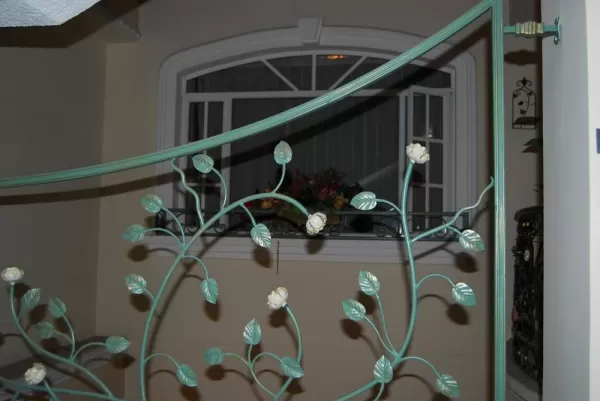
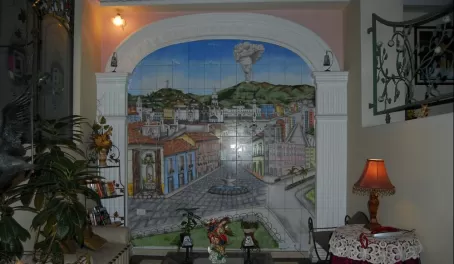
Lonesome George - Hey, anybody see my girlfriends?Hotel Eugenia's delicate ironworkThe lobby of Hotel Eugenia was warm and welcoming!Drinking my first glass of wine at the hotel cafe!Even the stairs were beautiful!Calderon and very fresh pork!Locals making masapan figurines in CalderonA young boy learning the ancient craft of masapan figurines.Typical cart selling grapes and other fruit.Beautiful Emerald ValleyEmerald River near the Guayllbamba valleyThis is an example of the various rock formations. Explaining about Panama Hats, made in Ecuador! Who knew?Mother and child. Abuela and llamalow clouds over volcanoYoung lady explaining the traditional dress of Ecuador.The colors of Otavalo Market were exquisite!A young entrepreneur counting his money at Otavalo Mkt.An Ecuadorian man sewing sacks and bags for sale.I think the colors were so bright I was smiling!Locals in Cotacachi serenading the touristsClean streets with tiled walkways are part of the charmThe local church in CotacachiDaily rainclouds form over Cotacachi volcanoThe town square in Cotacachi was full of vibrant colorCotacachi is known for its leather trade, like these shoes.Inside El Palacio de Arzobispo in downtown Quito Sunday, in the Plaza de Independencia in QuitoThe roads are closed on Sunday and people walk everywhere.La Catedral on the square - QuitoGuards at the President's House (Palacio del Gobierno)Lovely architecture on the PlazaNarrow streets wind up toward Panecillo Hill and the VirginThe facade of La Basilica is tremendous in size and concept.I couldn't wait to climb to the top!Interior of the neo-gothic BasilicaView from inside the Basilica on the way up!View of the Virgin of Quito from the BasilicaThe wooden bridge connecting the towers from the main parta dizzying climb to the top on metal stairs with gargoyles  spectacular view from the top of the Basilica clock towersNative Ecuadorians in costumes with instrumentsSan Francisco church- so imposingAll that glitters.....Fanny, the local cabbie and I at Mitad del MundoThis is where the REAL equator is, so they say!Marking the exact spot!At IntiNan, we learned about the local weavingsTeleferiQo going straight to the top!It was so cold and foggy, you couldn't see anything! At Parque Carolina there is a hidden Botanical Gardens!Such spectacular foliage!The Botanical Gardens in the rainAn entire pond ecosystem at the gardenOrchids are grown in large greenhouse structuresghost orchids!serenity at the end of the dayOur plane from Quito arrives in BaltraLoading Ferry with our bags for the short ride to Pt. AyoraPraying that our bags stay on the top!Our chariot, the panga arrives with LuisMy first glimpse of the Beagle, home for the next week.Marine Iguana convention on Santa CruzOur Guide, Daniel, explaining about the giant cactus This little guy will grow up to be big someday.Charles Darwin Research Station is amazing!Check out the tortoise whisperer!Fresh fish at the docks of Punta AyoraOur first look out to sea and wonder what we will see.My cabin, spacious and comfy.The bathroom or heada closet, drawers, what else could one ask for ?A view of an ancient volcano as we head out to sea.Floreana's local residentsTree finch on FloreanaHere I come to save the day! Gentle giants roam on FloreanaFloreana and epiphytes on the tropical forest treessmall tree finchThe Highlands and a view of the bay on FloreanaThis is where murder and mayhem reigned in FloreanaThe locals gathered elephant ears in bundlesPuerta Valiesco Ibarra and the welcoming committeeThe clear blue of the ocean as the waves crash on the rocksThe ever present slick sea lionsnorkeling at Pt. Comorant in the clear blue watersweathered volcanic rock on FloreanaAmerican oyster catcher wading as he looks for foodBlue footed boobie pair cooling offFlamingo colony on our evening excursionFlamingoes just before sunsetAll creatures, even hurt ones have little fear on the Islandwaiting for the panga, the sun sets over another dayThe remains of an ancient volcanic coneGreat Blue herons are so spectacular to viewFloyd, a doomed sea turtle and he has a story to tell.Colorful Sally Lightfoot crab on volcanic rocksea lions in the surf at Gardner Baybaby sea lion, perhaps 3 days old, sleeping and waiting.Hey! If you won't toss the stick, I will.So many sea lions, so much time!baby nursingMarine iguanas have great camouflage on the island.Hey, I am landing here with flaps out.Ok, so I have blue feet, but that is no reason to gawk!Is this Hollywood? I am ready for my close up now.swallow tail gullThe beautiful white Nasca boobieIf you like my blue footed boobie stomp, marry menasca baby boobie on the rocksMocking bird, have you heard?Waved albatross giving birth to an egg!I think it looks like you. No, you! But it is ours.Some day we will look back on this and smile.The blowhole, millions of years in the makingfluffy and full of down, this is a young boobie.The cliffs where seabirds gather and feed on local fish.Incoming! Waved albatross about to soar out to sea.I am airborne!Smoothly soaring over the water with huge wing spans.Another look at the wing span of the waved albatross.Dawn breaking over San CristobalRed Footed Boobies nesting on the low bushesRed Footed Boobie morphSurf's up Dude!curious adolescent sea liontuff rock or compressed ash, eroded by windThe path to the top of Frigatebird HillWe gave our rapt attention to our guide, DanielHere Daniel is explaining the geology of this islanda first peek  at the harbor below the cliffsFrom the top of Frigatebird Hill we see our boat, the Beaglewhere earth meets sky, tranquility and peace beginRed footed boobieNote the colors on this Red Footed BoobieBaby Boobie and he is hungry"Mom! I am hungry, bring me food!"red low brush and the sea in the distanceMy first look at Dormido Leon, or Sleeping LionUp close and personal with the lionMale Frigates with red pouchesMagnificent Frigate Bird with inflated gularIn the middle of it all, flowersFlowers grow even in the most barren places.Blue Footed Boobie waiting......Volcanic Boulders, a reminded of time gone byAshes to ashes, dust to dustDawn breaking over Bahia BarringtonThai Chi in the early morning sun with the Beach Mastersmall tree finch on a Paulo Santos treesmall tree finch on Santa Fe and the deep blue skyMedium tree finch scouting out its domainCactus trees on Santa Fe IslandHungry Cactus Finch babies waiting for momcactus finch and babies on Santa FeGolden Land Iguana on Santa FeThe comb of this land iguana can be seen through the bushessymbiosis in motion Mocking bird and IguanaA little to the left, would ya? Yeah!!This close up shows the iguana's molting skin the golden color of this iguanas comes from the cactus fruitIt is easy to see the prehistoric nature of this speciesLand iguana eating the purslane flowerThe iguana has adapted to the dry, arid conditions Red billed tropic bird in flightThey are the largest colony in the GalapagosNursing pup and mom basking in the sunswallow tailed gull pairHeeeeres Johnny!swallow tail baby being watched over by mom and dadThis is the path from the water to the batchelor padHere comes bachelor #1The famous, or infamous, bachelor pad!As we headed back to the boat, we came acoss a small snake Just ONE MORE PICTURE, please!Nesting male with iridescent green w/ contrasting red gular This male Great Frigate was a phenomenal sight!Chick, perhaps 2 months oldMom feeding chick #1 (Head going)Mom feeding chick #2 (Head going)Mom feeding chick #3  (head almost gone!)Mom feeding baby #4 (Gone!)Baby Frigate - very youngFur seals sleeping on the rocksDo you think I am a handsome fur seal?Galapagos penguinsGalapagos penguins practicing their dance routineI'll race you and I am winning!Galapagos penguin swimming in the surf near No. SeymourLove the webbed feet and socks!I'm molting.......Pinnacle Rock with all it's vast colorsThe beginning of the boardwalk to the topremains of an ancient calderaLava Cacti growing out of rock on near barren environmentsmall low growing shrub near boardwalkMom nursing pup near volcanic rockThe motley crew from the HMS Beagleextinct cinder cone viewed from the lighthousethe volcanic ash goes into the bayfragile lava tunnelslava tunnels lava tunnels leading to the seaI think the yellow warbler is a sign of luckyellow warbler taking a bath near the volcanic rocksThe volcanic rocks rolling in to the surflava lizard, looking identical to the volcanic rockThe compressed rocks looking out to seaCurious mocking birdTall cacti trees and the lunar landscapeReminds me of the wild west!lagoon on Dragon Hill which gets more than the avg. rainfallAngel, our engineer and mechanicLuis, the panga driver and all around handy manTricky, our steward, perfectionist and funny manDaniel and Luis make me smile!Each day, Tricky cleaned our cabins leaving us creations.That's CAPTAIN Washington, to you.Luis  snorkeling in the crystal blue watersThe fierce land iguana on Dragon Hillone of the valleys on Dragon Hill-Santa Cruz in the distanceView of Guy Fawkes islet from the top of Dragon HillAlternate view of the bay through Scalesia treesThe Crew - Daniel, Capt. Washington, Angel and TrickyThe crew- Tricky, Big Pedro, the chef and  LuisMy last Galapagos sunset over the islandsThe last morning as the sun risesDawn breaking as we motor to Black Turtle CoveBlack Turtle cove with mangrovesNoddy terns land on pelican's head to help eat the killGodlen Eagle Rays in the morning stillnessReminiscent of Florida Bay, dawn at Black Turtle covegolden eagle rays with tips out of the water, gliding by.green sea turtle on silent flippersEven the pelicans came out to say goodbye!The sea turtle swam directly at our pangaIt is hard to leave our floating home after 8 days at sea.As we disembarked at Baltra, the locals ignored us.The passanger wharf or bus stop to the airport on BaltraWhile I dined on Locro soup, the sun set over Quito.