USA Today Logo New York Times Logo Outside Magazine Logo Conde Nast Traveler Logo National Geographic Traveler
Create your Trip Journal [click here]

Expedition to the Top of the World

By : Paul Ackerman
Trip Begins July 22, 2010
Trip Ends August 4, 2010

Departing from Svalbard our Russian ship carried us north to within 600 miles of the North Pole before working its way southward to Greenland and our final destination in Iceland. Our spectacular Arctic cruise was bracketed by visits to old friends in both Norway and Iceland.
  • Jul 22 - LongyearbyenSvalbard
  • Jul 23 - Spitsbergen
  • Jul 24 - Spitsbergen
  • Jul 25 - Spitsbergen
  • Jul 26 - Greenland SeaArctic Exploration
  • Jul 27 - Greenland Sea
  • Jul 28 - Eastern GreenlandGreenland
  • Jul 29 - Eastern Greenland
  • Jul 30 - Eastern Greenland
  • Jul 31 - Eastern Greenland
  • Aug 1 - Eastern Greenland
  • Aug 2 - Eastern Greenland
  • Aug 3 - Vestmannaeyjar
  • Aug 4 - Reykjavik, IcelandIceland
See my photos : Expedition to the Top of the World

Want to go? Akademik Ioffe (old): Spitsbergen, Eastern Greenland & Iceland

I went to: Arctic, Iceland, Norway, Greenland
[enlarge map]
[reduce map]
July 22, 2010
Top

Svalbard

Longyearbyen

We had traveled to the Bottom of the World ten years ago when we sailed to Antarctica and so it was just a matter of time before we set off to visit the Top of the World as well. The two Polar Regions are totally opposite. Antarctica is a continent surrounded by an ocean; the Arctic is an ocean surrounded by continents. Antarctica is the land of penguins, seals and albatross; the Arctic is the land of polar bears, walruses and reindeer. Antarctica has no permanent population; the Arctic has been populated for over 20,000 years. And the bathtubs drain in opposite directions at the two poles, or so they say.

Following a wonderful reunion in Oslo with our long-time Norwegian friends, Jon and Solveig Stenberg, we flew north to Svalbard off the northern coast of Norway, one of the most remote and isolated places we have ever visited. Located high above the Arctic Circle, halfway between the northernmost tip of Norway and the North Pole, Svalbard was uninhabited for centuries, visited only by Arctic whalers and coal miners. After World War l it was placed under Norwegian jurisdiction.

The total population of the Svalbard islands is about 3,000 people, roughly the same size as its polar bear population. Of the nine islands in the archipelago, Spitsbergen is the largest. Longyearbyen is its administrative capital and the largest settlement on the island cluster. With a population of just under 2,000 people, this remote village lays claim to being the most northerly community of its size on the planet.

During the winter months Svalbard is a frigid and inhospitable place. Night falls in October and the sun does not return again until March. The temperatures drop to 40 below; the snows come and the Arctic gales howl. It’s hard to imagine living in the region during the winter months.

It was already full summer when we arrived in Longyearbyen in late July. The summer sun had edged the temperatures into the 40’s. The top few inches of the ground, which is frozen to a depth of several hundred feet, had warmed up and a rash of wild flowers temporarily brightened an otherwise barren landscape.

After April 20th, the sun does not set for the next four months. The fabled midnight sun completes a 360 degree loop around the horizon every twenty-four hours, higher in the sky by day and lower at night, but never dropping below the horizon for over 3,000 hours. The effect of constant daylight felt strange and it took us a while to grasp the idea that Arctic sunlight is a seasonal phenomenon and not a daily event. I don’t think we ever got totally used to seeing the sun outside our port hole at two or three o’clock in the morning.

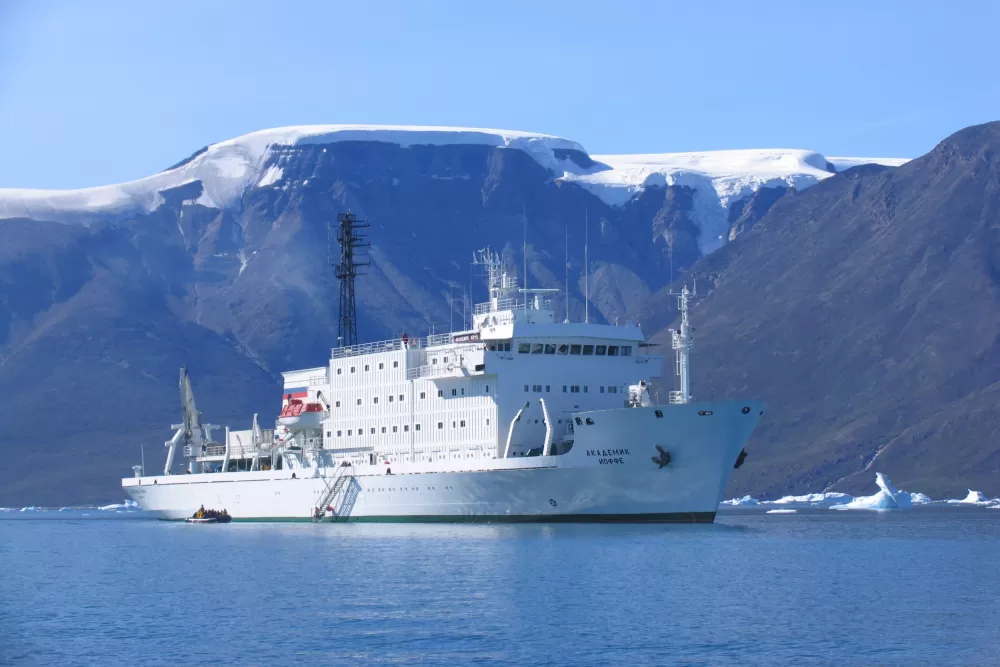
We caught our first glimpse of our ship, the Akademik Joffe, waiting for us in the harbor the next afternoon. It was to be our home for the next two weeks. Our daughter, Jill, and her husband had traveled to Antarctica on the Akademik Joffe five years earlier and had recommended it to us. With accommodations for 100 passengers plus its 50 Russian crewmembers and ten expedition staff, the Akademik Joffe is relatively small ship, just 350 feet long and weighing only 7,000 tons. It was built in Finland in 1989 as an oceanic research vessel for the Russians. Its ice-strengthened hull makes it particularly suitable for polar explorations.

It is an expedition ship, not a cruise ship. In place of a gambling casino, we had a library and lecture hall. Instead of dancers and entertainers, we had experienced naturalists and historians, who lectured us on all sorts of subjects such as wild life, icebergs and Arctic history. Comfortable but not luxurious, the Akademik Joffe was strong, sturdy and stable – all reassuring attributes when one sets out to venture into the frozen North.

We spent our first three days underway exploring the islands of the Svalbard archipelago. It is truly a spectacular, frozen world of sparkling fjords, glaciers, ice floes and snow-capped peaks. We generally made two shore excursions each day, using rubber Zodiacs to transport us from the ship to “wet landings” on the beach. Each landing offered a choice of short or longer hikes to explore the local settlements, glaciers and wildlife. Every landing party included a rifle-carrying staff member as a precaution against inquisitive polar bears.

Despite the latitude, Svalbard’s wild life is surprisingly rich with diverse species including polar bear, reindeer, musk-oxen, Arctic foxes, seals, walruses and whales. The gulf stream keeps the ocean relatively ice free and nutures massive concentrations of plankton which, in turn, lure whales and fish. The fish provide food for the sea birds, who migrate to Svalbard by the millions, as well as for the seals. The seals, in turn, keep the polar bears fed.

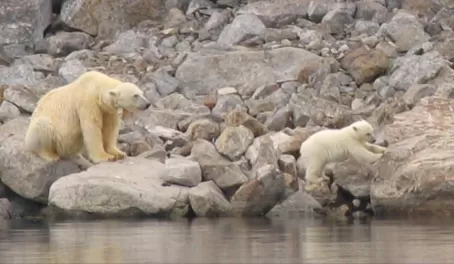
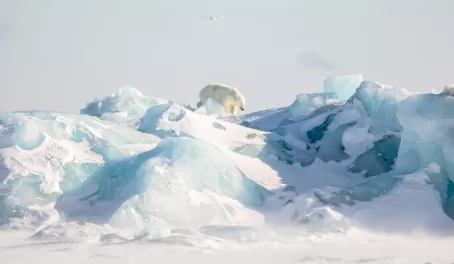
Polar bears are the prize sighting in any voyage in the Arctic. Seeing them is never a certainty but we managed to spot a half dozen or so while traveling around Spitsbergen. In comparison to the scores of polar bears that we saw in Churchill ten years earlier, these bear sightings were less frequent and at a much greater distances, but it was still a great thrill to see these magnificent animals in their natural elements. We spent one particularly memorable afternoon lying offshore in our Zodiacs as a female polar bear swam several times out to the decaying carcass of a dead fin whale to pull off chunks of blubber, while her six month old offspring waited patiently on shore for her meal.

One of our hikes took us to the site of a 17th century Dutch whaling station with its remains of old blubber pots along with the graves of over 100 young whalers, who came to the high Arctic in search of their fortune, but instead paid with their lives. Of course, the whales paid dearly, too. The bow whale, the longest lived mammal on earth, which numbered in the tens of thousands initially, was reduced to near extinction in the course of just two centuries.

At the most northerly point of our travels around Svalbard, the ship crossed the 80th parallel. At that point we were only 600 miles from the North Pole. In fact, if the pole had been a little taller we might have been able to see it from there. We celebrated with a champagne toast on the forward deck and a long blast from the ship’s horn.

Our final stop in Svalbard was at a small research settlement at Ny Alesund. It was from this spot that several polar explorers launched their expeditions from Svalbard - Byrd and Amundsen among them. A short walk outside of town, we found the rusting pylon from which Roald Amundsen – polar explorer extraordinaire – launched his airship on a successful attempt to fly over the North Pole. It was a poignant reminder of the heroic era of polar exploration. Before leaving home, we’d read a number of books about the polar explorers and were fascinated by their stories.

July 26, 2010
Top

Arctic Exploration

Greenland Sea

Ever since Christopher Columbus discovered that his route to the Orient was blocked by a new and unexpected continent, the quest for a Northwest Passage – a sea route from the Atlantic to the Pacific around the New World’s northern extremities – has been the dream of explorers and adventurers. Drake, Cook and Hudson were among the early seafarers who joined the search, but it was not until the 19th century that arctic exploration hit its peak with England leading the way. The twin arctic quests of the discovering a Northwest Passage and reaching the North Pole became a matter of great national prestige and pride.

Throughout the 19th century dozens of ships and hundreds of men ventured into the vast, unexplored Polar Regions. The tales of their heroic but often ill-fated expeditions provide some of the most thrilling adventure stories ever written. Perhaps the most well-known was the ill-fated Franklin expedition in which Sir John Franklin and his 128 man party left England in 1845 in search of the Northwest Passage and vanished into the Arctic forever. Over a dozen relief expeditions were launched to find the Franklin party but they, too, were unsuccessful, many resulting in further loss of life. It was not until 1905 that Roald Amundsen, a Norwegian, would complete the first successful navigation of the Northwest Passage. Four years later, in 1909, Robert Peary, an American, claimed the North Pole.

In any discussion of the great polar explorers, we should not fail to mention our own son-in-law, Whit Jackson who, as a young college student, spent a summer crossing the high Arctic in a walrus-skin umiak with a National Geographic expedition team, attempting to retrace the migration route of the native Thule Inuit people from Alaska to Greenland a thousand years earlier. Certainly Whit deserves to be included in any panoply of heroic Arctic explorers.

Today, one hundred years after Amundsen and Peary, commercial ships make seasonal transits of the Northwest Passage, giant nuclear submarines patrol the seas below the Arctic ice cap and tourists arrive on giant ice breakers to have their photos taken at the North Pole. Fast forwarding another one hundred years, ships may well be traveling in open waters from Europe to the Far East over the North Pole, if global warming continues at its current pace.

July 28, 2010
Top

Greenland

Eastern Greenland

Our crossing from Norway to Greenland took three days, our route taking us along the southern edges the massive ice sheet which covers the polar sea. The ship even made a non-scheduled detour into the polar sea ice, launching the Zodiacs for an exciting excursion into the ice filled sea. We spent much of our time on deck during the crossing looking for whales, sea ice and migrating sea birds as well as attending lectures from the naturalists on board on marine life, the changing sea ice and our destination, Greenland. When we arrived in the coastal waters of Greenland, we were greeted by floating icebergs and a dense fog bank, which slowed the ship to six knots and delayed our arrival by a half a day, a reminder that it is the sea and ice conditions that determine the itinerary and not any pre-planned schedule.

Remote, mysterious and extreme, the highly indented and ruggedly mountainous coast of Eastern Greenland is one of the most isolated habitations in the world. There are just two towns and seven small settlements with a total population of only 3,500 people along the full length of the 1,600 mile long East Coast. Trapped between the polar sea ice and the Greenlandic icecap, the coast is only accessible by ship for five months during the year.

A few bits of information on Greenland and its history that we picked up in our shipboard lectures: Greenland is the world’s largest island that is not a continent. Eighty percent of its surface is covered by the Greenland ice sheet which is, on average, a mile and a half thick. Greenland is the least densely populated country in the world with a population of just under 60,000 people in a country the size of Europe. 88% of the population is Inuit; the rest are Europeans, primarily Danish. Though geographically part of the North American continent, Greenland has been politically tied to Europe and Denmark for a thousand years, but has recently been granted virtual independence from Denmark.

Eric the Red, with a shipload of Vikings sailing from Iceland, discovered Greenland in the 10th century and then returned to Iceland to spread word about the country they had found. He called it “Greenland” to attract settlers. His marketing ploy worked; some 4,000 Norse eventually settled in Greenland. Despite their reputation as ferocious warriors, the Vikings were essentially farmers, who did a bit of pillaging, plundering and exploring on the side. Sometime around the Year 1000, Erik’s son Leif set out from Greenland and discovered North America. The Viking settlements continued in Greenland for four centuries, and then abruptly vanished.

Our destination in Greenland was Scoresby Sound, the largest fjord complex in the world, extending inland some 140 miles and harboring some the world’s largest glaciers, which launch more icebergs than any other region on the coast, possibly including the iceberg that sank the Titanic. (During the week of our visit, an island of ice more than four times the size of Manhattan broke off from a glacier in northern Greenland and began drifting across the Arctic Ocean.)

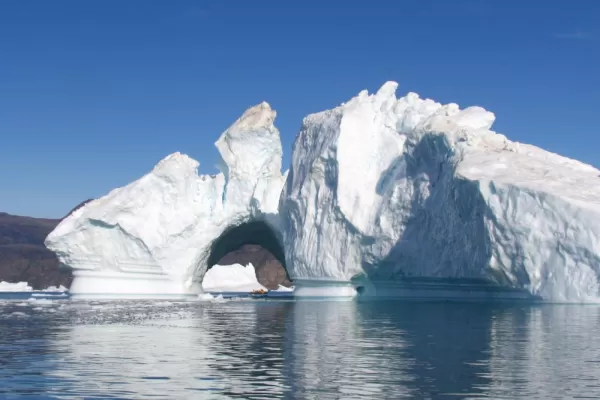
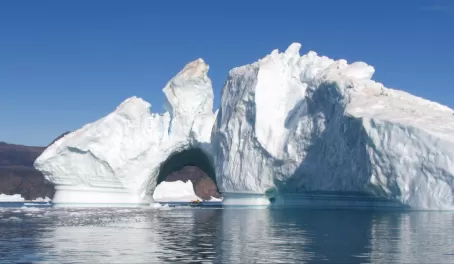
We spent our three days in the fjord on deck watching the parade of icebergs floating slowly past, some more than a block long and over 200 feet high. Watching the icebergs, we were reminded of a couple of things that our staff glaciologist had told us. First, only one-eighth of the iceberg is visible above water. Since the visible tips of many of the icebergs were gigantic, then the total size of each of the monster icebergs was unimaginable. Second, since the icebergs were formed from snow that had fallen ten to twenty thousand years ago, we were in the presence of pre-historic ice formations.

We went ashore several times in Scoresby Sound, including a morning at Ittoqqoortomitt, an Inuit village at the entrance to the sound, where we had a chance to wander around the settlement, meet some of the locals and send some postcards. We made another shore excursion to seek out the elusive musk ox of Greenland. We spotted what we thought were musk ox in the distance and took a few photgraphs but, when we looked at the photos back on the ship, they turned out to be musk rocks, and not the shaggy, pre-historic musk ox that we had hoped for.

But the most thrilling moments were our zodiac excursions out among the majestic icebergs. No two icebergs are the same; each one more spectacular than the last. The sculpted shapes of the dazzling icebergs floating by in the mile deep waters of the fjord, with the rugged mountains and blue skies in the background, were a photographer’s delight, although the true magnificence of these unique works of nature can never be totally captured on film.

The final leg of our 2,100 mile sea voyage was from Greenland to Iceland, where we spent our final day exploring two volcanic islands in the Westman Islands just offshore of Reykjavik. We went ashore in Heimaey, the scene of a violent volcanic eruption in 1973, which caused the island to be evacuated and resulted in over half the homes being buried under volcanic ash, earning it the name “The Pompeii of the North”. The other island was Surtsey, which we had first flown over 45 years ago as it emerged, bellowing smoke and lava from the sea. It was like being present at Creation. Access to this pristine island is still restricted to scientists, who are taking advantage of this unique opportunity to study the colonization processes of a new land by plant and animal life.

August 4, 2010
Top

Iceland

Reykjavik, Iceland

The ship entered Reykjavik harbor in the early morning hours on the final day of our two week cruise. The sparkling waterfront with its brightly colored houses offered a warm welcome as did our Icelandic friends, who met us at the dock to whisk us off for a week long tour of their charming island. But that would have to be the subject for another journal.

1-5 of 8 imagesMy Travel Photo Album


Share