USA Today Logo New York Times Logo Outside Magazine Logo Conde Nast Traveler Logo National Geographic Traveler
Create your Trip Journal [click here]

Mediterranean Expedition to the Ancient Wonders of the World

By : Mary Camp
Trip Begins October 16, 2009
Trip Ends October 30, 2009

We embarked on a luxury small ship cruise from Athens to Alexandria with land tours into Syria and Cairo. Along the way, we saw the site of four Ancient Wonders of the World and other ancient sites dating from 2500 BC to the Middle Ages.
See my photos : Mediterranean Expedition to the Ancient Wonders of the World

Want to go? Corinthian II: Remarkable Women of Antiquity and Their Times

I went to: Africa, Europe, Mediterranean, Greece, Turkey, Egypt, Syria
[enlarge map]
[reduce map]
October 16, 2009
Top

Arriving into Athens

Athens, Greece

We arrived into Athens on time (after 3 long flights- hooray!) and caught the Metro into town. It was rush hour and crowded so I tried to keep careful watch on all of our luggage. Just as we were about to get off in Monastiraki, I felt a man pushing me from behind who seemed to be in a bigger hurry than necessary. I was suspicious and turned around as he pushed by me. Sure enough, he had pickpocketed my daypack and had my travel wallet (with no money and only luggage tags and an itinerary) in his hand. I bumped the wallet saying loudly, "Hey, that's mine!". He dropped it on the floor and hurried out of the train.

We got to our hotel and walked to Victoria Square for a substantial dinner of meatballs, Cretan Salad, and souvlaki before trying to get some sleep.

October 17, 2009
Top

Exploring Athens on our own

Athens, Greece

We were very jet lagged and didn't sleep much last night. We both woke up at 2:30am and stayed awake for ~ 4 hours reading before napping through the morning. Fortunately, the Centrotel had a generous check out policy. We left around noon and caught a taxi to the fancy King George Hotel in Syntagma Square. This 5 star hotel was typically ~9 times the price of the Centrotel, but it was included in the cruise package. Our room was nice, but smaller than the Centrotel and really didn't have any advantages except the very convenient location and lovely breakfast views.

We spent the afternoon exploring in the rain that Ryan has decided he brings with him wherever he travels. We walked to Monastiraki for a delicious lunch of Greek Salad, tzatziki, pita, and souvlaki. The recipes were similar to Greek restaurants in the US, but the quality was so much better because all of the ingredients were extremely fresh.

After lunch, we visited the impressive National Archaeological Museum. The collections are extensive and the statues, particularly of Zeus, Poseidon, and Aphrodite, are impressive. Unfortunately, I was overcome with jetlag and spent much of my time on the museum benches. I'm really glad we planned this extra day on our own so that I wouldn't be in this shape once the cruise started!

After a short nap back at the hotel, we met the Corinthian group at a welcome cocktail reception. The staff is exceptional and we definitely feel like we will be in great hands. The lecturers were very down to earth and nearly all of their planned lectures sound too good to miss.

Dinner was on our own so we walked to the nearly Everest (Greek version of Quiznos with grilled sandwiches to order) for a quick bite.

October 18, 2009
Top

Brauron and Sounion

Sounion, Greece

We woke early for breakfast on the 7th floor restaurant. Most tables had stunning views of the Acropolis, though we settled for a spot with limited views so that we wouldn't have to wait.

This morning, we headed out to the temple of Brauron, dedicated to Artemis as the protector of childbirth and Ifigenia, guardian of the underworld for mothers or babies that didn't make it through. The nearby museum displayed hundreds of items that had been offered as sacrifice at the temple including statues and vases. The most common sacrifice, the clothes of the mother in labor, had, of course, not survived. Most interesting were the statues of children. Before the 4th century BC, sculptors did not know how to represent the form of a child so they simply created mini adults (they look like giants and dwarfs in the same piece of art as the children are proportioned just the same). In the 4th century, sculptors began to learn how to display kids and we could see the process of improvement as both the faces and bodies became more childlike in later pieces.

Next we headed to Cape Sounion. The sky was cloudless and it was a picture perfect Greek seen. The temple of Poseidon, protector of sailors, perched on a cliff overlooking the sea. We had moussaka and Greek salad on site and spent some time admiring the views.

From there, we headed to Piraeus to board the Corinthian II. The staff is amazing onboard, all very welcoming and ready to help. We checked into our Penthouse suite, a recent upgrade, and started unpacking. The room is lovely with a private balcony and enough space to feel like a comfortable hotel room. Though I had originally been overwhelmed to be upgraded to the fancy Penthouse, I actually felt very comfortable and appreciative of the space we had.

I went downstairs for afternoon tea, followed by a lecture on the Partnenon as a Greek national symbol. Dinner, like all of the meals we have had so far, was fantastic. It's a shame that I can't take advantage of the complimentary wines as they are paired specifically to each night's options and region.

October 19, 2009
Top

Bodrum, Turkey (Ancient Halicanarsus)

Masoleum, Bodrum, Turkey

Today we had a buffet breakfast on the sundeck. The spread, like all of the meals on the ship, was extensive, including most of the traditional American and European breakfast staples as well as thick Greek yogurt, a mix of local nuts, honey, and freshly dried fruit (apricots, figs, prunes, etc). I stuck to the local food and then went downstairs for a lecture on ancient Halicanarsus, modern day Bodrum. It is here that the Masouleum, an Ancient Wonder of the World was built in the 5th century BC and stood until it was toppled by an earthquake in the 13th century. Nearly all of the ruined structure had been taken for other building projects, including the building of a castle by the Knights of St. John, 15th century Crusaders.

We disembarked the ship after lunch and traveled first to the castle, one of the most unique historical sites I have ever visited. The castle itself was contructed and decorated by bits of the Masouleum and we were able to see one ancient piece that had not been stolen away (with "permission") to the British Museum by previous explorers. This was the head of a lion that had decorated the outside of the Masouleum. In addition to this ancient historical context, the castle itself was a fairly intact medieval fortress complete with engraved Coats of Arms from the knights who lived there and even medieval grafiti from knights of the 15th century who had engraved their names into the stone walls of the castle.

If these two glimses into history were not enough, the castle also now houses the largest Underwater Archaeological Museum in the world. It has ancient pottery, glass, personal items, and more from shipwrecks dating from the 13th century BC to the 14th century AD. The collections are amazing for all they have been able to tell historians about ancient trade routes, communication between cultures, ship building, and other trades. Particularly unique is the only known cartuche (gold seal) with Nefertiti's name. Apparently, later Egyptian priests had tried to eliminate anything with Nefertiti's name from the historical record because of her "heretical" belief in a single God. This single seal was saved because it had rested at the bottom of the sea for thousands of years. It is estimated that there are 10,000 such ship wrecks across the Mediterranean, many of them along this treacherous coast.

Also interesting at this castle museum was the skeleton and grave findings of an ancient princess, possibly niece of Masouleus. After leaving the museum, we walked through town up to the ancient site of the Masouleum. The foundations of this ancient wonder remained, as well as some broken column fragments, a few of the decorative sculptors (many more have been carted off to the British museum), and the walls of the actual tomb that was located beneath this 140 foot high Masouleum. I couldn't believe that they let tourists walk right on top of this old tomb, amongst these ancient pieces that are sitting out exposed to the elements and careless travelers. To me, it was breathtaking to be walking in the footprint of this Ancient Wonder of the World, along the same stones that the famous sculptors of antiquity sat as they prepared their carvings. Truly incredible!

After our visit, we returned to the ship for a lecture on the Seven Wonders of the Ancient World and then a Captain's Welcome Dinner.

October 20, 2009
Top

Rhodes, Greece

Rhodes, Greece

Today we arrived early to Rhodes, ancient site of the Colloseus of Rhodes, one of the Ancient Wonders of the World. There are no traces of the bronze Colloseus that was supposedly destroyed by an earthquake shortly after it was built and may have been melted down for use in other projects. We took a walk around Old Town Rhodes, the largest intact medieval town in Europe. The town is surrounded by 15th century walls constructed by the Crusaders in their efforts to insure safe passage for Christian pilgrims. The Knights of St. John of Jerusalem built several fortresses around the old town as well as two hospitals that also served as free hostels for poor travelers along their journey.
This order of Knights was composed of 7 nationalities who each protected a portion of the town and identified their segment with the Coat of Arms for their region and/or that of their Grand Master. After walking the town and visiting the archaeological museum housed in one of the Middle Age hospitals, we took a bus to Lindos on the other side of the island.
Here we had a lunch of mezedes (literally "tastes") of various Greek specialties including a chick pea sauce, squid stuffed with feta and red peppers, marinated squash, Greek salad, hearty Greek bread, and a dish similar to moussaka with eggplant, cheese, and marinara sauce.

After lunch, we rode donkeys to the acropolis above Lindos for stunning views across the island and the harbor. At the bottom of the cliffs beneath the acropolis was a small, sheltered harbor where St. Paul landed in approx 50 A.D.

We walked back into Lindos and caught the bus back to Rhodes old town for some much appreciated free time to gather a few souvenirs and visit the internet cafe before heading back to the ship.

October 21, 2009
Top

Fethiye, Turkey

Fethiye, Turkey

Today we took a large tender to shore at Fethiye. We met our fantastic local Turkish guides and boarded buses up to Xanthos, capital of the Lycian Empire. The Lycian people of the 4th century BC had a republic with representatives that were one of the models for the US Constitution. At Xanthos, we saw some Lycian tombs as well as a very well preserved Roman road (2nd century AD) and theater.
We then traveled to Letoon to see the temples of Leto, Apollo, and Artemis. The Leto Temple had been significantly rebuilt so it was the most substancial looking. The Apollo temple had a beautiful mosaic with bow/ arrow, sun symbol, and lyre.
After visiting the temples, we saw the nearby Greek theater and stone theater masks. We headed back to the ship for lunch and spent the afternoon watching "Clash of the Titans" while we sailed onwards.
Ryan was not feeling great so I headed to dinner without him. When I returned, Gabor (the matre'd) had insisted that he send food with me so Ricky (our butler) brought him a tray with spaghetti. We headed out on the observation deck for star gazing with John Frick, the articulate hotel manager. He gave a fascinating lesson combining Greek myths, physics, astronomy, and even Shakespeare sonnets as he pointed out various constellations.

October 22, 2009
Top

Tasucu, Turkey

Tasucu, Turkey

We arrived to the port of Tasucu as one of the only tourist ships to visit the semi-remote area. The mayor greeted our ship with a large welcome sign, sweets, and flowers for the ship. He also brought a newspaper photographer and shook hands with the tour managers, urging us to return (and bring larger ships).

We boarded the buses for a drive into the Turkey mountains to the ancient site of Diacaesarea. We saw the intact Hellenistic Tower from the 4th Century BC. We then walked down to the Temple of Zeus. Here the locals turned out in traditional dress and performed a few folk dances. We walked around the site, significant for being one of the first sites to use Corinthian capitals on their columns.

After touring the site, the mayor of the village welcomed us. They had arranged for the traveling loom operators to bring an art historian to the dusty village and give us a presentation about Turkish rug making. The loom operator travels across the mountains to these nomad villages with a government grant to provide them with the means of creating handicrafts for sale. They had, of course, brought dozens of rugs for sale. Apparantly (according to the guides and even a few fellow travelers who had bought rugs in the past), the rugs were all handmade and excellent quality. The art historian showed us how to tell a handmade rug from a machine made rug (the pile on the handmade rugs all lies the same direction creating a different shade and sheen when viewed from one side to the other).

The rugs were all laid out in the dirt and our chairs had been placed on top of some of them. They handed out Turkish snacks and apricot juice. One traveler spilled some juice on the rug beneath us, but the rug sellers did not seem even slightly concerned. Another traveler asked the price of that rug ($32,000!). The other rugs were similarly priced with the least expensive one I heard quoted at $9000. Of course, all rates are negotiable and bartering is expected. Several travelers purchased rugs at moderate discounts from these quoted rates. One traveler (who had two Turkish rugs already at home including one that cost him $16,000 and was rolled up under the bed because he didn't have space for it) said that the rates were a good deal because you could easily sell them for twice the price back in the US.

I was most amused that several travelers stopped to use the very basic toilet facilities (standard Asian design with two molded food pedals on either side of a dirty hole) after spending $30,000 on a rug - such an interesting group of travelers!

Back on the ship that night, Gabor surprised us with a glorious chocolate cake with colorful fresh fruit, chocolate fences, golden almond bark, and even a large sparkler all sticking out a various angles. The kitchen and hotel staf onboard sang "Won't You Be My Sweetheart?" and played instruments to celebrate our honeymoon.

October 23, 2009
Top

Arriving in Syria

Tartus, Syria

We arrived pierside to the industrial port of Tartus this morning. The Syrian Immigration officials boarded our ship including three masked health officers. These health officers watched us disembark to see if anyone looked like they had swine flu. Apparantly, they also brought a thermal camera to visualize our body temperatures as we passed, but I didn't see them using this.

We boarded two buses for the four hour drive to Palmyra. Our guide, Adib, lacked the sophistication and easy, informative style of our Turkish guides, but he still did his best to provide an overview of Syria along the drive. Each town seemed to have numerous billboards with a picture of the Syrian president and the flag. This newly formed republic was anxious to demonstrate pride in its leaders.

I was surprised by how many women were dressed in western attire. Though the population is 75% Muslim, only about 50% of the women had their heads covered and very few wore more than simple headscarves. Most were quite fashionable with coordinated outfits that matched their scarves.

Unlike Turkey where polygamy is forbidden, it is allowed in Syria. Having one wife is still the most common approach, especially in cities where the expense from two households can be cost prohibitive.

We drove through the mostly green and fertile hills toward Homs for a rest break. Along the way, we skirted the Lebanese border, once coming within four miles of the border crossing. Syria and Lebanon are on very good terms, both speak the same Arabic dialect and frequently have families living on both sides of the border.

After our rest stop, we continued to the Archaeological Museum at Palmyra. We weren't allowed to take photos inside, but we did see several statues from the site. We also saw a large scale model of Ancient Palmyra, a bustling city and caravan stop for camel trains along the Silk Road. It offered a huge agora for trading, a Roman style theater, Bel Temple (equivalent of Zeus), and lavish palace. Built around 100 BC, it was a mix of Mesopotamian and Roman influences.

We drove to the Semiramus Hotel at the actual site of ancient Palmyra and had a lavish buffet lunch. This included a variety of Mediterranean salads, soft cheeses, stuffed grape leaves, rice, potatoes, and a tomato dish with spiced meat (similar to the sauce on Lebanese beans and rice).

After lunch, we headed to the ruins of Palmyra. We visited the Bel Temple, Tower tomb, and Underground Tomb of the 3 Brothers. Then we drove up to the Palmyra citadel, a medieval fortress, to watch the desert sunset.

Dinner was in traditional Bedoin tents with long tables that had squat sofas and pillowed stools on either side. There were a selection of common dishes to share along the table. With no serving utensils, we used our personal forks to dish up lettuce salad, beets, falafel, hummus, flat bread, and mashed eggplant with pomegranite. It was touristy enough that they provided us with personal silverware rather than eating in traditional Bedoin style with the fingers of our right hand.

Musicians arrived to play sitar music and other Middle Eastern instruments. The group leader invited us individually out to dance in the center aisle between the tables. Next they brought out two roasted lambs and tasty fried rice with peas for the main course.

After more dancing (and the whiny, buzzing music that seemed never ending!), we headed back to the hotel and a picture of the ruins by night.

October 24, 2009
Top

Palmyra, Syria

Palmyra, Syria

We had a large buffet breakfast with lots of Middle Eastern fare (salads, cheeses, olives, hummus) as well as American favorites.

We then visited the Great Collonade, agor, and palace baths of the Palmyra ruins. Ryan and I couldn't wait to ride the camels and hastily paid the "going rate" (likely more than we should have) for a quick five minute loop. Still, it was great fun and the camel driver was very nice. His friend wrapped us in headscarves for a picture afterwards.

The stream of souvenir sellers spoke decent English and pursued us through the site offering postcards, necklaces, and small figurines. Ryan bought a silver camel and a necklace after minimal negotiations. In general, the sales people seemed genuinely friendly and a couple of them chatted with us without even trying to make a sale. Of course, there were also several pushy ones insisting that we needed their scarves and pushing postcards at us.

I felt comfortable with the ones we brought from who seemed appreciative. However, I refused to buy from the young children or the adults who seemed to be with these kids. There was one particularly sad boy who sat looking dejected and refused to get up and sell when prompted by older boys. One of the older boys kicked him and shoved him in the side of the head. The scuffle was over as soon as it began, but I didn't know what to do aside from staying away from this group of sellers.

After the ruins, we drove halfway back to the ship and stopped at crusader castle of Krak des Chevaliers. We had lunch at a nearby restaurant including chicken, French fries, and most of the same appetizers as the night before. The we toured the expansive castle, walking along the castle walls and admiring the panoramic views of Homs.

We returned to the ship for a restful evening onboard. Returning to our cabin and the fantastic crew as like coming home. Unfortunately, Ryan got TD and didn't sleep well.

October 25, 2009
Top

At Sea

This morning, nearly a third of our ship was ill with stomach issues, likely from the Syrian food. Fortunately, this was a day at sea so we all had time to rest up.

We took a bridge tour with John Frick, always dynamic, explaining the communication and navigational instruments. He also pointed out the 40 or so different flags that they carry onboard to raise in each port that the Corinthian visits.

We attended a couple more lectures, watched Tootside, and relaxed for the day. That evening we had a cocktail reception and a fantastic slide show of the trip.

October 26, 2009
Top

Alexandria

Alexandria, Egypt

We were very late disembarking today as we waited until 11am for their immigration officials to come onboard and finish our forms. Once we finally disembarked, we made a hurried tour of Alexandria including Pompey's Pillar and the Roman catacombs.

We had lunch in a hotel and then continued for a quick photo stops at a Roman theater and the site of the Pharos lighthouse, the last Ancient Wonder of the World to be added to the list.

We all piled on the bus for what was supposed to be a three hour ride to Cairo. After nearly four hours, we were all getting cramped in the tiny seats and quite hungry. Petula announced that we were thankfully five minutes from the hotel and started explaining the check in procedures. Another twenty minutes later, she annouced that the drive thought we were going somewhere else and it would actually be another hour to the hotel. She said it so matter of factly that we thought she was kidding.

We finally arrived at the Heliopolis Fairmont Towers hotel ~ 6 hours after leaving Alexandria at 9pm. We were very hungry, tired, and sore from the small bus seats. The rooms were stunning and we all wished that we would have more time to enjoy them, but gratefully fell into bed.

October 27, 2009
Top

Great Pyramids and Sphinx

Giza, Egypt

This morning we were greeted at the hotel by our Egypt operator including a tour coordinator, guide, and driver for the two of us. They drove us to the Meridien Pyramids to check into our room overlooking the pyramids. The room was lovely and well worth the cost.

After check in, we drove to the nearby Sphinx and Pyramids. Contrary to my impressions from books and movies, the pyramids are essentially located in the center of Cairo (Giza is one side of the Nile, Old Cairo is the other, but they are all part of one large 22 million person metropolis). We were literally in stop and go 6 lane traffic with commericial buildings all around and there were the pyramids on our left. The Sphinx was right across the street from Pizza Hut and Kentucky Fried Chicken.

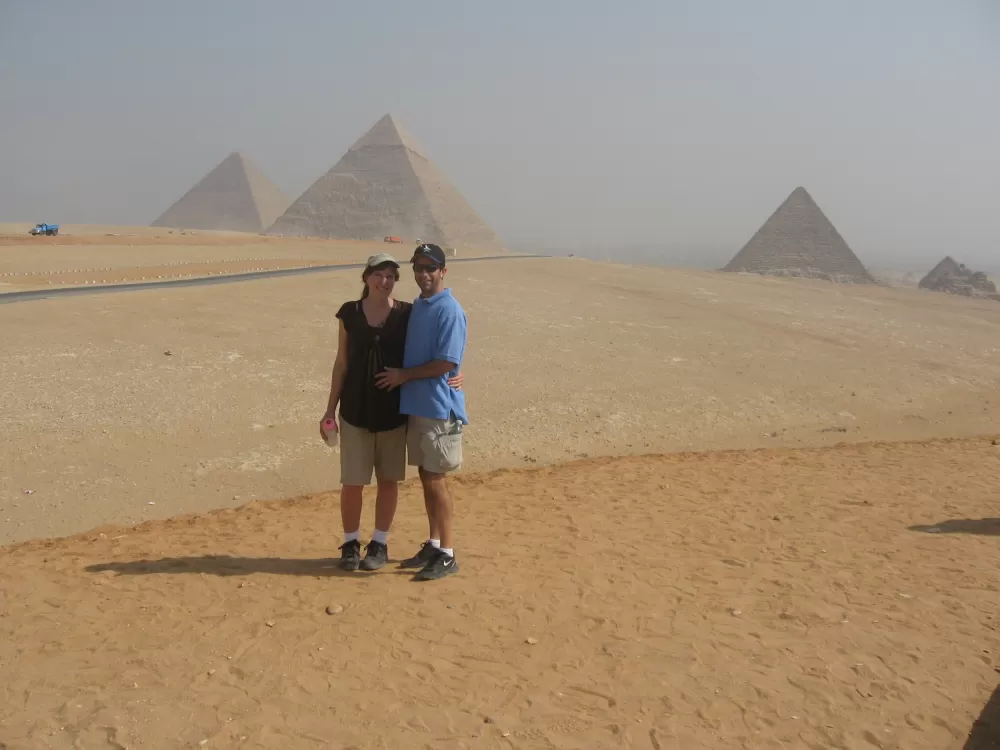
Despite the metropolitan location, the pyramids did not disappoint. They are an architectural phenomenon for our time, let alone 4500 BC when they were first built. We were able to climb up the first 20 or so steps to get a sense of the amazing gradeur of the Great Pyramid. The entire pyramid had once been covered by a white limestone sheath so that it at one time looked like a smooth, glistening, and geometrical perfect pyramid.

Travelers are allowed to enter only a short distance within the pyramid. Unfortunately, I was still suffering from terrible TD so I was not up for very much. We headed instead to the panoramic viewpoint where you see most photos of the 3 pyramids, complete with the swath of the only sand in the area.

Next, we visited the Sphinx, standing in a crowded line waiting to get close enough for a good photo. While we waited, our guide detailed the theories of the Sphinx creation and the reasons for the statue.

We finished our tour shortly after noon and headed back to the hotel for some much needed R and R to recover from our stomach troubles. We ordered room service (soup and bread) and spent much of the afternoon napping so that we would be ready for the evening Sound and Light Show.

The Sound and Light Show was truly incredible. They had ~ 200 chairs set outside the Sphinx. Using lasers and dramatic colored spotlights, the Sphinx narrated the history of the Pyramids and Ancient Egypt. Though the historical accuracy was questionable, the show was beautiful and the temperatures by evening are comfortable.

October 28, 2009
Top

Islamic Cairo and Bazaar

Cairo, Egypt

Today, we were driven through the crazy Cairo traffic to two of the most extravagant mosques from the Middle Ages. I was asked to wear a green sack-like garment to enter but no head covering. The mosques had intricate wood carvings and lovely mosaics.

After the mosques, we visited the Khan Al Khalil Bazaar in old Cairo. Our guide tipped a market security man to follow us through the market as we bartered for purses, dresses, photo albums, and other souvenirs. Prices were extremely inflated. It was a bit challenging to find the true "best" price as some items were marked up only ~ 50% and others were inflated by up to 10 times the actual price we paid. If you really want the very best deal, it helps to negotiate the item at one stand, sticking to a very low price. If the vendor declines, walk away and try upping your offer slightly at the next stand. Often, I wasn't this dedicated to getting the absolute best deal as long as the price seemed fair. I really enjoyed the vendors who were playful and funny, some actually saying "Lady, come back... how can I take your money?" Only a couple of the vendors seemed truly aggressive in their sales spiels, though we may have had a very different experience without our private security detail accompanying us.

After the market, our guide suggested a papyrus museum and shop as a place to buy authentic papyrus artwork (the papyrus drawings in the market are made on cheaper banana and sugar cane and quickly deteriorate). We watched the papyrus saleman demonstrate how papyrus is made and he told us about the meaning behind several of the depictions. We requested personalized drawings with names written in hieroglyphics.

After the museum, we headed back to the hotel for a relaxing evening and dinner at the Lebanese restaurant by the pool.

October 29, 2009
Top

Back to Athens- Acropolis

Athens, Greece

This morning, we were transferred to the airport by our tour coordinator. I was really impressed by their service throughout. At the airport, they had someone waiting for us to speed us through check in and security with no hassle. It was the easiest international check in that I have experienced in years thanks to their help.

Egypt Air was also great. For the two hour flight to Athens, they provided English newspapers, headsets for TV shows, and a wonderful lunch including grape leaves, cheese, bread, and more. Airlines in the US could take a huge customer service lesson from them!

When we arrived in Athens, we left our luggage at their airport locked luggage storage for a small fee. This allowed us to head straight to the metro to get to the Acropolis before closing.

When we arrived at the Acropolis, we were trying to figure out why there was so much security and press around. We were a bit dazed as we walked past a huge news crew. Just as we were about to cross the entrance gate, a group of runners came down the hill from the Acropolis carrying the Olympic torch to begin its journey to the next location.

At the Acropolis, we wandered on our own, enjoying the relaxed pace to take photos and enjoy the sunset over Athens. After our visit, we headed down to the new Acropolis museum. This was the best museum that we visited on our entire trip. They had many of the sculptures and friezes displayed from the Acropolis. The entire structure was built on stilts with a glass floor looking down on another set of ruins. Though the museum was all stainless steel and glass, it was designed according to many of the specifications of the Acropolis. It had stainless steel columns in the same configuration as the Acropolis and the upper level was oriented with friezes in the same placement as they would have been on the Acropolis. They also had two well done movies talking about the history of the Acropolis and the museum.

After our visit, we went to a lovely, though touristy, restaurant in the Plaka for dinner. A pianist played fun tunes as we savored our final taste of fresh Mediterranean cuisine- keftedes (meatballs), tzatziki, pita, and wonderful Greek salad.

October 30, 2009
Top

Returning home

We woke early for the metro ride back to the airport and the 20 hour journey home. Unfortunately, the airlines in the US were not as generous and we had to buy our own food for all of the flights except the first one (even our 5 hour flight).

My Photo Album: Mediterranean Expedition to the Ancient Wonders of the World
Departing homeFrescoes in museum (recovered from Akrotiri)View from our hotel's breakfast roomTemple at Brauron Temple to protector of childbirth outside AthensAphrodite sculpture in Natl Archaeological Museum of AthensSolunionSnacks waiting in our room when we embarkedOur beautiful ship cabin!Breakfast our first morning onboardRecovered from ancient shipwreckcarving from Ancient MasouleumView from Bodrum castleCrusader grafiti- they signed their names on the wall!English coat of arms at Bodrum castleMedieval Islamic armor  (from crusader times)Columns from MasoleumDessert onboard Corinthian IIFountain in Rhodes townCoat of Arms for one of 7 Crusader nationalities in RhodesAncient canon balls from medieval RhodesMosaic in Rhodes museumRiding up to Lindos Acropolis, RhodesView to cove where St. Paul preachedLindos, RhodesRhodes portLook at that gelato!!!Rhodes CityAfternoon snacks on Corinthian IIRoom service on our balcony!Breakfast on our balconyLycian tombMosaic along Roman road, 2nd centuryTemple of LetoMosaic in Temple of ApolloRoman theater at LetoonGreek Theater MasksGreek Theater at Letoon, TurkeyMayor welcoming ship to his small townHellenistic TowerTypical Turkish CafeFolk dancers greeting us in small Turkish villageSome of the earliest Corinthian columnsTurkish rug specialist$30,000 Turkish carpet!St. Tecla's GrottoHeading to SyriaHoneymoon cake on Corinthian IISyrian portSyrian presidentBedouin tentWhich way should we go?Palmyra Archaeological MuseumTruth in AdvertisingFantastic Syrian buffetPalmyrian ruins in SyriaBel TempleBel Temple EntranceOriginal ceiling from 1st century in Bel TempleOther tourists at Bel TempleWhere is the green oasis?Palmyra TombCeiling in tombView out the window of the tombCastle overlooking PalmyraMusicians at bedouin dinnerWomen cooking bread at our bedouin dinnerBedouin dinner near PalmyraEntrance for bedouin dinnerSyrian boy reluctantly selling postcardsPalmyra ruinsMe and our camel driverNow we fit in... :)Camel train crossing Syrian desertTaking pictures of camel train and road to IraqCrusader's Castle near Homs, SyriaInside the CastleWalking the castle wallInside the CastleDriving along Lebanese borderRoom service breakfast on our balcony!Pax taking the wheel during bridge tourNational flags used on Corinthian II for different portsOur fantastic Matre'd, GaborMore beautiful food!Final evening on the shipLarge ships at AlexandriaPort of AlexandriaPort of AlexandriaPompey's Pillar in AlexandriaLine for ladies' restroom (a hotel room they opened for us)Site of Ancient Lighthouse of AlexandriaView from Great Pyramid of CairoLook closely- He's taking her picture in a full burqaJust like us- he's showing his wife the picture he just tookAncient entrance to the Great PyramidView from our hotel room in Cairo!Sound and Light Show at SphinxIslamic CairoMosque decorationsDressed to see the mosqueWoman drawing at mosqueKhan El-Khalili Bazaar in CairoTypical Cairo trafficMaking papyrusOur Cairo hotelMeal at Cairo hotelTour coordinator in CairoLeaving CairoEncountering the Olympic torch coming out of AcropolisFlags at AcropolisTemple at AcropolisGreek FlagNew Acropolis MuseumRuins under Acropolis museumStained glass at restaurant in Plaka, AthensPianist at restaurant in Plaka