USA Today Logo New York Times Logo Outside Magazine Logo Conde Nast Traveler Logo National Geographic Traveler
Create your Trip Journal [click here]

Patagonia Tour, End of the World

By : Pam Thomas
Trip Begins February 9, 2009
Trip Ends February 21, 2009

It’s February school vacation week, and most of our friends have been indulging in pedicures and manicures for trips to the Caribbean and Florida. Though we are not glamorous, we are happy, happy, happy because we are going to tour Patagonia today.
See my photos : PatagoniaTour, End of the World

Want to go? End of the World, End of the World, M/V Mare Australis, M/V Via Australis

I went to: Chile, Argentina, Patagonia, Punta Arenas, Ushuaia, El Calafate, Las Torres EcoCamp, Buenos Aires, Perito Moreno Glacier, Torres del Paine
[enlarge map]
[reduce map]
February 9, 2009
Top

Taking off for Patagonia

It’s February school vacation week, and most of our friends have been indulging in pedicures and manicures for trips to the Caribbean and Florida. We have spent the past weeks shopping for…. RAIN PANTS! And hiking boots. And sweat-free socks. But though we are not glamorous, we are happy, happy, happy because we are going to Patagonia today. (To which our friends say: Where?)

February 10, 2009
Top

Animal lover goes vegetarian

Buenos Aires, Argentina

We land in Buenos Aires, and the elegant Hotel Elevage has a nice triple room for me, my husband Chris, and my 16-year-old daughter Caitlin. Joy of joys, it’s ready, even though it’s morning. We try to nap, but only the teenager manages to sleep. And sleep. And sleep. Chris and I give up on her and go out into the pouring rain for a walk around the city center. This is – our luck! – Buenos Aires’s first rain in ages. We duck under beautiful pink flowering trees in the park, which attract scads of hummingbirds. We eat luscious pastries in a café. We admire, from under our umbrella, the architecture, which looks like Paris.

Finally, at 6:30, Caitlin wakes up hungry. Nobody eats dinner at 6:30 in Argentina, so we stroll around before heading to La Chacra, which the hotel had recommended for our first taste of Argentine beef. White tablecloths, formal waiters, and casual atmosphere. A Texan businessman at the next table hears us speaking English and tells us this is his favorite restaurant; he suggests some cuts of meat for us. Exquisite. But Caitlin, our animal lover, is so appalled by the taxidermied longhorn outside and the spread-eagled pork and lamb carcasses around the BBQ pit that she becomes a vegetarian for the rest of the trip and beyond! Her dinner: pureed apples.

February 11, 2009
Top

Can we get a Ushuaia Yacht Club tshirt?

Ushuaia, Argentina

A driver and guide pick us up for our flight to Ushuaia. On the way, the guide says Buenos Aires has started raising the tolls during the hours when the city is most crowded, a sort of energy tax to persuade residents to take public transportation. A green behavior shaper! Unfortunately, he says, they don’t have much of a bus/train system for people to take as an alternative. Oops.

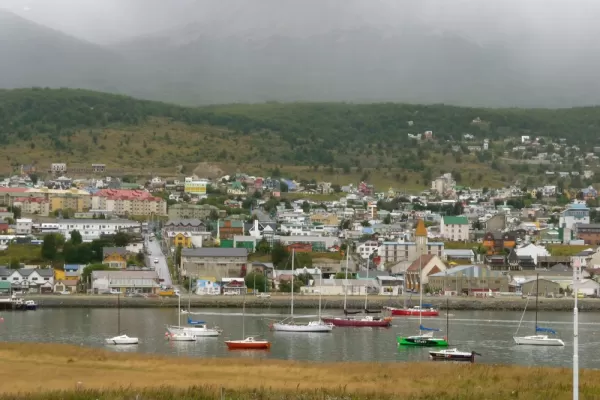
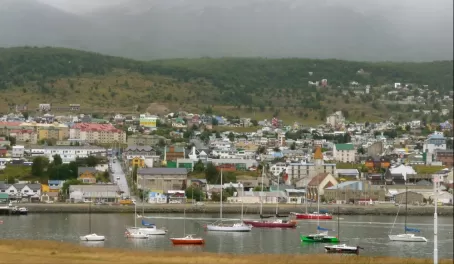
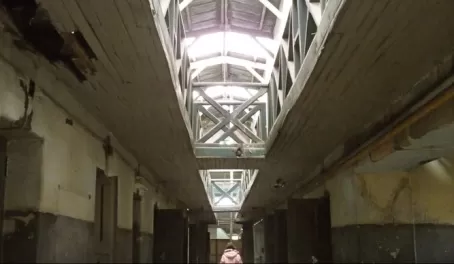
The plane trip is long, soaring over empty land. When we arrive in Ushuaia, it is drizzly and foggy – just what we expected at the end of the world! A cute young guide whisks us to his favorite lookout over the town. The fog lifts and we can see the dark mountains towering over a rustic collection of houses and businesses lining the harbor. A flotilla of sailboats rocks in the wind – the Ushuaia Yacht Club! That’d be a great t-shirt to wear at our marina in Rhode Island. Then we’re dropped off at the city museum, which was once the prison that Argentina established here to populate this part of the world. Museum shows the bleak life prisoners endured, but is interestingly folksy.

We stroll down Ushuaia’s main street on our way to our expedition ship, the Mare Australis, docked a few blocks away. Ushuaia has a curiously Alpine feel to it, very quaint. Lupine flowers are blooming everywhere, the biggest, most robust ones I’ve ever seen (maybe Miss Rumphius was here, remember that kids’ book?) Why didn’t we come a day earlier and hang out? Bad planning on our part. By 6, we board the ship, which is quite cushy for an expedition vessel. Shortly, we are heading out into the Beagle Channel and the islands of Tierra del Fuego.

February 12, 2009
Top

One of the most beautiful days of my life!

During the night we travel through a passage of open water unprotected by islands, as the captain had warned us the evening before, and sure enough, the waves are high. The motion wakes us up, and we peer out our cabin windows into nothingness. We lay down and let the boat rock us back to sleep until 6 a.m. when we have to get up for Cape Horn. Even the teenager rises promptly, as she can tell from the way everyone acts about Cape Horn that it’s a big deal.

We put on layers, in case it’s windy and cold. Then we add big orange life jackets with a whistle. Out on deck we line up to board black rubber zodiacs that hold about 12 people. One by one, they ferry us to the Cape Monument. It is 45 degrees and drizzly (already the rain pants are a godsend). As we get off the zodiac we spot a lone penguin perched on a rocky outcrop. By the time we climb up 160 steps we are regretting our layers. We are steaming.

The monument is on a huge chunk of rolling hills, covered with short lush foliage, including mosses, daisies and berries. A boardwalk snakes across fields of green to a lighthouse with a round top, all glass, and a tiny chapel of rough bark. A little store yields no souvenir hats big enough for Chris’s curly head.

The boardwalk meanders to the highest point where a tall monument with an albatross carved out of it stands on top, symbolizing the soaring souls of all the sailors who shipwrecked trying to round that dastardly point. We peer at the two islands next to us, the southernmost tip of the continent: 600 miles to Antarctica! It is amazing to be here at the end of the earth.

Wet on the outside and dry on the inside, we are glad to be ferried back to breakfast at 9. Eggs, bacon, hot cakes – we feel like we deserve them all. Caitlin pronounces the hot chocolate the waiter brings her the best she’s ever had. But the waiter is not as cute as the crew member who helped her aboard the zodiac. She had worn her contacts at 6 a.m. for him! She is the only kid on board, but eyeballing the guys on the crew keeps her amused.

We had had to sign releases saying we knew how crowded our room would be with the addition of a rollaway bed, but it isn’t so bad. And much better than paying for a second cabin! We hang our wet clothes all around to dry. Then we go to the salon to watch a documentary about Ernest Shackleton’s attempt to cross Antarctica, when his ship got stuck in the ice in winter.

On board our own ship, it is rolling, and our sea legs are awkward. The salon is beautiful with rich wood and a blue and yellow plaid carpet. Big poufy leather couches send some movie watchers into a snooze.

The movie is in English. We find that few of the 120 people aboard are from the U.S.: us and a couple from Baltimore. There’s a bunch of people from the UK, some from Canada. Many French, some from Spain and Germany, 1 from Argentina. You sit at dining tables according to your language. (We often exchanged travel tips; one couple whose time is very flexible said they asked tour companies in Ushuaia about last-minute Antarctica cruise deals and the best discount was only 20 percent – even in this economy. The Mare Australis sailings were sold out.)

We have it much better than Shackleton’s crew: Lunch is an antipasto buffet including calamari, which would have been plenty. But it is followed by 5 pastas, from gnocchi to lasagna. Then a dessert buffet!

We hope to walk it off on our afternoon expedition to Wulaia Bay, where Darwin landed and formed some of his theory of evolution. By the time we pile into zodiacs, the sun is lighting up the many greens of the island. T-shirt weather! An historic house is the focal point on the island, whose 20 acres I think are leased by the cruise company which now is restoring the house. Francisco, our guide, said the whole area is an archeological dig, studying the ways of the Yamani, the aborigines. We opt for the “soft” walk, along the water, instead of the “hill” walk, which others said later was easy and had a great view.

The island is green and peaceful, bay on one side, little coves on the other, pine trees slanted to one side by the wind, which can get up to 200 mph. Francisco has us sit on rocks smeared with mustard-colored lichen to listen to nature. We sit for 5 minutes, listening to the waves, sun washing over us, gazing into the clear, clear water. He tells us that Darwin saw the Yamani people, living naked and covered with sea lion fat to keep dry, upper torso well developed and lower not so much because they paddled canoes on their knees, and he thought they were the Missing Link between ape and man, almost human but not quite. Three of them, including Jemmy Button, were taken to England and exhibited in cages. Later, Darwin said he was wrong and apologized. The Yamani ate berries, sea lion, clams and mussels. Shellfish shells are all over the beach. Red poppies are there too, and beautiful grasses. Everything is strong and healthy, yellow dandelions and white clover on steroids.

After our walk, the cruise company has a surprise at the house – a 200th birthday celebration for Darwin. They bring Champagne, pisco sours and hors d’oeuvres -- a catered event in the middle of nowhere. As we hop in the zodiacs, we spot a huge red crab down in four feet of pristine water. Caitlin proclaims this one of “the most beautiful days of my life.” Score! Even in her un-stylish rain pants!

After dinner, Caitlin and I go to the “international fashion show” on the 4th deck, which turns out to be crew modelling stuff from the ship’s store. Then we play bingo, in 3 languages, good practice on Spanish and French numbers. The catch: If you call bingo and are wrong, you have to sing a song. Caitlin wins a fleece vest with the words “Cape Horn” and a penguin on it.

February 13, 2009
Top

Glaciers really ARE blue

Today we are gliding through narrow passages with the islands quite close on either side of us, majestic ancient hulks of rocks slathered in green, sometimes with rivulets of water running down. Seagulls swoop around the boat. Clouds hover on top of the rocks. It rains a little and is windy. Chris, the dewy Irish-American, is out on the deck, loving nature. Chris and I note that the rocky, empty islands plunge straight into the sea – if you tried to anchor a sailboat, there’d be no place to get even a toehold on land.

After breakfast, I listen to a lecture about explorers of the Magellan Strait. Then more people show up for a nautical knots class. The first knot is my favorite – 3 knots magically appear on the rope, like a bar trick. Caitlin is astoundingly good at the noose knot. Chris is intent on learning the Spanish bowline. Meanwhile, we pass through another area open to the Pacific and the boat rocks and rolls and everyone holds onto their drinks glasses.

Next up: Chilean wine class. First fact learned: Chile is the longest country in the world. We taste a Carmenere, a red made from grapes that came from France but disappeared there (insect invasion) in the 1800s. Then it was found again in Chile, which the Chileans seem quite proud of.

A sailboat goes by in the distance. We see so few things in this empty land that many of us take its picture.

After a lunch of roast lamb and leg of veal, we get ready for our afternoon expedition. All we know is that it’s aboard the zodiacs and will last about an hour. It turns out to be a tremendous one.

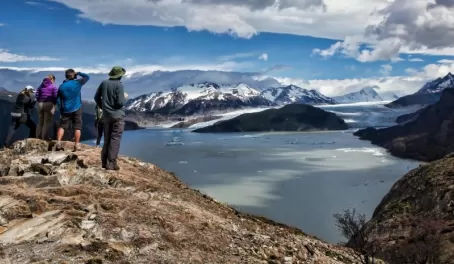
In a light rain, we putter into a fjord, and as we round a rocky outcrop, there in front of us is a bright blue glacier. We all gasp. Next to it is a wall full of cormorants sitting on mud nests, hundreds of them, flapping their wings, taking off, landing. A tall waterfall cascades down and off boulders in one spot, mist rising all around it. The water is the pale color of the sea-green Crayola crayon, thanks to the minerals, and when the cormorants fly, their white bellies look green, reflecting off the water. But the glacier is the highlight, massive and craggy, fingers of ice pointing up, white-blue and bluer in spots, dotted with ice caves. It is like an abstract art painting. I ask Francisco why the glacier is in this particular spot, and he says 10,000 years ago it was ALL glacier up and down the fjords. The glacier we see is all that is left. He says it gets smaller every trip.

Back on board, it is the French and Spanish speakers’ turn to see the glacier, so we head up to the Sky Deck so Chris can teach me and Caitlin to play poker. We catch on pretty quickly, and the bartender gives us sangria and virgin pina coladas. Just as Caitlin is demanding to play for money, we say it’s time to dress up as fancy as possible (in Caitlin’s case, an actual slinky black dress – where did that come from?) for the Captain’s farewell dinner. We miss the pre-dinner penguin lecture for all the gussying up.

I can barely eat dinner I am so full of cruise food. After, we go to the Sky Deck with everyone for the captain’s farewell toast (in 3 languages) and a raffle of the boat flag. A huge chart with our cruise tracked and signed by the captain is auctioned off beginning at $90, with people from Canada, France, Germany and Switzerland bidding. Very fun; the bartender threatens to shut off the bar if bids don’t go higher (money is for the employee tip fund). It finally goes to Switzerland for $260. Makes our smaller chart, purchased for $52 at the ship’s store and still signed by the captain, look like a deal!

February 14, 2009
Top

100,000 penguins!

Punta Arenas, Chile

The alarm rings at 6 a.m. and one word gets us up: PENGUINS! It’s our expedition to Isla Magdalena, where between 100,000 and 150,000 Magellan penguins live.

It is raining a little (don’t care: rain pants!) as we file into the zodiacs, with the island a big brown hill topped by a white steepled lighthouse. It is open water in the Strait of Magellan, so the swells are high as we step aboard.

The sight of so many penguins is astounding. They cover the brown hill, and they are so on-the-go that the island almost looks like it’s moving, the way an ant hill does. Only two rules: no camera flash and no touching. A path leading way up to the lighthouse is roped off for us, and as we walk along, the penguins toddle back and forth to the sea to swim or fetch seaweed. They bring the seaweed back to their burrows, whose holes are everywhere. They scoot down them and you can see dirt fly through the air as someone decides to dig a new one. They ignore us as they traipse around, preening and playing. They are loud, too, throwing their heads back and squawking, beaks to the sky.

We have about an hour, so we skip the lighthouse. We only have eyes for penguins. The sun comes out. So many things beg our attention: the fuzzy teenagers hanging out at the beach, the albino penguin sitting still, pairs having beak slapping fests (is it love or hate?). The crew finally has to shoo us back to the boat. How lucky are we?

To top it off, as we reach the Mare Australis, a rainbow appears over the island. I know this is an occasion as Francisco, the boat photographer, is hurrying to document it. Me too of course!

I have discovered, by the way, an excellent method of keeping dry. I put on my wide sun hat with chin strap, then pull my hood up over it. It looks a little goofy, but it keeps my face out of the wind and rain, and my cameras too.

We are very near Punta Arenas, and colorful tugboats push the ship into the busy port; ocean-going ships lay at anchor all around us. We say goodbye to our dining companions from Canada and get their email addresses. A slight mixup: the tour company that is supposed to pick us up does not have our name on their list; they are fetching someone else. We board their van anyway as a 15-minute rainstorm suddenly wipes out the sun. Afterwards it is completely sunny again and extremely windy.

The van takes us on a short jaunt to the Plaza Hotel, on the town’s main square; a classic with lots of trees and a statue in middle. The hotel has plenty of old-fashioned charm: high ceilings, colonial, very quaint. Caitlin, up since 6, is as crabby as only tired teens can be, and we encourage her to take a nap.

Chris goes to the bank for Chilean pesos; I can’t nap. The wind is blowing around the hotel like a hurricane. The sun suddenly gives way to rain. From our window, I can see a tourist on a street corner holding her arms out to the wind and twirling in the gale. Patagonian weather! We wait out the rain until 4, as the sun tries to come out. As we stroll the main street, a huge rainbow spreads over the town because it is literally raining and sunny at the same time.

The main street is full of little clothes and shoe stores like you’d see in any small town, plus a big grocery store, a department store and a smattering of restaurants and pizzerias. Caitlin scores a raspberry ice cream cone in a little 2-story mall, and we buy peanuts being roasted on the street.

After about 6 blocks, the shopping peters out; the mélange of architecture is interesting though, from deco to belle époque to modern. One building has a plaque marking where the British Club was when Shackleton tried to get them to help him rescue his men off Elephant Isle. We end up at the lemon yellow Puerto Café, where from a cozy little tearoom on the second floor we can see ships at anchor swinging madly in the waves. Passersby are wearing parkas. In summer! With the sun blazing! At the store downstairs selling handicrafts, lapis lazuli jewelry and wine, a boy tells us the wind blows like this all year round. We buy a penguin hat for Caitlin, a golf shirt for Chris (the color of his eyes with a penguin on it), and a potholder for me with every Chilean symbol on it. Am I living it up or what?

By now it’s after 8 and still bright as day. We head to a restaurant called La Luna, kind of trendy, kind of touristy with a couple of maps into which travelers stick pins for their hometowns.

After dinner, Caitlin takes advantage of the free internet in the lobby, and Chris and I go for a stroll. We pick up The Black Sheep, billed as Patagonia’s only English language paper. It’s aimed at backpackers and trekkers, but has lots of useful info, including bus schedules and ads for tours. Handy if traveling on your own. (www.patagoniablacksheep.com) And one article details the stray dog problem all over Chile. That explains all the pooches we’ve seen!

February 15, 2009
Top

Settling into our eco-dome -- brrrr!

Las Torres EcoCamp, Torres del Paine

In the morning we have breakfast in the hotel’s lovely tearoom-like dining room. Historic pictures of Patagonia line the walls.

Maria, our guide for the day, whisks us out to the airport, where we pick up Nicola and Tertius from South Africa and Celine and Christophe from Switzerland. Then we head to Puerto Natales, the closest town to Torres del Paine National Park, 2½ hours away. It’s fun meeting people from so many places.

At PN, we have lunch and chat with Maria, who is in her last year of law school in Santiago. She was born in a town of 4,000 in Tierra del Fuego across from PN. The government has given companies incentives to move there to keep the people in her tiny hometown. Nicola and Tertius, meanwhile, tell us they have 2 girls in university and now they can finally travel. They are going to Antarctica (camping!) after Torres.

After lunch a Brazilian couple, Mariana and Ronaldo, arrives, and the van takes us all 2 more hours to Torres. At PN, we have picked up Javier, who will be our guide for the camp, and he points out the black-necked swans with white bodies that are the symbol of PN.

It continues to be rainy and cold as we stop at La Cueva del Minodol. This is a huge, airy cave where archeologists found a perfectly preserved large piece of fur as well as bones of a minodol or giant sloth.

We arrive at the Eco Camp, our home for the next 3 days, at about 8, and see our domes – no heat! It is freezing. Ours is a little larger than most because it has 3 beds; it’s very pretty and simple, a green geodesic dome with bark on the bottom. We head to the big dining dome, which has a wood fire roaring in the stove, to have pisco sours and then dinner. Javier hands out a large flashlight for each dome because there’s only electricity in the common domes. You can charge up cameras and iPods in the dining room and the bathroom. The bathroom has composting toilets and solar-heated showers.

Dinner is thankfully yuppified, salmon with onions and peppers along with a tasty corn soup. It's great that the guides dine with us -- Javier is a fountain of facts, a culture junky who amazes us with his breadth of knowledge. Then we head to our beds, which have thick comforters topped with sheepskins. We’re freezing, so we sleep in our clothes after finding our way to the bathroom with our flashlight. The bed is so toasty that in the middle of the night I have to shed a few layers. Caitlin says her father and I slept so soundly we snored like “dying chipmunks. “

February 16, 2009
Top

Condors and guanacos and foxes, oh wow

Las Torres EcoCamp, Torres del Paine

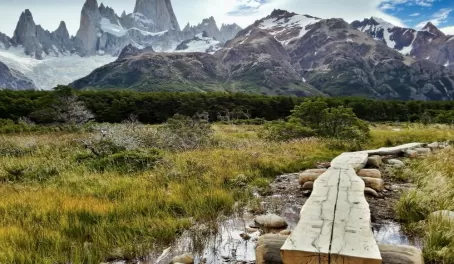
I wake up at dawn as Chris heads for the bano, and through the door I spot -- golden sunlight! I dash out of the tent to see the park’s three famous towers aglow. Mariana and Ronaldo are out in front of their dome and we all silently make crazy cheering motions for the sun.

I take a walk behind the camp and scare up 2 hares, which are so big and run so fast I think they must be mara (even though they didn’t hop like a kangaroo.) But Javier later said that though the mara is a national symbol of Chile, it is now found only in one part of Argentina.

It’s too cold to change clothes or shower; we opt for breakfast in the warm dining room: eggs, toast, chocolate cereal that Caitlin loved, salami and cheese. Javier explains that the buffet table next to the cereal table is for us to make a box lunch – wonderful choices including smoked salmon, prosciutto, cheese, ham, hearts of palm, tuna. Javier says to pack extra because it is going to be a long day. So we stock up with bags of raisins and nuts, cereal bars, chocolate bars, oranges, apples, bananas. If you don’t see it, ask for it. They suggest we recycle the plastic zip lock bags.

In the van, our first stop is where a couple of dozen Andean condors are soaring in circles right above two herds of guanacos – a park postcard! We walk carefully into the fields so as not to startle the guanacos. They keep an eye on us and move away if we get too close, especially to the babies. Babies are gamboling with their mamas, and the males perch atop the ridge as if posing for a calendar. They have a camel-like look to them but their brown and ivory coats blend easily into the backdrop of olive green, wheat and rusty red grasses.

Meanwhile, the condors fly over the valley, drying off their wings, Javier said. In Caitlin’s research report for school before we left, we learned that Andean condors can be as big as 33 pounds, and they need strong winds to help them glide. In a park so big it helps to have a guide who knows where the wildlife congregates.

Drifts of daisies and white yarrow line the roads. Smooth pale green hills are evidence of the glacier moving through. There are few trees; Javier says most of them burned some time ago in a fire started by a Czech tourist’s camp fire (Chileans know how to gold a grudge).

Next stop: a waterfall. I think waterfalls are overrated, but this is a good one. We hike up past a pale green rushing river to see it roaring over a drop and surging down the mountain. At one point it turns into a lake where we spot a catamaran.

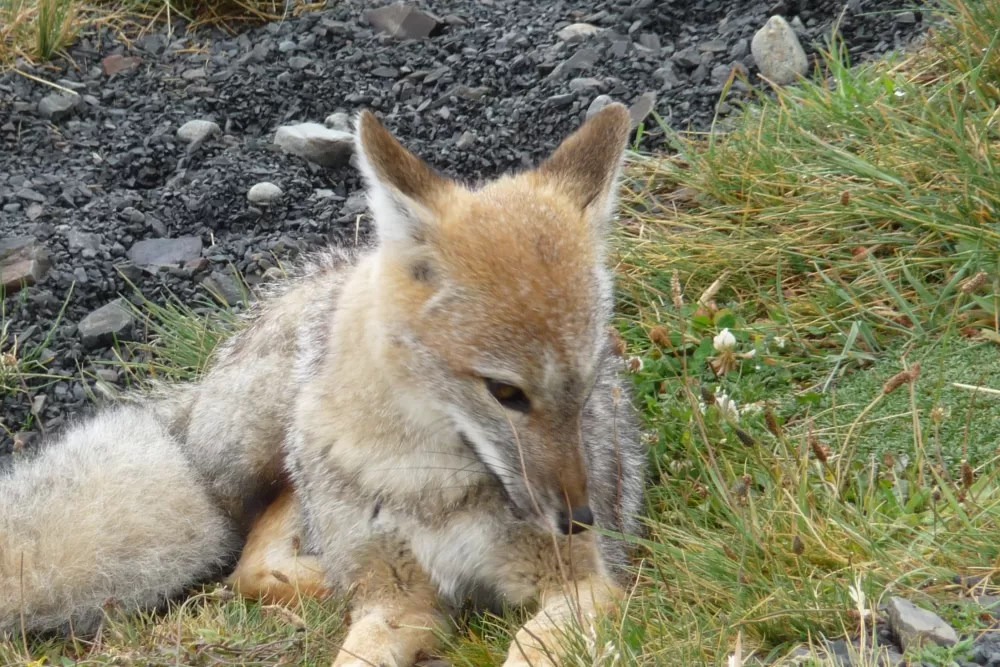
Then we head over to Grey Lake where we are to board a boat. But first we stop to take pictures where a cute grey fox is hanging around to beg.

At Grey Lake, Javier tells us to eat at the picnic tables outside the lodge and then go inside and sit in the big lounge chairs with huge picture windows facing the lake. At the hotel shop, Caitlin snags a zip fleece with the lake logo. The hotel itself is 263,000 pesos for a triple – a little more than $400 a night. Lodging here seems quite expensive; we don’t even know how much Eco Camp is.

The roads in the park are very rough -- unpaved, tho not muddy, with gigantic potholes and corrugated ruts. You wouldn’t want to drive your own car here and few private cars are seen. There are mostly tourist vans and buses, and not many of those. Very uncrowded for high season, but everyone seems to think this is normal. This figure might not be accurate, but someone said there are only 140,000 visitors a year (compared to 3 million at Yellowstone).

We hike to the departure point for the boat, on a beautiful lake with a couple of big blue icebergs floating in it. Couldn’t take enough pix of those. The little red boat seats about 50 people and is comfortable inside, with banos and a bar. Going out, water splashes like crazy over the bow windows, and not too many of us bother to go out on deck.

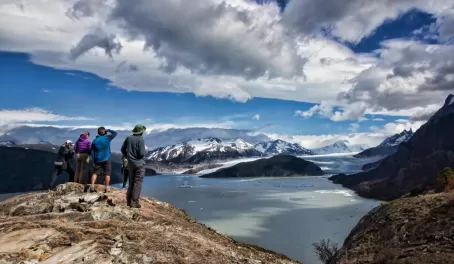
But when we get close to the glacier we are all out there, ogling it. The snow-covered mountains tower around it, and it glows like a huge blue mass of whipped cream. Passengers from Japan to Paris are snapping away, astounded by this miracle of nature. The huge ice caverns are even bluer as the ice compresses more. (Only blue, short wavelengths can pass through.)

Then the boat motors around a rocky area to an even bigger part of the glacier. This one is like a lunar landscape -- or violently whipped cream! On the end a couple of slabs are so blue they look like turquoise gem stones. We are given pisco sours or glasses of whiskey cooled by pieces of iceberg. People from all over the world are toasting each other and saying how lucky we feel to be witnessing this. Then, as we leave, the boat’s pilot put the nose of the boat in a turn against a huge iceberg, and we all reach to touch it.

It is an hour and a half drive back to camp, where we arrive at 8:30 with cocktails at 8:50. Chris and I try the tasty artisan microbrew from PN, both light and dark. Hard to top a pisco sour, though.

After dinner, we chat with everyone including a Dutch family whose 18-year-old son – as blond and blue-eyed as Hans Brinker – is living in Santiago with a family for a gap year. They brought his 2 “house sisters” who were 17 and 18. The mother and father were spending several weeks traveling around Chile. The boy did not speak Spanish before he came and that’s what he wanted to learn. Caitlin hung out with them and the girls told her she should come stay with them and learn Spanish.

Ronaldo and Mariana tell us they had planned on going to go to the US this year, to NYC and then skiing in Utah, but then the dollar went way up so they switched to Patagonia. They live in sprawling Sao Paolo, which they say can be quite dangerous, though the homicide rate has dropped a lot. Biggest problem: robbers holding you up then making you take money out of the ATM for them. They said people there are workaholics. He is a manager for an internet clothing business, and she is a community lawyer. She said robbers are not scared of the sentences because sometimes it takes so long for a case to go to court that they just get off. Or their sentences are reduced after the first third. So it’s not a deterrent. Nicola and Tertius said crime is bad in their town in South Africa too. They said they need a big dog like their Newfoundland so people won’t come into their garden.

We hit the sack in our clothes again, but Caitlin’s hands and feet are so cold I have to crawl in with her and warm her up.

February 17, 2009
Top

A sunny trek among the guanacos

Las Torres EcoCamp, Torres del Paine

Today we are to go to the northeast part of the park for more wildlife viewing and a trek. Celine, instead, signs on for a 4-hour-in, 4-hour-out trek toward the towers. You apparently do it somewhat on your own, though you’re with other people who are also trekking.

We drive to a beautiful green/blue lake with flamingos, and I see one fly, something you don't see in the zoo. Then we go to a very salty lake (I tasted it) that supports a primitive life form that looks like brains washed up on shore. Actually, the whole lake looked like a big green margarita and the crashing white caps like salt around it.

At another wild waterfall, it starts to rain quite a lot. Javier says he had planned to do a trek there but suggests we go elsewhere in hopes of rain stopping. We do, and sure enough, the sun comes out. So we agree on a 3-hour trek to see cave paintings instead of visiting a “beautiful farm.” Caitlin is not happy about the idea of a 3-hour walk, but the rest of us do not want to drive around anymore. Caitlin likes to be on a horse instead of her feet.

We put our lunches in backpacks, and Javier leads us off among golden hills. It is an easy walk across the steppes, dotted with grazing guanacos. We have lunch amid giant sedimentary boulders. Purple thistles and margaritas grow all around, attracting butterflies and bees. The sun is warm, all is lovely.

The rock paintings, another thing I find highly overrated, are uphill, but the views are beautiful; guanacos, munching everywhere, paying us no heed. In some spots the red grasses against the pale green are breathtaking.

We have to cross a ridge and go down the other side, quite steep and gravelly for a bit. Javier gives me one of this trekking sticks but Caitlin says she doesn’t want one until her feet are slipping on the gravel and Chris and Javier have to rescue her. After that she grows more cheerful. The plains are rather like an elephant graveyard, she says, because guanaco skeletons dot the fields, picked clean by both the pumas that brought them down and the birds. Bones are bleached white, and skulls excellently preserved, right down to the teeth, rib cages sticking up. Javier says 40 to 50 percent of the offspring are lost to pumas.

Back in the van, my pedometer reads more than 13,000 steps! Javier says it was a trek of 8 or 9 kilometers.

Back at Eco Camp, it’s 530 and dinner isn’t until 730. Caitlin goes to sleep and Chris closes his eyes, but I go for a walk. The clouds appear to be lifting over the towers – the rest of the area is sunny – so I cruise around the new part of the camp, the domes with private bathrooms, wood stoves and little wooden decks. Celine, who had one, said you are still cold in the morning because you would have to stoke the fire in the middle of the night. But the bathroom being right there is huge, she agrees!

Chris is up by now, so he gets a beer and we bring our 2 chairs outside the dome to see whether the clouds will lift off the towers. Ronaldo and Tertius are up too, watching for them. But there is actually so much in the park that seeing the famous towers no longer seems like such a big deal.

At dinner, Celine says she only made it through 3 hours of the trek because of her bronchitis, and she went back down with a passing returning group. They had said they couldn’t see anything at the top anyway.

Dinner is a lamb bbq, with roasted peppers for Caitlin – not that she needed it with the huge salad/side dish buffet.

All the couples and Caitlin take their pictures together, and we all say how wonderful (and lucky) it is that we all got along and found each other interesting. We invite each other to visit and exchange email addresses.

Javier, our mother hen, promises he will wake us up at 530 for 6 am breakfast (we have no alarm). Chris said the showers had been so-so, ok for him because he likes lukewarm water. But others said it was touch and go with the hot water, which depends on solar panels.

February 18, 2009
Top

A sunset horseback ride on the estancia

El Calafate, Argentina

Javier wakes us up in the pitch dark, and soon we are on our way to the border. We see several skunks, as well as a baby eagle eating a dead hare in the road. When we leave the rough road for pavement, we cheer.

The bus stop is at a café/handiworks shop we had visited several days before. This time I buy a striking pair of lapis lazuli earrings for $127, designed by a local artisan.

Javier gets us on the right bus to Argentina, and at the border, the Argentines collect our passports and we are entertained by episodes of “Mr. Bean” on the bus’s TV, which every nationality seems to find hilarious.

Argentina here is flat; no signs of life. Everyone sleeps. Then, suddenly, there are snow-covered mountains and we are in El Calafate. We are looking forward to hanging out in EC since we haven’t been in many towns, but our itinerary says our hotel is 20 kilometers away. Hmmmm. Chris is eager for email service.

It turns out we are staying on an estancia, once a working sheep ranch but now somewhat of a tourist ranch (they have agrotourism here too, just like in New England). Chris grumbles about email, but Caitlin is in heaven. Several dogs and teenage pups mob her; horses and sheep are on the premises. There’s a picture on the wall that initially looks like a flooded road but on closer inspection the water is hundreds of sheep. Caitlin says, “I feel like I’ve come home!”

We urge Chris to ask for a ride to town so he can walk around while we participate in the afternoon/evening tourist activities. These include tea at 5:30 followed by a sheep herding and shearing demonstration and then a bbq and a folk music/tango show. (Tourists from EC book this as a dinner/activity.)

Caitlin and I can hardly wait to jump into the hot shower after Eco Camp. The heater in our room feels so good! And we can recharge all our electrics without worrying about anyone else. (Nicola had said her favorite part about camping is how much you appreciate everything once you stop camping).

We’re also feeling a bit over-glaciered. If we had to do it over again, we would have opted for another activity at Torres instead of the Grey Lake glacier boat ride considering that we were going to walk on a glacier 2 days later. Maybe horseback riding? In any case, we apparently aren’t the straight nature type. We like towns too, wandering around to see how people live.

We have a fabulous late lunch. Cait has penne with tomatoes and olives; Chris and I share a smoked meats and cheeses plate. Chris naps, and Caitlin and I check out the sheep, so cuddly and picturesque they could have costarred in "Babe."

Then we see people arriving for tea. A huge table is piled with pastries, plus tea and coffee. We sample plenty, including Argentina’s dulce de leche, very sweet.

After, the guide leads folks on a 40-minute walk around the estancia, but says up to 8 people can opt for a horseback ride instead. It will be slow, she promises, following the walkers. Four of us volunteer (20 pesos extra, but I don’t think they ever charged us) and they have us hop on the horses tied up right there. Funny because the two Brazilian women who went with us both had to haul along their big shiny leather handbags!

We mount, and with absolutely no instruction, we take off with 2 gauchos. We immediately trot. And we trot almost the entire way! Not my favorite gait. And my horse, a paint, is a go-getter. I have to constantly slow him down.

Meanwhile, the scenery is magnificent. The pale turquoise Lake Argentino is to the left, mesas and craggy mountains in the distance to our right. But the lowering sun – it’s 7 by now at least –sets the colors aglow. Creamy yellow and cornflower blue of the water are everywhere. We lead the horses into a marsh and they splash through, sending geese into the air. Black-necked swans coast in another part. The border collie darts in and out, hopping from dry spot to dry spot. Enchanting. I can’t get my horse to slow down and stay still for enough pix! But the cute gaucho takes some of me and Caitlin.

I could take photos for hours in this amazing light. But as usual, we are on the hoof – literally today! Caitlin is on a brown and white horse that is a bit spooky (they had asked who was the good rider). She stays behind us, but no one seems concerned with the nose-to-tail, stay-on-the-trail idea. There’s no trail, anyway. Horses change position all the time, riding up next to each other. Caitlin canters at least once. Well worth it.

After we dismount, the gaucho who led the ride shows us how electric sheep shearing equipment cut the shearing time from 7 minutes per sheep to 2 ½ minutes. And he does indeed shear the entire sheep – in one huge piece that he holds up for us when he is done!

The sheep outside that we had petted in their stalls are let in one by one to show us the different types and which ones are best for wool, meat or milk. I notice quite a few Americans (for Patagonia), and a man from Iowa tells me about a dozen of them are on a tour with Nature Photography from Missouri. I had thought there was a lot of camera power in that shearing shed.

We wake up Chris, who has slept through his idea of going into town. The BBQ dinner starts with a salad buffet, then big plates of chicken, sausage, blood sausage, lamb and beef. Chicken is the best, with really crispy skin. Dessert is a beautiful flan with cream and a squeeze of dulce de leche. For the after dinner show, a couple does some folk music and performs 3 flashy tangos.

We crawl into bed. The radiator radiates. Great to sleep in nightgown, not jeans! And to have light to read “In Patagonia” by.

February 19, 2009
Top

The fine art of glacier walking

Perito Moreno Glacier, Argentina

Up at 7 for glacier trekking day; thank goodness it's sunny! We fetch our box lunches and head out to look at the horses in the corral. There’s a brown and white shepherd that looks just like our English Shepherd at home, but a bit darker.

A big bus full of tourists picks us up – we have the last 3 seats. In the park, the entrance fee is 60 pesos per person, not 20 as our itinerary had said; the driver stops briefly for the banos and a beautiful view overlooking the glacier Perito Moreno. He drops us off at a lake, and we pile onto a white boat that holds 64 people. It heads out in the pale green water, and all the photogs dash up to the deck – must be their first glacier!

The boat lets us off at a rustic shelter/picnic area where our guides give us instructions, separated into different languages. You can leave your backpacks here to travel light, they say, but make sure you have gloves because if you fall the ice will cut your hands.

We walk through a tortured and twisted forest, a trek of about half a mile. Trees are split apart, branches are everywhere, giant tree trunks lay around like pick-up sticks. Puzzling. Wind? Fire?

The guide leads us up a hill toward what look like shoeshine stands – but turn out to be crampon stands. The guides fit our feet into the spiky crampons that will enable us to walk on the ice. Our instructions: make a V when you go uphill and lean forward; when you descend, stay straight, keep your feet straight and bend your knees. Most important: walk with your feet flat on the ice, stepping with enough force to kill a cockroach.

We take tentative steps. Going up is not so hard – the ice is the consistency of a snow cone. But our first descent is unnervingly steep -- the guides critique our technique, reminding me to bend my knees. In parts we climb up open fields, while in others we squeeze though narrow passages in walls of ice. We take each other’s pictures in the sunshine. The electric blue holes and crevasses are captivating. At several points the guides take us one by one, holding our arms as they let us peer down an endless chasm.

The guides say the glacier is growing in parts and disappearing in others. It is one of the few holding its own; until 1988, they say, it was actually growing.

Oddly, we spot a little table on an ice mesa in the distance. When we reach it, the guides pull out a bottle of Wild Grouse whiskey and a box of glasses. They hack off ice to cool the whiskey, then we all give the glacier a “salud”!

The final descent is easy. Used to the crampons now, we practically scamper around.

Back on shore, the bus is waiting for us. The guide says we are spending another hour at a lookout in the park that gives us a view over the glacier and of the rarely seen north side. More glacier! But it is interesting -- a point on the glacier that seems very close is actually 8 miles away. And the north face is dramatic and serene against the green sea. There’s a nice walking loop but we stop at the first lookout point as it is now windy and rainy. We thought this would be the first day of vacation without rain – but no!

Back at the ranch I persuade Chris to take a walk with me, as the weather is back to sunny and windy. We come to the marshy part I remember from yesterday, and I am happy he can see the colors in this light.

We walk to the lake where the wind is whipping up the waves; the swirling sand turns the light blue of the waves glassy. The tidal pools are deep blue. Two hawks dive close to us and swoop away. Feathers are scattered everywhere, perhaps simply blasted out of birds by the wind. We see a hawk corpse, still bloody. We see a practically mummified cat corpse: freaky. As we circle back to the ranch house, we are startled by a hare as big as a fox.

By now we’re hungry, and we wolf down carrot soup, appetizer empanadas, pastas filled with lamb and a stew duo – beef and lamb in 2 different dishes. Dessert is unusual wedges of cheese and “jam” which turn out to be some kind of aspic/gelatin slices. The waiter says one of them is sweet potato, and they are delicious.

At one point during dinner we look out the window and see the sheep gazing back at us in the dark; they’ve escaped their pens. Caitlin leaps up and tells an estancia guy who immediately goes out to get them -- before the puma does.

Then we hit the sack to be up at 6:30 to fly to Buenos Aires. Hey -- the soap here is shaped like sheep!

February 20, 2009
Top

Warming up to Buenos Aires

Buenos Aires, Argentina

At the airport our plane is delayed 3 hours. Ugh. Finally we get to the Park Chateau Unique Hotel in Buenos Aires, which a friend had recommended. It was discounted by Expedia from $105 to $74, but the extra person charge is $66! It’s in Recoleta, a beautiful somewhat residential district, kind of like the upper East Side of NYC. It is hot, but not as beastly as we feared after translating a weather article in La Nacion on the plane – yesterday it was a record-breaking 40 degrees centigrade! I don’t even know what that is in Farenheit, and we have Patagonia gear like wool clogs.

Our spacious room is very chic, with a white leather chaise and egg-shaped lights. By 7 we’re out cruising the stores until they close at 9. We end up at a kind of diner/cafe where they bring us so much food with our drinks that we wonder why we’ve bothered to order dinner. We struggle to do justice to our meals, especially Caitlin’s: a giant calzone with mozzarella, ricotta, egg, lemon and walnuts. We stagger out, grateful for the walk to the hotel. On CNN, Larry King is interviewing Dolly Parton – apparently nothing has happened in the 2 weeks we’ve been gone!

February 21, 2009
Top

In Recoleta, artisans and an over-the-top cemetery

We let Caitlin sleep and go for a walk around the chi-chi neighborhood including, it turns out, the Great Britain and New Zealand embassies. Very Parisian. Flower stands are incredible.

We blast Caitlin out of bed and head to the Recoleta cemetery and Evita’s grave. Finally it feels like a summer day! But first we run into an artisans fair. We snap up earrings and necklaces with pink rodocrosita or "Rose of the Inca,” the Argentine national stone.

We finally enter the cemetery, which Caitlin immediately loves. Teens today are into vampires and morbidity and the drama of life and death, and this is one over-the-top cemetery. She loves peering into the elaborately decorated tombs, with caskets on display. Statues abound, including a haunting life-sized one of a girl and her dog that could inspire a story. Stray cats lurk; food and water for them have been placed on some of the broken-into or maybe just neglected tombs. We find Evita’s family tomb by the small crowd gathered down its aisle. A man from Tucson said he’s heard Evita’s body was moved out, but nobody knows for sure. You can see stairwells leading down into some of the crypts. Others have dead flowers inside; some are covered in cobwebs. Creepy. But overall, it’s beautiful and exotic. To have a family crypt where everybody goes is some kind of cool.

We feel raindrops (and we don’t have our pants on!), so we head to a café for ice cream, which we’ve been assured we should not leave without tasting. Nearby, we can see a gentleman in a fedora playing a guitar and waltzing, apparently for money, taking requests. We’re back to the hotel in plenty of time to gather up our worldly goods and head for the airport. Ten hours and 15 minutes and we’ll be home.

1-5 of 14 imagesMy Travel Photo Album


Share