Most visitors arrive in Belize for the reef. They leave thinking about the people. This small Central American nation packs an outsized amount of cultural complexity into roughly 22,966 square kilometers (8,867 square miles), with a population of under 450,000 that speaks at least five languages, traces its roots across four continents, and holds onto traditions that long predate European contact.
A Country Shaped by Many Arrivals
Belize sits at the crossroads of Mesoamerica and the Caribbean, and its history is a series of arrivals that never quite displaced what came before:
Maya — the original inhabitants, building cities like Caracol, Lamanai, and Xunantunich thousands of years before European contact. Their descendants still live across the Toledo and Cayo Districts today.
British colonizers — logwood cutters and mahogany traders who arrived in the 17th century and established the colonial infrastructure of what became British Honduras.
Africans — brought through the slave trade, whose cultural influence shaped Belizean music, food, and spiritual practice in ways still central to daily life.
Garifuna — descended from Carib, Arawak, and West African communities, arriving on the southern coast in the early 19th century after resisting British expansion in St. Vincent.
Mestizo communities — expanding from Mexico and Guatemala across the north and west.
East Indian and Chinese workers — arriving in the 19th and 20th centuries.
Mennonite farmers — originally from Germany via Russia and Canada, settling the western agricultural plains in the 1950s.
That layered history could have produced a fractured society. In Belize, it produced something more interesting: a population that genuinely shares a country rather than simply inhabiting the same one.
The People and Where to Find Them
Belize has no ethnic majority. Mestizo people make up roughly 53 percent of the population and are concentrated in the north and west. Kriols account for around 26 percent and are the heart of Belize City and the cayes. Maya communities, comprising the Yucatec, Mopan, and Kekchi peoples, make up around 10 percent, living primarily in the Toledo and Cayo Districts. The Garifuna, at around 6 percent, are centered in Dangriga and the southern coastal communities of Hopkins and Punta Gorda. Mennonite communities are smaller but economically significant, producing a substantial share of the country's food.
The region you're in shifts the cultural register considerably. Belize City is Caribbean in feel, loud and colorful, with a Kriol street culture built on the waterfront, the market, and the sound system. Head west into the Cayo District and the atmosphere becomes more Mestizo and Maya, with Spanish spoken as often as English and a stronger connection to the agricultural and ceremonial traditions of the interior. The south, particularly Toledo, is the most distinct: geographically remote, with Garifuna fishing communities on the coast and Kekchi Maya villages a short drive inland, it carries a different pace and a more intact relationship with traditional practice than the more visited parts of the country.
Ruins of Belize (michael castle)
A Country That Speaks in Five Directions
English is the official language, making Belize the only English-speaking country in Central America, a legacy of British colonial administration that is genuinely useful for visitors. But it is Kriol that functions as the country's real lingua franca, spoken across ethnic lines as the language of informal life. Kriol developed from English through the linguistic creativity of enslaved and free African communities, and while it shares much of its vocabulary with English, its grammar and rhythm are its own. Hearing Belizeans code-switch between Kriol and English mid-sentence is one of the more telling signs that this is not a straightforwardly anglophone country.
Spanish is widely spoken in the north and west. Garifuna, an Arawakan language that absorbed significant African vocabulary during the community's history in the Caribbean, is actively spoken and taught in Dangriga and other southern communities, with serious efforts underway to pass it to younger generations. Maya languages, including Yucatec, Mopan, and Kekchi, are maintained in rural communities and carry enormous cultural weight as living links to pre-colonial history. Mennonite communities speak Plautdietsch, a Low German dialect, among themselves, maintaining a linguistic separation that reflects their broader relationship to Belizean society.
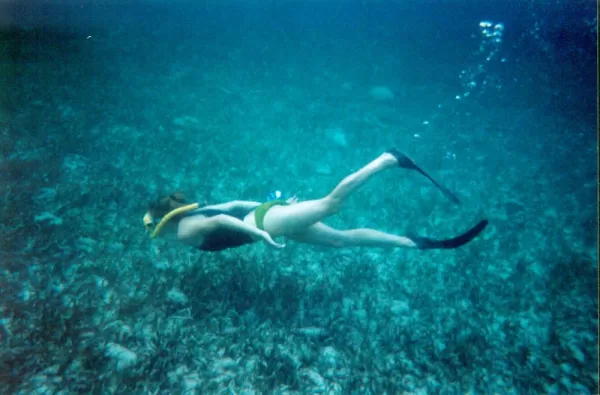
Snorkeling on a trip to Belize (Aaron Conway)
Food as Cultural Map
Belizean food is a direct record of the country's ethnic history. The Kriol staple, rice and beans cooked in coconut milk with stewed chicken and plantain, draws on both African and Caribbean culinary traditions. Mestizo cooking brings tamales, escabeche (a pickled onion and chicken soup), and relleno negro, a complex black-sauce dish with Yucatan roots. Garifuna cooking centers on hudut, fish simmered in coconut milk and served with mashed plantain, a dish whose technique and ingredients reflect both West African and indigenous Caribbean influence. In the Toledo markets, Maya cacao products made from heritage varieties are as close to pre-Columbian food as you will find anywhere.
Street food in Belize City tells the same story more casually: fry jacks for breakfast, garnaches (fried tortillas with beans and cheese) as a snack, salbutes (puffed tortillas with chicken and pickled onion) in the afternoon. The food is not elaborate, but it is specific to this place, and eating it is a reasonable way to start understanding where you are.
Music and Dance
Punta is the sound most associated with Belize internationally. Developed by the Garifuna from West African rhythmic traditions, it is built on layered hand drumming, call-and-response vocals, and a hip-driven dance style that requires real skill to execute. Punta rock, which electrified those rhythms in the 1970s and 1980s, spread across the Caribbean coast of Central America and produced artists like Andy Palacio, the Dangriga-born musician who became punta's most internationally recognized voice before his death in 2008. His work was also a serious effort at Garifuna language preservation, embedding traditional vocabulary and oral history into contemporary music.
Brukdown, the Kriol musical form, has older and less glamorous roots: it developed among mahogany logging camps in the 19th century, built from banjo, guitar, and improvised percussion made from conch shells and timber offcuts. The call-and-response structure it shares with New Orleans jazz and Caribbean string band traditions is not coincidental; all of them developed from the same movement of people and musical ideas across the Atlantic world. Mariachi and cumbia fill the north and west, and Mennonite hymn singing occasionally surfaces in the western communities for anyone who finds themselves there on a Sunday.
Garifuna performers (Marissa Jensen)
Practical Notes for Visitors
A few things make a big difference. Learning a basic Kriol greeting, 'Weh di go on?' or simply 'All right?', signals an awareness that you are in a specific place rather than a generic tropical destination, and it is received accordingly. In Maya communities in the Toledo District, ask before photographing people or ceremonies; many villages have explicit community policies, and respecting them is both courteous and practically important for the community-based tourism economy that supports local livelihoods.
Garifuna drumming and dance encountered in a community setting is not background entertainment. It is a living cultural practice with deep historical roots, and engaging with it as such is the difference between a transactional experience and a meaningful one. Finally, Belize runs on what Belizeans themselves call Belize time: schedules are approximate, rushing is considered slightly rude, and the country rewards visitors who adjust their pace accordingly.
The Country Behind the Coral
Belize's natural attractions are real. The Mesoamerican Barrier Reef, the Cockscomb Basin Wildlife Sanctuary, the cave systems of the interior, the Maya ruins rising out of the jungle canopy: all of it is as compelling as advertised. But the country that contains these things is more interesting than a list of sights suggests. It is a place with a long and layered history, a population that has built something cohesive out of genuine complexity, and traditions that are living rather than preserved. The reef will be there. The people, and what they carry with them, are the part worth paying attention to.
Our team is waiting and ready to talk with you about your next adventure.
So go ahead and book an appointment with one of our specialized trip planners.
Jess was great! She seemed to be one step ahead of me, anticipating my next question. Her experience and thoughtfulness are unmatched.
David Herr
2 months ago
I am booking a trip to Belize. We are staying at more upscale resorts and my standard AAA travel team was not able to access and book. Adventure Life has been responsive, fair in price and extremely helpful in booking a trip at the preferred resorts, provided excellent knowledge and experience for Belize and put together all our transportation so we can relax and enjoy!
Kris Mathison
4 months ago
Kassi Magruder -
Sandi Costa
6 months ago
The trip booking process was smooth and easy due to the trip planners' courteous, quick assistance. I made inquiries at pretty much the 11th hour for a particular trip date, and the planners were able to respond promptly with a customized itinerary that alleviated a concern I had about a particular day trip. Thank you, Adventure-Life trip planners for your help!
Annelise Judd
8 months ago
They have good first hand experience with the locations and excursions. All the guides they have arranged for us are super knowledgeable, personable, and great. The group excursions they arrange for us are almost always a very small group, often just us.