USA Today Logo New York Times Logo Outside Magazine Logo Conde Nast Traveler Logo National Geographic Traveler
Create your Trip Journal [click here]

Peru Part Deux!

By : Andrea Edwards & Lee Riggins
Trip Begins September 21, 2012
Trip Ends October 3, 2012

A journey back to an incredible country...this time featuring condors, flamingos, and pink dolphins!
See my photos : Peru Part Deux!

Want to go? Arequipa & Colca Canyon, Lake Titicaca with Homestay, MV Aqua: Luxury Amazon

I went to: Peru, Lima, Arequipa, Colca Canyon, Puno, Lake Titicaca, Amantani Island, Iquitos, Cusco, Uros Islands, South America, Amazon
[enlarge map]
[reduce map]
September 21, 2012
Top

We arrive!

Lima, Peru

Lee here. I'll journal the first part of the trip and Andrea will take over at the Amazon. The trip really started last January when I received a call on a weekday morning from my friend Andrea in Little Rock. Sitting in my office in Seattle, I held my breath, anticipating her news. The prior May, Andrea and I took an Adventure Life trip together to Peru, and we had recently submitted our journal to AL's annual travel journal contest. That trip to Peru had been magical, and the thought of returning so soon by winning a contest seemed too good to be true. But true it turned out to be, as Andrea shrieked WE WON!!!! loud enough for even my co-workers sitting nearby to hear. Peru, here we come again!

We arrive in Lima from Miami at approximately 9 p.m. Blessedly we sail through customs, our bags arrive on time and intact, and our hotel is directly across the street from the airport. We go to bed as soon as we check in, because a) we are beat; and b) we have to be back at the airport by 7:20 am for our flight to Arequipa!

September 22, 2012
Top

Arequipa, the White City

Arequipa, Peru

Our LAN flight from Lima to Arequipa takes just over an hour. Arequipa is around 600 miles south of Lima. Its heritage is Spanish, and it is nicknamed the White City because the prevalent building material is sillar, a white volcanic stone, and also apparently because the Spanish people were considered to be so 'white' compared to the indigenous people. We are met at the airport by our guide, Liliana, and a driver. The plan is that they will take us to our hotel and then leave us to explore the city for the rest of the day. Along the way Liliana tells us a bit about the city and the things we will likely want to do while here. At the hotel she circles several landmarks on a map, all within walking distance. After checking in we strike out immediately to get some lunch. Liliana had recommended a restaurant called Zigzag, which is also touted in our guidebooks, but we strangely cannot find it so continue walking. (The facades of stores and buildings in Peru are often non-descript, with little signage, and you sometimes have to peer into doorways and windows in order to ascertain what is happening inside). We come upon Chi Cha's, a restaurant owned by Gaston Acurio, who also owns the first restaurant we ate at on our last trip, Astrid y Gaston in Lima. Our meal there was fantastic, so we see this as a good sign and stop for lunch. We order two traditional dishes recommended to us by Liliana: Rocoto Relleno, a pepper filled with spicy beef and pork and cheese; and shrimp soup, or cauche camaron. We share both dishes and they are delicious.

After lunch we walk to the Museo Santuarios Andinos, where Juanita, the Ice Maiden of Ampato, is kept. Juanita was an Inca maiden, approximately 13 years old, who made the trek from Cusco to the top of the Ampato volcano (20,600 feet) with priests over 500 years ago to be sacrificed to the gods. Her body, mummified in a glacier, was discovered in 1995 by anthropologist Johan Reinhard. She was studied extensively when she was brought down from the volcano, as her body was so well-preserved that her stomach still contained the contents of her last meal! Today she is kept in a clear case in the museum, still frozen for all to see. When the neighboring volcano, Sabancaya, erupted centuries ago, the volcanic ash caused melting at the top of Ampato which exposed Juanita, causing her body to fall a short ways. The fall seriously bruised her face and eyes, giving her a particularly haunting look. While her story is fascinating and the museum well worth visiting, Andrea and I both now wish we had stopped short of viewing her actual body. It somehow seems disrespectful to view her like that. What an incomprehensible (to us) life she led: She was chosen as a young child for sacrifice due to her physical perfection. She was taken from her family to live with the other chosen children in Cusco. It was a tremendous honor to her family that she would be offered up to the gods. She knew her mission in life from a very early age, and yet willingly made the incredible trek to her death. Yet another reason I'm grateful to be a child of the 20th century!

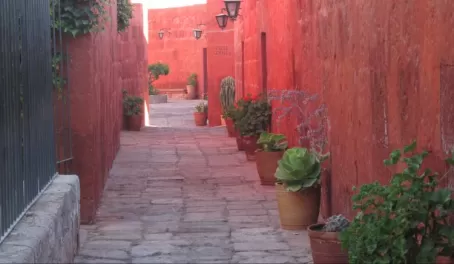
After our visit to see Juanita, we visit the Plaza de Armas, or city square. We walk around the square a bit with the many locals out enjoying this beautiful day. We stop to take pictures of an active 17th century Jesuit church, La Compania, and then walk to the nearby cloisters where there are several shops selling alpaca woolen goods. We continue our walk to the Monasterio de Santa Catalina. It is a convent founded in 1579 which is its own stand-alone village where more than 200 nuns once lived and approximately 30 still do. It's a labyrinth of chapels, private quarters, kitchens and art galleries. We opt not to take the guided tour but instead wander through it at our own pace. I find it peaceful, serene and incredibly beautiful. The walls of the structures are painted bright blue and burnt orange, and there are pots of flowers everywhere. Because the nuns originally came from Spain, Santa Catalina looks very much like a Spanish village. And the brilliant blue, sunny sky lends itself to some gorgeous photographs.

It's about 5:30 by the time we finish at the Monastery, and we are exhausted. We walk back to the hotel, freshen up, and decide to find Zigzag for dinner. This time we do, and have a meal of Peruvian beef (MUCH better than Argentinean beef, according to our waiter!). It's served with different dipping sauces and quinoa on the side. After dinner we walk back to the hotel and turn in early. It's been a busy day!

September 23, 2012
Top

Patapampa and the Colca Valley

Colca Canyon, Peru

Today we drive from Arequipa to the Colca Valley with Liliana and a driver. We leave Arequipa and on the way out of town stop for Gatorade and coca leaves, as we will reach an altitude of over 16,000 feet today and will need all the help we can get!

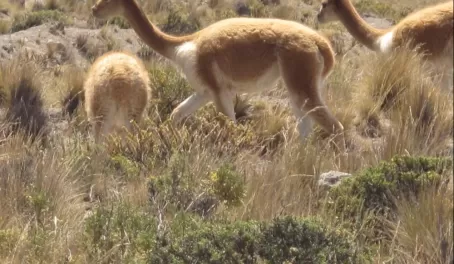
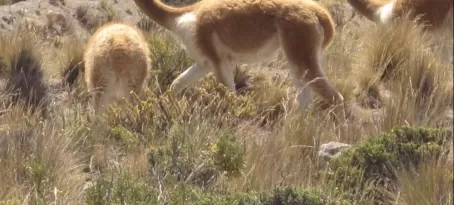
We drive through a national park that is a refuge for vicunyas, established to help ensure that the vicunya population continues to thrive. We stop and eagerly take lots of pictures of the vicunyas and alpacas, not realizing that before the day is over we will have seen tons of them! We also see lots of cactus, which surprises me a little, as I thought they preferred hot climates. There is one cactus that looks like a small ottoman and Liliana tells us it's called a mother-in-law's seat! It is quite cold and windy. We stop to look at birds, including Andean geese and beautiful Puna Teals, ducks with bright blue beaks.

We arrive at Patapampa, which literally means 'high flat place'. This is the spot that is over 16,000 feet. From here we have views of the mountains Chachani, Misti and Pichu Pichu. There are literally thousands of apachetas here--rocks stacked by travelers to give thanks. Of course, we each make one, too. When in Rome!

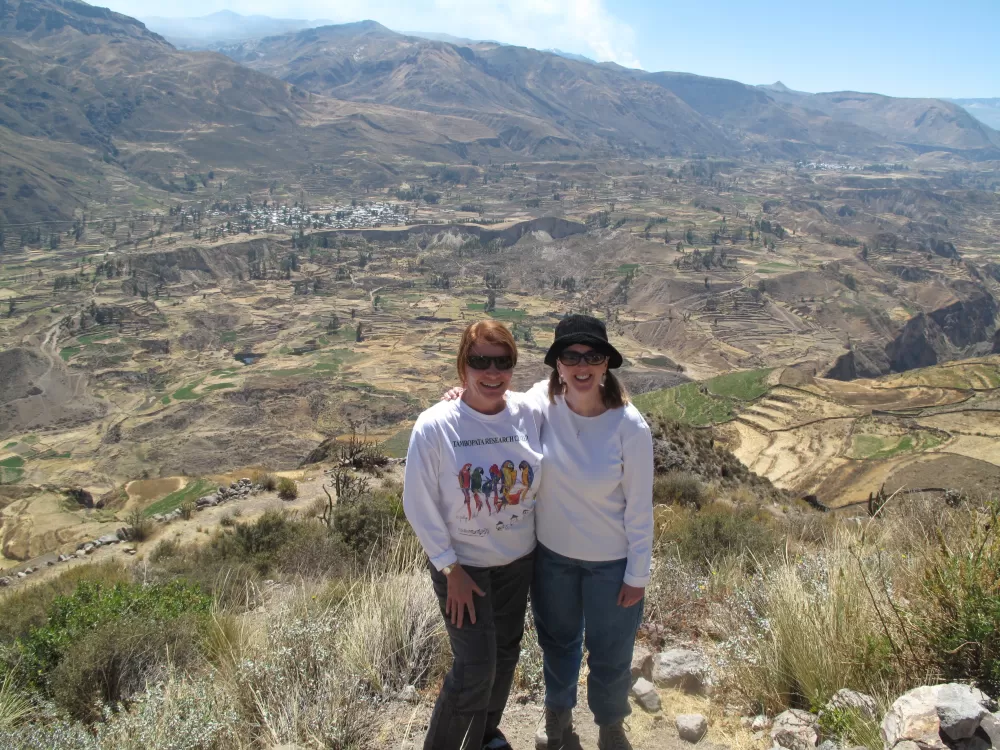
We stop in the town of Chivay for lunch. I have alpaca spaghetti, and Andrea has an alpaca burger, so we are continuing our Peruvian food theme! After lunch we start descending into the Colca Valley. (although it's hard to call anything sitting at 14,000 feet a 'valley'). The scenery is beautiful, alternately flat and prairie-like and mountainous and green. There are many terraces throughout the valley, and Liliana explains that they are from pre-Incan times. The people in this part of the country were captured by the Incas. So, while I was giving the Incas credit last year for coming up with the brilliant idea of farming in the mountains using terraces, apparently they got the idea from their captives!

As we approach the Colca Lodge, where we will spend the next two nights, the road gets rough and winding. Eventually we are able to look down on the Lodge, and it is gorgeous. When we arrive we check in and quickly change into our bathing suits. We go soak in one of the four pools outside the lodge that are fed from the hot springs. The water is warm and heavenly, and as luck would have it, the Lodge has a bar at the pools that makes divine pisco sours! Siting in a hot mineral bath, looking at breath-taking scenery, with a pisco sour in hand-- Priceless! There are a few others at the pools, mostly Italians, and it's just a great way to mingle!

The Lodge is isolated from any town, so we have no choice but to eat at the Lodge restaurant. The good news is that the food is wonderful and so is the atmosphere. We have aji de galina and wine for dinner, followed by dessert. Then, stuffed, we return to our room and read for a while. We have an early start tomorrow.

September 24, 2012
Top

Condors, Condors, and More Condors!

Colca Canyon, Peru

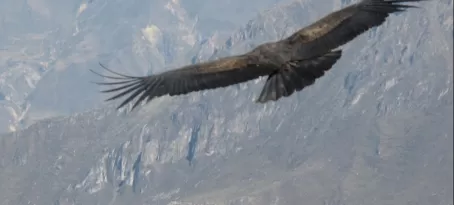
Although technically only 30 miles away, it takes about an hour and a half to get to Cruz del Condor (Condor Cross), where we will hopefully see the Andean Condors this morning. So, it's up early for a bite of breakfast before heading out. The drive is on a crazy, winding dirt road, and before we know it everything is covered in a film of dust. We are wearing our warmest clothes for the trip this morning – hats, gloves and scarves. We make a few brief stops along the way, but save most of them for the return trip. We are anxious to see the condors! At Condor Cross there are already a number of buses and vans when we arrive. The Condors are the reason most people come to this part of Peru. Liliana guides us to a particular spot she prefers, and we wait. We need only wait a few minutes, seconds really, when we spot our first condor, gliding in the canyon below us. Even though he is far away he seems huge for a bird. After our initial sighting, at a distance, of one condor several times, we have a short 5-minute intermission and then it seems that condors are everywhere, flying above and around us. Some come very close to us and Liliana surmises that these must be young condors who do not yet know how to control their flight patterns very well! We don't even need the binoculars most of the time, although with them we can see the detail of the wings and feathers. It is spectacular! Then, another 5-minute intermission followed by more condors! We know we saw at least 8 different condors, each several times. The show is over by about 9, so we walk around a bit before leaving. Just as we are about to board the van for the return trip, a last lone condor circles above us, higher and higher for a long time, bidding us goodbye! What magnificent birds, what beautiful soaring and gliding, and what a privilege to see them!

On the way back to the Colca Canyon, we stop for a photo op with two older women and their llamas. The women are wearing two different kinds of hats. Liliana explains that the shape of each hat distinguishes the tribe the women are from. Up until the time of the Spanish conquistadors in the mid-1500s, the indigenous people would make their babies wear certain types of hats to mold their soft heads into the shape of their favorite mountain, the one their tribe worshipped. Thus one could distinguish people from the various tribes by the shape of their heads. Apparently the Spanish were horrified by this practice and ordered it to stop. So, today the hats distinguish the tribes, and depending on whether the brim is up or down you can tell if a woman is single or married.

When we return to the Lodge, we order a mixed grill lunch to be served outside by the pools, at the bar. After lunch we take a short walk along the riverbank until we reach another independently owned hot spring pool. We pay the man 3 soles each to cross his suspension bridge. Andrea was a bit disappointed he didn't ask her three questions first! But it's fun -- just rickety enough to be an adventure and another good photo op. Then we go back to the pools at the Lodge for a soak and another pisco sour, followed by a massage at the Lodge spa. Heaven! After the massages we are so relaxed and sleepy that we decide to call it a day, even though it's still early. We return to the room to read and journal and fall asleep by 8.

September 25, 2012
Top

Flamingos, Manco Capac, and Santiago!

Puno, Peru

Today is a travel day. We will take our van with Liliana to Puno, about 6 hours away. We pack up, grab breakfast and leave by 8. By then we are the last guests at the Lodge. Apparently most tourists only stay 1 night, just enough time to go to Condor Cross. Then they make the long drive to Puno afterward. Adventure Life arranged for us to have 2 nights at the Lodge instead, and we were really glad they did. While we didn't do a lot yesterday after seeing the condors, it was nice to have time to relax.

Our goal is to see flamingos today! Liliana is wearing a pink top and says she will stand in the water on one leg if we don't see any real flamingos! Andrea says she is fairly certain that we will see 50-60 flamingos, and Liliana says to expect more like 5 or 6. We come to a marsh where there are a lot of them, more than 30! We have to cross a field where alpacas graze in order to get close enough to take pictures. The flamingos are beautiful, especially when they open their wings. The color is a bright salmon pink. We determine with Liliana that we are seeing both Andean and Chilean flamingos. She tells us that there is another spot up the road where we might see some more, a bit closer. Unfortunately, it's on a bridge where we're not supposed to stop. We do anyway, and Liliana even lets us cross the road to get a better look. There must be another 20 flamingos here! We can't stay long--the trucks passing us honk their horns and we need to move along--but Andrea was right. We saw 50 or 60 flamingos!

When booking this trip, we arranged for Santiago, our guide from Machu Picchu in 2011, to guide us at Lake Titicaca. We thought that we would meet up with Santiago in Puno, but instead he contacts Liliana to pick him up in Juliaca, the largest town in the area, about 45 minutes from Puno. When we arrive at the town square in Juliaca – a very busy, noisy, crowded city -- Liliana tells us to keep a look out for Santiago. I spot him and wave, and he waves back. While I wait with the driver, who has rounded the corner to find a place to pull over, Andrea and Liliana go get Santiago and bring him to the van. It's so good to see him and his smile says that he's happy to see us too!

We arrive in Puno, which is much bigger than I expected it to be (population of about 100,000, I think). We hug Liliana goodbye at the hotel and then check in. It's about 2 and we are hungry, so after freshening up we walk to a nearby restaurant for pizza and to catch up. After lunch, we change some money for the next couple of days, and then Santiago suggests we go the market for some food for the family we will be staying with tomorrow on Amantani Island. He feels we should plan to cook dinner for them, and maybe even breakfast as well. This enables us to do something nice for them, fills the time, and ensures that the food is prepared to our standards of cleanliness. Sounds like a good plan! We decide that we will make spaghetti for dinner and cereal and hot chocolate for breakfast. We take a moto taxi to the market, an open-air affair with fresh foods and packaged foods for sale at various kiosks. We buy spaghetti, tomato paste, onions, garlic, a box of cookies and some fruit. Then we go to the supermarket for everything else we need: canned milk, packaged cheese, water, chocolate, etc. We also purchase bags of rice and beans and pasta for the family to use after we leave. The supermarket is exactly like going to Walmart in the States! We are loaded down with bags and return to the hotel to stow them until tomorrow.

In the evening we take a cab to see the statue of Manco Capac (the Inca chieftain believed to be a direct descendant of the sun and who rose from Lake Titicaca to found the Incan empire), and then to a city park with a huge statue of a really skinny puma. After a light dinner we return to the hotel and get ready for our trip to the islands tomorrow!

September 26, 2012
Top

Papi Shows us Amantani Island

Lake Titicaca

Today we will take a boat on Lake Titicaca and travel to the island of Amantani, where we will spend the night with a local family. As I'm showering in the hotel before leaving, I give myself a little pep talk: even if it's miserable, it will be an adventure and something to remember for the rest of my life!Really, I am excited but naturally a little nervous. After breakfast we meet in the lobby: Andrea and I, Santiago, and Santiago's friend Marco, who is also a guide. Marco's tourists are sick and won't be making the trip, and Marco has decided to go anyway because he has never experienced a homestay. Marco is with us for the entire time, and he is very nice, although he doesn't speak a word of English so we communicate with him only through Santiago. We will be taking a boat on Lake Titicaca first to the floating Uros Islands, and then on to Amantani. There will be approximately 15-20 of us going, so after we're picked up in a large passenger van at the hotel we stop and pick up the remaining passengers. We are the only Americans; the others are from the UK, Belgium and various other countries.

The van takes us to the dock where we will catch our boat. We have the opportunity to purchase last-minute family gifts and snacks before boarding. Andrea and I each buy a large, ugly rain poncho for the trip, because unfortunately it's already raining and looks like it could continue for a while.

We pile into the boat and travel about an hour to our first stop, the Uros Floating Islands. Lake Titicaca is one of the largest lakes in the world, and the largest above 6560 feet. It is also the highest navigable body of water in the world. In other words, it is one impressive lake! There are many reeds in the shallow water when we first set out. We will later learn that these are totora reeds, used to make the floating islands and just about everything else the indigenous people use and need.

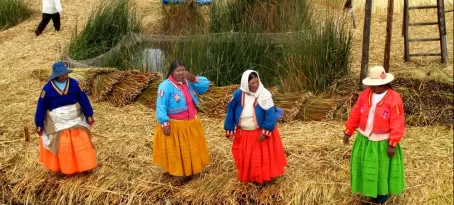
We are greeted at our first floating island by the local people dressed up in bright colors and big hats. They look genuinely delighted to see us. In the short time we spend here it becomes obvious that these people are truly happy. We gather in a circle under a canopy and listen as Angel, our guide for this trip, describes the islands and the people who live here. With the help of the local people, he describes how they cut the thick earth that the totora reeds grow from and tie these blocks of earth together to form these artificial islands. They were originally created by the indigenous people to escape their conquerors. Today there are only 5 or 6 families (albeit large ones) that live on the island we visited.

Walking about the island is strange. It is covered with thick layers of reeds and feels kind of spongy. The huts, also made from totora reeds, are built up on platforms of, what else, totora reeds! We are invited by one of the women to enter her house. Although small, it's quite pretty. I sit on the bed, and she shows me that it is made of totora reeds covered with several thick blankets. She asks if we would like to dress up? Why, yes! She hands me a bright yellow skirt, a vest, pom poms to wear around my neck (I think these are traditionally worn by single girls) and a crazy hat. Of course Andrea and the young couple with us do the same. It is crazy fun!

We then look over the local handicrafts for sale, mostly mobiles and replica boats made of reeds. We then climb to the top of the lookout tower on the Island for the view. Because it's still sprinkling, I wear my stupid green poncho and nearly kill myself getting up and down the steps. We take a boat, made of totora reeds, naturally, to another floating island a short ways away (there are approximately 40 of these islands on the Lake). It's a row boat and looks a bit like a replica Viking ship. Once underway, Santiago insists that we take the oars. So, Andrea gets on one side, and I get on the other, and we attempt to move the boat with the help of the real oarsmen. We don't do very well, but it makes for yet another fun photo op!

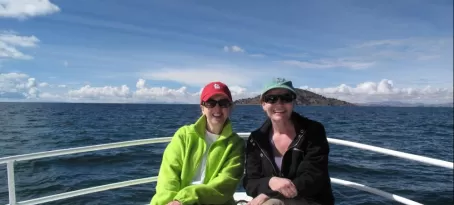
The second floating island is much like the first, only this one has --swear to God-- a Seventh Day Adventist Church! We get souvenir stamps in our passports. After a brief visit we load back into our boat and head to Amantani, approximately three hours away. The weather clears up en route so we are able to spend some time outside, both on top of the boat and on the deck. We see the mountains of Bolivia, Taquile Island (which we will visit tomorrow), and off in the distance, Amantani Island.

When we arrive at Amantani we are greeted by women and men from the families that will host us. The women are dressed in traditional black skirts and white blouses decorated with flowers. The women have long braids and the men wear hats. They are friendly but also a little shy. Angel puts us in groups of 4 or 5 and assigns us to a family. Andrea, me, Santiago, Marco, and Augustin, a tourist from Lima, will stay with the same family. We are introduced to Alejandro, the family patriarch, a man I guess to be in his 60s, and he leads us to his home. My first impression of this place is that it is more modern (I use the term loosely!) than I expected. After all, the only thing I really have to compare it to is the home we visited last year in Ollantaytambo that had dozens of guinea pigs roaming around and human skulls decorating the mantle! As Alejandro leads us up the path to his home, we pass the bathroom, which is a separate small building. It has an actual porcelain toilet and sink, although we will have to pour buckets of water into the toilet to flush it. And it has no electricity. Still, it beats the outhouse I had envisioned! We turn a corner and the main part of the house is directly before us, and the bedrooms are in a separate courtyard to our right. This part of the house has two stories. There are 3 bedrooms on the second story where we will stay: Andrea and I in one; Santiago and Marco in another; and Augustin in the third. The rooms are surprisingly nice, with painted walls, curtains on the windows, colorful blankets on the beds, and posters decorating the walls. Heck, this feels like the Ritz! I assume that the family sleeps in rooms on the lower floor. The staircase up to the second-story bedroom is a bit treacherous, but all in all, just fine. And the view from our bedroom is absolutely breathtaking.

We go to the main part of the house for lunch. It is one room, approximately 20 x 8, with a table, fireplace, and kitchen. There we meet the family matriarch, Graciela, their daughter-in-law, and Isabella, their 16-month-old granddaughter. Richard, their son, is Isabella's father. Alejandro and Graciela have four children, and they have been married 40 years. Graciela is very shy. She smiles but does not sit with us at lunch, even though Santiago implores here to. I don't know what we would do without Santiago here to speak with them and for us. We are very lucky to have our own guide here. None of the others do, and their experiences don't seem to be as rich. And none of them would of course know where to begin to fix dinner for their families, and yet we will because Santiago has been here before.

We are served a lunch of quinoa soup, roasted potatoes, and a kind of cake made of baked cheese. Delicious, but very filling. After we eat, we have tea with mint pulled from their garden. Even at this altitude, and although a very cold climate, they are able to grow most of what they need. There is, in fact, a huge bush with passion fruit outside their front door. Who knew passion fruit would grow in a place like this?

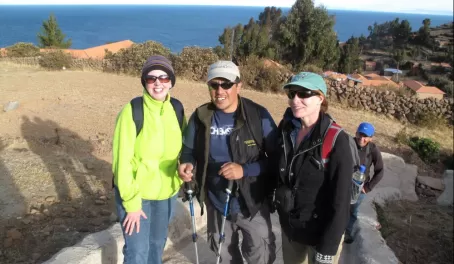
We are to meet Angel and the others at the local soccer field at 4 for a trek up Pachatata, or Father Earth, the second highest point on the island. Alejandro, or Papi as he is called, leads us there. It's a steady uphill climb, past sheep and cows and chickens and homes, and by the time we get to the soccer field my heart and lungs and legs already hurt--and we haven't even begun the actual climb! We have not been bothered a lot by altitude yet, but this climbing at over 13,000 feet is kicking our butts! Thankfully we have a few minutes to recover at the soccer field while Angel explains the significance of Pachamama and Pachatata. Pachamama is slightly higher but further away. There is a shrine at the top of each mountain and each January the local people gather there for a big festival. We will walk to this shrine on Pachatata.

I'm rarely concerned about my ability to make these kinds of treks, but I'm concerned about this one. Pachatata exceeds 14,000 feet. Andrea is concerned, too, but we decide that we will stop as often as necessary to catch our breath, even if it takes all night! Luckily the path is mostly paved, but it's a steady incline in very thin air. It's beautiful, however, and the views are fabulous. Lining the pathway are local people selling their handicrafts and chocolate bars. And, very oddly, nearly at the top there is a huge building under construction, apparently to be used to sell handicrafts to who??? Really, who the heck is going to climb up here to buy enough stuff to justify this big building all alone up here on a mountain? Santiago calls it a white elephant. We take a lot of pictures as we climb, both goofy and scenic, not only because everything is so photogenic but because it's also a good excuse to stop and catch our breath!

As we approach the shrine we pass through a series of arches. The shrine itself is actually an enclosed space made of stone, and entry is only possible during the festival. We all linger at the top, waiting for the sun to set. It's about 5:30 p.m., and it's cold and windy. Santiago had secretly bought 2 Diet Cokes in Puno and gave them to us earlier (Andrea has not been able to get Diet Coke in restaurants and doesn't like the readily available Coke Zero. It's jokingly become a kind of quest to find Diet Coke here). We share one can to celebrate, in lieu of champagne.

The walk down is much easier, and by the time we reach the soccer field again it's completely dark. Papi meets us there and leads us back home. We wash up and meet in the kitchen to fix dinner. As the family watches, we boil spaghetti over the fire. Meanwhile, Andrea and Santiago chop vegetables while I make the sauce over a kerosene stove: onions, tomatoes, mushrooms, tomato paste, water and lots of garlic powder. And, fresh oregano from the family garden. Marco and Andrea also prepare the bread with butter and garlic powder. Santiago and Marco take pictures throughout the process. It's a lot of activity for a small space! The family, this time including son Richard, sit by the fire and watch and play with baby Isabella. She is a beautiful little girl, shy but happy.

When the food is ready Andrea and I dish it up and all of us sit around the table: the five of us and the family of five. Graciela is clearly not comfortable sitting at the table with everyone, and she sits in the furthest corner quietly. But everyone seems to enjoy the meal. At one point I survey all of these wonderful strangers that we've been so lucky to meet and marvel that we have prepared them dinner on a far-away island in Peru. The world is a wonderful place and I feel so lucky to be able to travel and experience it.

After dinner Andrea, Santiago and I linger at the table, drinking tea, while the family does the dishes (we offered to do them but Santiago said it wasn't necessary, that the family would likely prefer to do them themselves. I think he just didn't want to do dishes!). Marco went to the featival that the locals put on for the tourists at the soccer field. We decided not to go because Santiago had described it as being kind of cheesy and mainly an excuse to drink beer. Andrea and I have absolutely nothing against cheesiness or beer, but it's frigid out and we don't particularly want to trek back up to the soccer field, so we enjoy the warmth of the kitchen instead. At about 8:30 we decide to go to bed. We are lucky that our room has electricity, but no heat. So we take additional blankets from the third bed in our room and add them to the stack already on our own beds. I sleep in sweats and a t-shirt under six thick blankets. It's quite cozy, but incredibly heavy. I can't even roll over! But despite it all we both get a decent night's sleep with only one trip down the rickety stairs with a flashlight in the middle of the night to use the bathroom.

September 27, 2012
Top

Amantani, Taquile, and a Surprise Wedding

Amantani Island, Peru

Andrea wakes me up at about 5:30 a.m. to see the sunrise out our window. It's gorgeous! We step outside to try to get a picture and we're surprised that it seems much warmer than last night, mainly, I think, because the wind isn't blowing. Everyone said the sunsets and sunrises here would be spectacular because of the thin air and they weren't wrong. We lay around until about 6:15 -- getting ready is going to take all of 5 minutes this morning! Although we'd brought cereal for breakfast, the family has made us pancakes that we eat with the hot chocolate Santiago makes. Isabella is especially sweet this morning, laughing and playing like babies all over the world. Although I'm not sure how much how mama appreciated us letting her have cookies for breakfast!

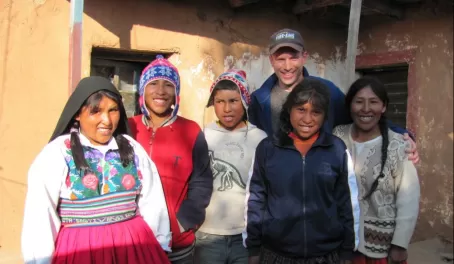
After we finish breakfast we pack up our belongings and say goodbye to the family. We take many pictures with them and they are happy to oblige, although I see no pictures of them anywhere. Andrea takes a beautiful picture of Papi with Isabella, and we arrange for Andrea to send prints of the family to Santiago, who will eventually bring them to the family.

At the market in Puno yesterday we had purchased a large bag of candy to give to the children and the locals. We forgot to bring it on our climb yesterday, so offer it to the family. All of them take a large handful. They seem delighted. The love of candy is universal! Graciela even comes over and hugs us, which is very touching. When we ask Santiago if we can give our family a tip, he tells us to give it to Graciela because the women take better care of the finances than the men!

Papi walks us back to the dock. Today we are traveling to Taquile Island before returning to Puno. Taquile is about an hour away from Amantani. The weather is beautiful, and everyone sits outside on the upper and aft decks. When we reach Taquile, we will walk approximately one hour to a village for lunch. This walk is easier today, not constantly uphill, and the scenery is gorgeous. We are hugging the coastline, and all around us are terraced gardens, farm animals and homes. The people on Taquile are apparently a little less isolated and shy than those on Amantani. They dress in a similar fashion, although their clothing does not feature the flowers of the traditional Amantani Island clothing. This walk is one of the most beautiful I've ever taken. When we arrive in the village, we have time to look in a store featuring some of the textiles that the people of Taquile are famous for: bags, scarves, hats, belts, etc.

We walk a short way further to have lunch at a local restaurant. We eat outside and while waiting to be served, Angel tells us a bit more about the history of this place. At one point, he pulls Andrea up and dresses her in traditional clothes and then has a waiter model the men's clothes. At Santiago's urging, he says a couple of things, wraps a scarf around Andrea and the waiter's hands, and then we're pretty sure Andrea got married to the waiter. Or at least that's what Santiago says. Of course Santiago says a lot of things! Lunch is trout and fried potatoes, preceded by quinoa soup, all quite good. We talk with a young couple from Belgium, who are traveling throughout Peru for an entire month. They tell us that their homestay was a bit of a disappointment because the family spoke little with them and did not eat with them, even though they speak Spanish. Santiago explains that this is not because they are unfriendly, but because they are shy and have been conditioned from early times to think of themselves as inferior to those who captured and later ruled them. This just underscores again the value of having had Santiago with us, enabling us to cook for the family and bridge the gap between their world and ours.

After lunch we have another 20-minute walk to the dock, mostly downhill on unevenly cobbled steps. It's a little treacherous but much easier on the heart and lungs. Our boat trip back to Puno is another 3 hours, some of which is spent outside until we decide we are getting too much sun. We sack out inside the boat, writing our journals and napping. By the time we return to Puno it's raining. The van that meets us at the dock in Puno delivers us back to our hotel. The shower in Puno feels so good after our 2-day trip to the islands.

After showering and changing clothes, we go to the lobby to check email and wait for Santiago and Marco. When Santiago comes down, he informs us that he will need to take the bus back to Cusco tonight, because the farmers are going on strike to protest a new tax and will shut down the roads around Cusco tomorrow.

We head out to dinner and share a pizza at a local restaurant. It's kind of sad-- we will be saying goodbye to Santiago and Marco after dinner--and we decide to share our high and low points of the past two days. Some cause us to laugh, and others make us cry, like when Santiago says that his low point will be saying goodbye to us. We all agree that it's been a wonderful time and we will stay in touch on Facebook and hopefully cross paths again someday.

Back at the hotel we bid adieu with more than a few tears. How lucky we are to have friends that it is this hard to say goodbye to.

September 28, 2012
Top

Pisco Sours and Beef Hearts

Lima, Peru

The ride to the airport in Juliaca takes about an hour. While we wait at the airport we journal and Andrea gets a little teary-eyed, thinking of the wonderful people and memories we are leaving behind. Just about the time she comments that she needs something to cheer her up, a local band starts playing happy traditional music right next to us in the airport, right on cue! Peru always delivers! The band is the perfect remedy for Andrea's blues.

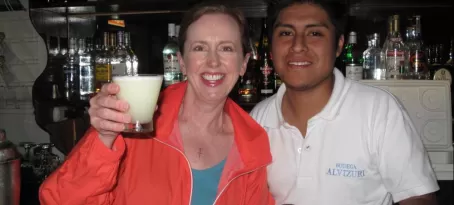
We have a couple of hours to relax before our culinary adventure in Lima. We had booked this excursion with Capital Culinaria a couple of months ago based on positive reviews we read on Trip Advisor. We're not sure exactly what we're getting ourselves into, and fear that it will be a bit cheesy. Oh well, anything is better than an evening at the airport hotel! A nice man in his mid-30s picks us up at the hotel. His name is Lucas, and as our reservation promised, he is wearing an apron. We get into the back of his BMW. He explains that because we are so far away from Miraflores, where the other tourists participating in tonight's adventure are staying, we have been upgraded to a private tour. Lucas explains that he is the owner. He and his wife, an American from Kansas City, opened the business 9 months ago to fill a niche: tourists traveling through Lima to get to Cusco or other destinations, needing something to do to fill their time in Lima. We end up having a wonderful evening. Lucas is charming and interesting and funny and we tell him that this outing feels a lot like simply going out with a good friend. He drives us first to the Barranco District, an old, original, artsy part of Lima that has been steadily growing in popularity. Here we stop at a bar overlooking the water and learn how to make pisco sours. After watching the first one made, Andrea takes over and makes the second one. Both hers and the professional's are delicious, and we drink them on the balcony even though it's not a pretty night -- it's foggy, cool and misty. From here Lucas drives us to one of the top restaurants in Peru, la Huaca Pucllana, which is situated adjacent to Inca ruins of the same name. Apparently the owner made a deal with the Peruvian government that he would maintain the ruins in exchange for putting his restaurant there. We have appetizers here, and another yummy drink with pisco in it. The appetizers include one with beef heart, which we both eat and which really isn't bad. I've never given much thought to what heart tastes like but I'm sure if I had, it would have been worse than this! Next stop: a dinner buffet featuring traditional Peruvian dancing. Lucas leaves us for a short while to walk his dog (apparently he lives close by). The food here is OK, about what you'd expect from a buffet, and the show is interesting although we personally think we could have stopped with the appetizers at the previous restaurant and called it a night! Still, this evening has been a pleasant surprise and well worth what we paid. By the time Lucas drops us off at the hotel it is after midnight. Luckily we have a late departure for Iquitos tomorrow (2:40 pm) so we can sleep in a bit. But the next time you're in Lima, we highly recommend Capital Culinara. Tell Lucas that Andrea and Lee sent you!

September 29, 2012
Top

Setting Sail on the Amazon!

Iquitos, Peru

Andrea here, signing in to detail the rest of the journey.

We fly from Lima to Iquitos, landing in the late afternoon. At the tiny Iquitos airport, we meet up with the rest of the group going on the Aqua cruise. I have to say, the folks from Aqua Expeditions more than lived up to the hospitality we've come to expect from Peruvians. After a couple of hours on a very nice bus with bottled water and yummy plantain chips, we made it to the boat. The MV Aqua will be our home for the next four days as we go through the Pacaya Samira National Preserve. And what a home it is! While it's small, only 24 passengers, it's packed with luxury and the most incredible staff you can imagine. And forget grubs and snails, for dinner we had a 20-course tasting menu. Okay, maybe not 20 courses, but a lot. Each more delicious than the last. The other passengers are great and we meet some new friends almost immediately.

As I'm drifting off to sleep that first night, all I can think is that I'm on the Amazon! The Amazon for gosh sakes!

September 30, 2012
Top

Snakes, Shooting Stars, and Champagne

Iquitos, Peru

The Aqua has three naturalist guides on staff and each day the passengers are broken up into smaller groups and set out for an adventure with one of the guides. This morning our little group of 8 went for a jungle walk with Julio. We board skiffs and head upriver. On the way, we pick up a local guide named Cletus who doesn't speak English but has a very kind smile. We pulled the boat over and walked up a little hill to head into the jungle. At the top of the hill, Julio asks for a volunteer so of course I immediately say 'me!' BAD IDEA. Little tip from me to you: if you're ever in the jungle and your guide says he needs a volunteer, do NOT step to the front. Julio proceeds to scratch a giant termite nest so that the little crawly things start swarming out. Then he places my hand flat on the nest so that they start swarming on my hand and up my arm and down my back. He says I must leave my hand there for 1 full minute. Let me tell you, there are a lot of termites in those nests and they move fast. But after a very long minute, followed by another couple of minutes so everyone could take pictures, Julio starts crushing the little buggers on my hand and tells us they release a chemical that acts as a natural insect repellent. Ugh. I have to confess, I could have happily lived my life not knowing that little fact. Of course the group is enjoying it a little too much and I get caught up in the laughter. What are a few creepy-crawlies among friends!

On our jungle walk we see an incredible amount of things. Cletus is amazing! This guy can find anything. We see a massively huge spider called a Goliath, several different poison dart frogs (incredible colors!), a little whip snake that I actually hold, several lizards, an armored millipede, some interesting medicinal plants, giant ants, birds, other spiders, and so much more. But the big news of the morning is the fer de lance snake we saw! A fer de lance is a viper and one of the top five most poisonous snakes in the world. Thankfully this one was a baby, was coiled up on a log in a deep sleep, and our guides wouldn't let us get within five feet of him. Thank goodness for the zoom on the camera. Very cool moment.

We also come across a gigantic strangler fig tree with huge buttress roots extending 10 and 20 feet in all directions. The perfect spot for a group photo! A few of us try out our luck swinging from a vine but I don't see any of use playing Tarzan on the big screen any time soon.

After a quick trip back to the Aqua for lunch, we headed back out to the Fucata River for a little piranha fishing. On the way we saw our first pink dolphin! And then another, and another, and another! Pictures don't do them justice. While some are a kind of pinkish-gray, others are Pepto-pink. What a treat to watch them swimming all around you.

So here's the thing about piranha fishing--you have to beat the water with your cane pole rather vigorously. A few wimpy taps just won't do. We're all beating the water furiously but nothing is happening. Finally I catch one. Victor, our guide this afternoon, is relieved. You can tell that he did not want a boat full of unhappy fisherpeople. Frankly, I wasn't that excited. The thing was tiny. Then I caught another one and Victor really got excited, saying 'this is the most ferocious piranha we have on this part of the Amazon!!' I swear, if that fish was more than 5 inches long, I'll eat my dad's lucky fishing hat. But once Victor opened the fish's mouth and showed us his teeth, I showed a little more respect to this 'most ferocious' fish. After that, the fish started coming around and everyone caught at least one. As we were fishing, a local guy walked down to the bank with a baby red-tailed boa constrictor. I still can't believe how much wildlife we're seeing so close.

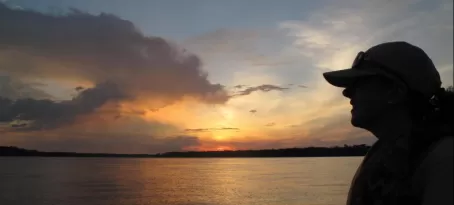
After fishing, the three little boats all meet and tie up together to watch the sunset. And then the guides surprise us by breaking out lovely glass champagne flutes and making mimosas for everyone. How many people can say they got to watch a glorious sunset on the Amazon while drinking champagne! This was definitely one of those 'I love my life!' moments for everyone!

The perfect end to the perfect day--on the way back in the dark, with a brilliant full moon shining, we saw a shooting star.

October 1, 2012
Top

A New Amiga

Iquitos, Peru

This morning we took the little boats to the Yurapa River and on the way saw some incredible birds--bright yellow kiskadees, kingfishers, hawks, a yellow-headed caracara, a woodpecker, herons, a beautiful purple bird called a plum-throated cotinga, and cardinals. Juan, our guide this morning, asked, 'what's the difference between South American cardinals and North American cardinals? Ours don't play baseball!' Of course that made me launch into a long dissertation on how great my St. Louis Cardinals are. I think everyone really enjoyed it. NOT. We pulled over to the bank and hiked up a small hill to see these adorable night monkeys high in a tree. Such sweet faces staring down at us. According to Juan, these are nocturnal monkeys and very rare to see in the daylight.

Back to the Aqua for breakfast and then out again to visit a little village called San Jose. The Aqua and its sister ship the Aria stop at different villages in the Pacaya Samira area. This way no one village gets dependent on the gifts from the tourists. Some of us had brought gifts from home while others purchased little gift bags of rice and school supplies from the boat. As we pulled to the shore, lots of smiling children ran down to greet us. Most of the men were away harvesting rice, but the head of the village was there to greet us and show us around. One of the elders in the village, Pedro, and his wife invited us into their house. The homes are raised on stilts to protect from river flooding, and very simple in design and construction. The sides are generally open and no one has much privacy, especialy since many extended famlies all live together.

At one of the houses, a little girl was holding a dusky titi monkey on a leash. I can't stand the thought of wildlife being kept as a pet and when I said something to Julio, he said he also thinks it's cruel to have the monkeys tied down. The little girl wasn't trying to be cruel, she was petting her monkey and you could tell she genuinely cared for her little pet, but there needs to be a lot more education to protect the wildlife here.

Bless her heart, Lee had to leave and go back to the boat. She's been battling stomach issues and the heat just got too much for her.

One of my favorite places in the village was the jail. It was basically a Mayberry-style jail where their local version of Otis would need to go to occasionally sleep one off.

Several people invited us into their homes to see how they store and cook food. Everyone was incredibly friendly and open to showing us their way of life. One of the little girls stuck close to my side throughout the visit and the highlight of my day was when she shyly put her hand in mine. I looked down and said the only Spanish word I could think of, Amiga? It made my day when she looked up and said, Amiga!

At the end of the tour of the village, we went to the nicest building, the schoolhouse. Most villages have at least an elementary school because all children in Peru are required to go through 6th grade. We sat in a semi-circle and the kids all sat in a semi-circle opposite us. Everyone introduced themselves and then we all sang songs to each other. If it sounds cheesy, I promise you, it wasn't. It was absolutely delightful! All in all, one of my favorite parts of the trip and something I'll never forget. After, the women of the village had spread out some of their handmade crafts. Most of us came back with armfuls of lovely things.

After lunch, we headed out to Lake Clivaro to go canoeing. Some of the locals had their wooden dugouts and if you wanted, you could get in and paddle around the lake. Of course I wanted! Lee is still back on the boat with her stomach issues so David, one of the guests from Australia, went with me. What a great guy! We had the most wonderful time paddling around this beautiful lake. Marina, the local woman with us, didn't speak English but she was so nice. It's interesting how you can always find a way to communicate if you try hard enough.

On the way back to the Aqua we saw a group of 20-30 pink dolphins, some were so brilliantly pink that they didn't look real. I never tire of seeing them. We stayed on the skiffs after the dolphins headed out and watched what was one of the most beautiful sunsets I’ve ever seen in my life. Bright yellows and oranges and golds and purples reflecting off the clouds and the water. Bliss. Absolute bliss.

Back on the Aqua, everyone dressed up for dinner. Dressing up on the Amazon means clean khakis and your hair not in a baseball cap. Before dinner, everyone gathered in the lounge and I attempted to make pisco sours for everyone. I'm pretty sure I made our bartender a nervous wreck, but he laughingly went along with it. Then Anna, the cruise director, brought in the entire crew so she could introduce them. All 24 passengers loved the opportunity to acknowledge and thank this amazing crew. Then Juan introduced the Aqua band and the fun really began. They did this beautiful song about the Andean condors that made me think back to a few days ago when we saw these incredible birds flying. After that, they picked up the beat. Edgar, our waiter, came over and grabbed my hand and we started dancing. So. Much. Fun! Then others got up and we had the best time. I have to say, Lisa, my canoe buddy David's wife, does a mean version of the Macarena! Our last dinner was delicious and Cisco, the chef, really outdid himself. I stayed up late talking with some of my new friends--Peter, Steven, Kim, Doris, Helen, David, and Lisa. Such a great group!

October 2, 2012
Top

The Amazon, Manatees, and Good-bye

Iquitos, Peru

One of my favorite things about the Aqua is the wall-to-wall, floor-to-ceiling windows that are in every room. Each morning you wake up not knowing what your view is going to be. After breakfast we boarded the skiffs and headed out to where the Ucayali and Maranon Rivers meet. This is the precise spot where the river changes names and the capital A, Amazon River officially begins. You could see a clear line in the water where the two rivers met. I swung my legs over the side and dipped my feet in the Amazon. And then Victor yelled at me to get fully back in the boat because he had no intention of diving in after me when I fell. I'm so glad Lee felt well enough this morning to come with us. To make a perfect morning somehow even more perfect, another big group of pink dolphins came to say goodbye.

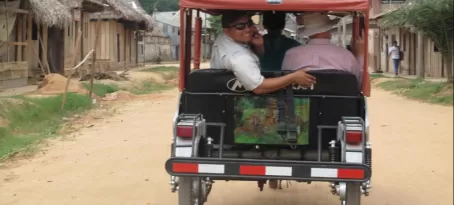
Saying goodbye to the dolphins was hard, but saying goodbye to the crew and friends we made on the Aqua was even harder. That's one thing I've discovered about Peru. The hellos are joyous but the goodbyes are painful. Disembarking, we got on these hilarious little moto-taxis (tut-tuts) and drove through Nauta. Although our driver didn't speak English, he quickly caught on to my hand signals that we wanted to pass the others and lead the procession. As we started passing everyone, Julio, my favorite guide, started shaking his head and laughing. He was trying to yell to our driver to slow down, but he was laughing too hard to be any kind of credible threat. At the edge of Nauta, we got back on the buses and headed back to Iquitos for our flights.

On the way, we stopped at a manatee rescue center. This non-profit group rescues manatees that villagers have captured. They rehabilitate them with the goal of returning them to the wild. What a lot of people don’t realize is that manatees drink their mother's milk until the age of 2, so when villagers capture a baby and try to feed it vegetables, the baby dies. The rescue center bottle feeds the manatees and gradually teaches them to feed themselves. In one of the tanks they had three manatees between the ages of 18- and 24-months and you could touch them. Their skin was smoother and harder than I would have imagined, and their faces are so sweet. In another tank were some older manatees, 3- and 4-year-olds, and the biologist gave us all some plants to feed them. It was hilarious to watch them crowd around to get the food. Then he gave me a bottle of milk and showed me how to support their chin with one hand while holding the bottle with the other. Let me tell you one thing, a manatee can drain a bottle of milk faster than you would think! Another incredible experience in this great country.

Another round of goodbyes at the airport. Big hugs from Juan and Julio, but Victor was nowhere to be seen. I think he was done with us! I will miss the wonderful team from the Aqua!

From Iquitos to Lima and then to Miami.

October 3, 2012
Top

Home

Lima, Peru

Landing in Miami this morning, I looked at my email and there was a message from Santiago. Just like last time, my sweet friend eased my transition home with a kind message.

Before we left for Peru this time, I told my friend and great travel buddy Lee that I was a little worried about the trip. Our trip to Peru last year had been one of the best travel experiences of my life and I was worried that there was no way this trip could live up to that one. Lee agreed and told me we needed to manage our expectations. And you know what? We didn't need to manage our expectations at all. In its own way, this trip was just as special, just as beautiful, just as much fun. I don't know what it is, but there's something about this country that tells me I'll be back again one day.

1-5 of 78 imagesMy Travel Photo Album


Share