How difficult is the hike?
The entire 4-day trail hike is 25 miles so the distances traveled each day are not terribly long. Although it is generally accepted that anyone who is accustomed to hiking and camping (i.e. walking for several hours and sleeping in tents) can hike the Inca Trail, the altitude can make hiking these distances feel about twice as difficult as hiking the same distance at sea level. For a detailed description of the hike itself, check out
Hiking the Inca Trail.
What are the guides like?
Our Adventure Life Tour Leaders are among the very best and most experienced guides anywhere. They are from the surrounding Cusco/ Sacred Valley area and speak fluent English, in addition to Spanish and the native language of Quechua. Most have 5-10 years of experience leading Inca trail hikes and all have training in the history, spirituality, culture, and ecology of the area. We receive rave reviews on our guides. Check out our Traveler Testimonials
here.
What is the food like on the Inca trail?
A cook accompanies every group on the Inca trail. Almost invariably, travelers comment on the delicious menu. Breakfast, lunch, dinner, and hearty snacks are provided for your hike. Meals are a mix of local specialties and international favorites. Vegetarian meals are also available upon request. Other special dietary requests can usually be accommodated as well with sufficient notice.
How is drinking water supplied?
Although there are places to purchase bottled water occasionally along the trail, we recommend that travelers bring their own refillable bottles to limit plastic waste. Water is boiled and then filtered with one of our portable filters. It is available in the morning to fill your bottles as well as at every meal.
Which campsites do you use?
Campsites are subject to change depending upon the crowds and the season. We generally try to camp in less trafficked areas so that travelers can enjoy the natural beauty of the Inca trail and minimize environmental impacts. Our typical campsite choices are Huayllabamba, Pacaymayo and Wiñay Wayna or Puyupatamarca. Our first choice is Puyupatamarca due to less crowds and nicer camp spots.
What equipment is supplied by Adventure Life?
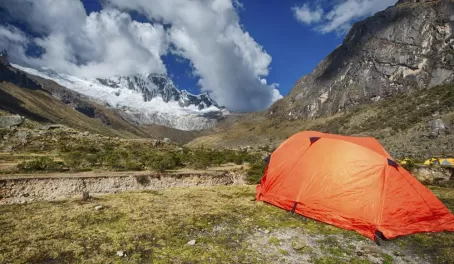
We supply the sleeping tents (Alps Mountaineering Taurus Outfitter 3 person tents for two travelers/ Alps Mountaineering Taurus Outfitter 2 person tents for single travelers), sleeping bags, Eureka dining tents, tables, chairs, toilet tents, cooking equipment, water purifiers, Therma-rest inflatable sleeping pads, and other camping equipment. Our outfitter purchases the highest quality equipment in Peru and older equipment is evaluated and replaced on a regular basis.
What do I need to bring for the hike?
Travelers only need to bring their own personal items and a daypack. A duffle bag will be provided for your belongings on the Inca trail so travelers do not need to bring a large backpack unless desired. Proper sun gear, layers of comfortable trekking clothes, trekking poles, mosquito repellent, hiking shoes, a flashlight, a camera, and 1-2 refillable water bottles are recommended. Rain gear is also recommended during the wet season (December-March) and cold weather gear (warm jacket, thermals, hat and gloves) is recommended for the dry season (especially June-August).
What do I need to carry?
We recommend that travelers carry the items that they will need each day while hiking such as water, snacks, camera and film. Porters will carry all of your other supplies including camping equipment, clothes, sleeping bags, etc. We generally ask travelers to bring only the belongings that they will need for the trail and leave any unneeded luggage at the hotel in Cusco or the Sacred Valley. To prevent porters from becoming overloaded, we ask all travelers to limit their personal belongings to 15 lbs for the hike.
How can I be sure that the porters are well-cared for?
Adventure Life insures proper staffing, have weight limits for individual porters, and support fair wages. Most of our porters come from villages in the Sacred Valley. Some of these include Cachiccatta, Socma, and Huilloc. We have a long and successful relationship with the people of these villages and frequently contribute to the needs of the community through direct donations, community service and
Adventure Life's micro-grant program. We also arrange
volunteer opportunities for some of our travelers to build homes, paint the school, and fix playground equipment.
What does Adventure Life do to minimize environmental impact?
We use biodegradable soap and detergents, and we transport all garbage back to Cusco. We also use environmentally-friendly chemical portable toilets that allow us to pack waste out. Our flashlights are even solar-powered to avoid battery usage. We highly recommend that travelers bring one or two large water bottles to use on the hike to limit plastic water bottle waste.
What if I have a medical emergency while hiking the trail?
Guides carry a first aid kit for basic medical problems (traveler's diarrhea, cuts/scrapes, etc.). They receive Red Cross First Aid and other emergency training every year. Our guides lead over 500 travelers along the Inca trail each year and we have rarely had a traveler unable to complete the hike. In these rare instances when someone has not felt well enough to finish the hike, he/ she has been escorted back to Cusco and generally felt well enough to re-join the group in Machu Picchu via train a few days later. Cusco has the nearest modern medical facilities so travelers with a serious medical emergency would need to be evacuated there. Guides and porters have pre-established evacuation strategies in place should this need occur.
How concerned should I be about the altitude on the hike?
Altitude affects each traveler differently and until you have visited an area with high altitude, it is impossible to predict how your body will react. For this reason, all of our hiking tours include at least 3 days at high altitude with mild activities before travelers begin hiking. This time allows your body to begin acclimatizing (though full acclimatization would take several months) and provides travelers a good indication of how they will feel on the Inca trail (as altitude symptoms are generally the worst on the first day or two at elevation). Commonly, our travelers report mild altitude symptoms such as fatigue, headache, or light-headedness during their first day or two at elevation. Hotels and our porters on the Inca trail have oxygen available for travelers feeling the effects of the elevation.
Severe altitude sickness is rare. In this case, the best treatment is to go down in elevation as soon as possible. We have never had a traveler that had to be evacuated to low altitude. Many severe cases of altitude sickness are the result of a pre-existing condition that is aggravated by the altitude. It is important to ask your doctor whether or not travel to high altitude is advised, especially if you have a pre-existing heart or lung condition such as high blood pressure, asthma, angina, etc. You might also want to ask your doctor about prescription Diamox, a diuretic that many travelers swear by to help them adjust to the altitude more readily. On the Inca trail, you will be hiking in altitudes ranging from ~ 9,000-14,500 ft. The highest camping spot is ~ 12,000 ft.