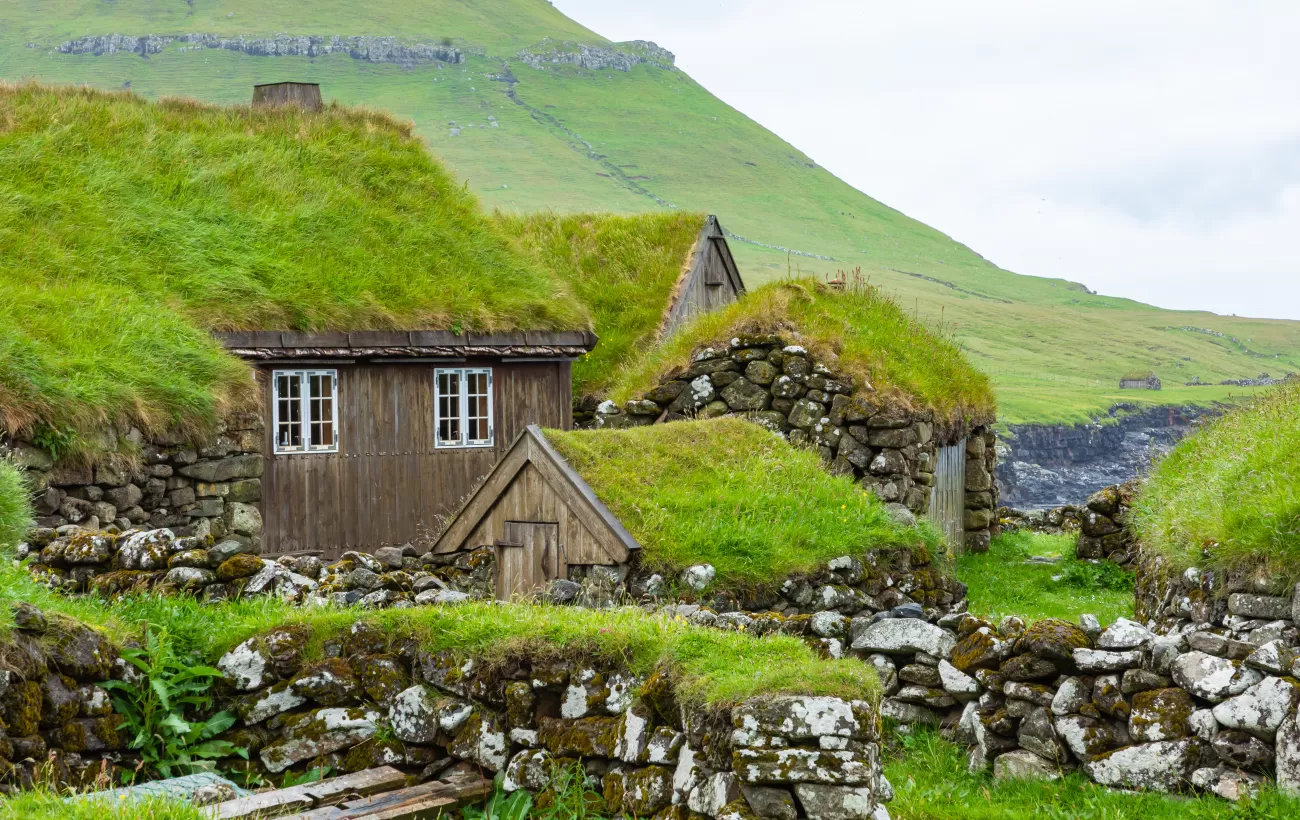
Suduroy Island, literally “South Island”, has one of the smallest populations in the Faroe Islands. It has sheer cliffs along its western face. The island is an important breeding ground for seabirds, including northern fulmars, black-legged kittiwakes, Atlantic puffins, and guillemots. You will be guided through the island, exploring its authentic villages with black, tarred-wood churches typical of the Faroe Islands, as well as its hiking trails lined with peat fields and stone sheepfolds. Sheep are indeed omnipresent throughout the Faroe Islands — in fact, there are more sheep than humans —, and they add to the charm of these wild landscapes.
Included Excursions:
Hiking in Hvannhagi
Duration : 3h00
A geological marvel testifying to the natural forces that have shaped the Faroese landscape over the millennia, the valley of Hvannhagi will reveal itself during this strenuous but breathtaking hike.
Located on the eastern coast of Suðuroy, the charming village of Tvøroyri marks the beginning of your hike. Leaving behind the small colorful houses, you will join a narrow path, climbing steeply along the hills. Soon, the mountain will open up and you will reach “the door”, a point that reaches an altitude of 300 meters (almost 1,000 feet), offering an incredible panorama over the neighboring cliffs and the islands of Lítla Dímun, Stóra Dímun and Skúvoy.
After this first step, it will be time to reach the valley of Hvannhagi, taking the Shepherd’s Steps, constructed by Nepalese artisans in summer 2023. After a fairly steep descent, you will finally reach this preserved site, peopled with sheep and birds. Surrounded by sculptural mountains and facing a peaceful lake, this raw nature forged by millennia of tectonic and volcanic activity is a veritable paradise for those who love large open spaces and geology, as well as for photographs.
This hike of 8 to 9 kilometers (between 5 and 5.6 miles) is demanding, especially the descent and the climb back up at Hvannhagi. It is not suitable for people who are not used to walking in the mountains or suffering from vertigo. A shorter option involves stopping at the Shepherd’s Steps (around 1 hour of walking). Wear suitable shoes, several layers of clothing and a waterproof coat. Remember to bring water from the ship. Observation of wildlife cannot be guaranteed: remember your binoculars.
Suduroy, Unspoiled Nature
Duration : 3h30
Welcome to Suduroy, the southernmost Faroe Island. Nature has pride of place here, while authenticity is the watchword. Between fjords, tall mountains and sheer cliffs, its untamed landscapes will not leave you indifferent.
During your tour around the island in a car, you will marvel at the diversity and breathtaking beauty of Suduroy’s scenery. With scarcely 5,000 inhabitants scattered over around 165 km² (68 square miles), nature prevails over the picturesque villages, with some of the most magical natural sites in the Faroe Islands. The fjords, mountains, fields (and sheep) and forests will unfold as you explore the island.
You will stop at Cape Akraberg on the southern point of the island, to take photos. This narrow strip of land that juts out into the sea and finishes in a cliff capped with a lighthouse will impress you with its beauty and its wild side. Watch out for the wind! The breathtaking views over the Sandvík cliffs are magical.
The nearby small village of Sumba (barely 300 inhabitants), with its wooden houses clinging to the cliffs, offers very pretty views over the windswept ocean.
After a snack in the equally charming village of Porkeri, your adventure on the island of Suduroy will come to an end.
The level of difficulty of this excursion is medium. The ground is flat, with uneven surfaces and some stairs.
Faroese Geology
Duration : 2h00
The Faroe Islands were created by a series of eruptions some 50 millions years ago or so. The island of Suduroy consists of the lower and middle basalt layers, while the other islands mostly consist of the middle and top layers. The columnar basalt are most visible in Frodba.
Discover these extraordinary basalt columns up close only a short drive from the port of Tvoroyri. Just below these basalt columns, by the bay in Frodba, walk the short distance to ‘Kúlugjógv’, where you can see even more spectacular basalt rock formations.This striking geological feature is nestled amidst the pristine Faroese landscape, showcases the immense power of natural forces that have sculpted the terrain over time. These basalt formations are a quite specific geological find.
This excursion involves walking on small hill, grass surface and several steps. The team recommend you wear comfortable walking shoes and layered clothing. Bring a wind-proof and water-proof jacket and water from the ship.
Hiking in the Mountains
Duration : 3h30
The Faroe Islands archipelago is a territory with unique geography, a paradise for those who love big pristine spaces. Explore these incredible landscapes during a demanding hike, discovering basalt columns, alpine lakes and rocky outcrops sculpted by ancient glaciers.From Tórshavn, gigantic waterfalls and peaceful sheep punctuate the road that runs along the Kaldbak fjord and will take you to the departure point of your hike.
There, 280 meters (920 feet) above sea level, the impressive Streymoy basalt columns mark the beginning of your adventure. Before these geological rarities, take the path that leads to the summit where it will open up onto an incredible panorama. Make the most of a pause near mountain lakes to admire the rocky formations polished by the ice, the magnificent Vágar Island revealing itself on the horizon, before walking back down towards your coach and the road back to Tórshavn.
This demanding hike involves walking around 4 kilometers (2.5 miles) on uneven and steep ground. The team recommend you wear comfortable walking shoes, several layers of clothing, a windbreaker and a waterproof jacket. Bring water from the ship and do not forget your binoculars.
The Village of Saksun
Duration : 3h30
Explore Saksun, an iconic little village in the Faroe Islands. It will charm you with its surprising landscapes, which reflect past local life.
You will set off for the first stop on your adventure: the village of Kollafjørður, famous for its old wooden church with its turf roof. Then you will head north to discover the village of Saksun. As you come closer to your destination, majestic panoramas reveal themselves. Nestling at the end of the road, between the green meadows and the mountains, a singular village will appear. You are seeing Dúvugardar and its old farm, which has today become a national heritage museum which recounts the day-to-day lives of Faroese farmers in the 20th century. Admire the bay below the village, the centerpiece of a spectacular panorama. In the past, it sheltered a harbor but, since a storm made it shallow, it has only been accessible by small boats at high tide. On the road back, you will have splendid views over the island’s capital, Tórshavn.
This excursion involves some walking on flat paths and small hills. The team recommend you wear comfortable walking shoes, layered clothing, and a windproof/rainproof jacket. Also bring a bottle of water from the ship
The Vestmanna Cliffs
Duration : 2h00
Set off to discover the spectacular Vestmanna cliffs, natural splendours that plunge steeply into the depths of the ocean.
The small town of Vestmanna is the theatre of Dantean cliffs that are 600 meters (2,000 feet) high and home to marine caves and abundant wildlife.
You will board a local boat to discover this natural diamond in the rough. You will sail along the cliff to a narrow gorge, where the sheer rock walls rise towards the sky, then you will enter one of the caves. Here, the daylight will disappear to make way for the whisper of the flowing water that surrounds you… An experience during which time stands still, reminding you of the great power of the elements.
This excursion involves walking on primarily flat paths, including some steps. The team recommend you wear warm clothing, a waterproof jacket and a windbreaker, and bring binoculars.
A walk in the village of Vestmanna
Duration : 2h00
Set off to discover Vestmanna, an emblematic and authentic Faroe Islands village whose history, dating back to the time of the Vikings, is as rich as the surrounding nature.
A guide will welcome you in the village and take you to your first stop: the Viking ruins of Gálgarðurin, precious evidence of the island’s first settlers. You will then visit the village’s beautiful church, which dates from the end of the 19th century. Next, you will go to Krambúðin, a traditional shop dating back to 1906 where you will learn how Vestmanna changed from an agricultural community into a fishing village.
Another stop on your walk is the hydroelectric power plant, which today supplies most of the island’s regions. You will visit this unique site, a fine example of a community that has been able to innovate to ensure its future while respecting its exceptional natural environment.
You will finish your walk with a visit of the local rowing club which houses a superb selection of Faroese wooden boats, used in the past for fishing and now for taking part in this national sport.
This excursion involves walking 4 kilometers (2.5 miles) on flat ground and small hills. The team recommend you wear comfortable walking shoes, several layers of clothing, a windbreaker and a waterproof jacket, and bring water.
The Daer Isles distillery
Duration : 2h00
In the heart of the wild and windswept landscapes of the Faroe Islands, whisky enthusiasts have joined forces to open what could well be the world’s most isolated distillery. During a visit, followed by a tasting, discover the history of the Faer Isles Distillery and its singular beverages, which are closely linked to their environment.
It takes boldness to open a distillery in one of the most distant places in the world. Boldness and a good nose, because the geology of the Faroe Islands, as well as the wet, salty and windy climate of these lands, offer perhaps the ideal conditions to produce first-class spirits. During a visit in the company of the Faer Isles brewers, discover all their secrets and taste the very first whisky produced by this new wave of Faroese creatives.
This excursion involves walking approximately 2 kilometers (1.2 miles) on mostly flat ground to reach the distillery, with a small hill to climb. The team recommend you wear comfortable walking shoes and several layers of clothing.

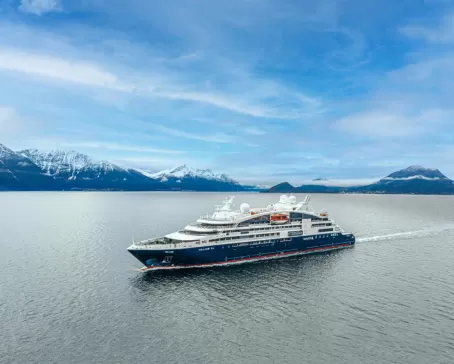
During your journey at sea, make the most of the many services and activities on board. Treat yourself to a moment of relaxation in the spa or stay in shape in the fitness center. Depending on the season, let yourself be tempted by the swimming pool or a spot of sunbathing. This journey without a port of call will also be an opportunity to enjoy the conferences or shows proposed on board, depending on the activities offered, or to do some shopping in the boutique or to meet the PONANT photographers in their dedicated space. As for lovers of the open sea, they will be able to visit the ship’s upper deck to admire the spectacle of the waves and perhaps be lucky enough to observe marine species. A truly enchanted interlude, combining comfort, rest and entertainment.

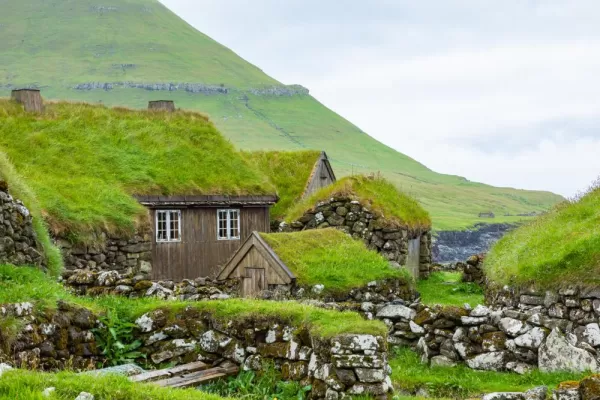
Streymoy Island is the largest and most populated of the Faroe Islands, with 22,500 inhabitants. Lying between Scotland and Iceland, the 18-island Danish archipelago boasts natural wonders that will fascinate lovers of the great outdoors. Here, the hilly green landscapes stand in contrast with the huge basalt cliffs and the invigorating air shifts with the moods of the ocean. To the north, the small village of Saksun, with its traditional grass-covered rooftops, has 14 inhabitants. In the curve of a magnificent natural amphitheatre, it overlooks a fjord with a lagoon: an idyllic setting in a secluded and peaceful environment. To the west, in Vestmanna, myriad birds nest in the crags along the eroded and vertiginous cliff faces.
Included Excursions:
Circumnavigation of Heimaey
Duration : 2h00
Begin the tour from the harbor that for a long time has been a shelter for the Icelandic fishing fleet, but was almost lost in the volcanic eruption on the island in 1973.
After some 15 minutes of walking, embark aboard a boat to discover the island from the sea.
Sail past the cliffs surrounding the harbour to start an interesting and informative journey passing bird colonies with millions of inhabitants and exploring caves that can only be visited by boat.
The bird life you get a chance to see on this tour is magnificent, as the Westman Islands have one of the largest varieties of sea bird species in Iceland. These include puffin colonies of an estimated 6 to 8 million puffins. Nowhere else in the world can such large number of puffins be found in such close proximity to man.
In addition, the islands also house one of the world’s largest gannet and guillemot colonies. Numerous other species of nesting sea birds can also be seen. In addition to the bird life, whales are also often sighted, including orcas, dolphins and porpoises. After viewing the island and bird cliffs from every angle, the boat tour (approximately 1 ½ hour) ends by sailing into Klettshellir (Cliff Cave). From there, return to the harbor.
For this easy excursion, we recommend you wear comfortable shoes, a wind and waterproof jacket and you take a warm pullover. Please be aware that this tour is weather depended and that circumnavigation may not be possible. Wildlife sightings are not guaranteed. Sight of puffins can go down after mid-August.
Heimaey, Pompeii of the North
Duration : 3h00
Leave from the perfectly formed natural harbour with its tall cliffs inhabited by multitudes of birds. Both the birds and their eggs have been an important source of food for the islanders. From there, drive from the pier into the Herjólfsdalur Valley where ruins of old farmhouses dating back to the settlement can be found.
The tour then continues along the scenic western part of the island, providing an opportunity to view the outer islands of the archipelago. The youngest island, 'Surtsey', was formed in a volcanic eruption in 1963; it is a UNESCO World Heritage Site.
Next, a photostop will be made at Stórhöfði, which offers magnificent views over the island; here puffins nest during spring and the early summer months.
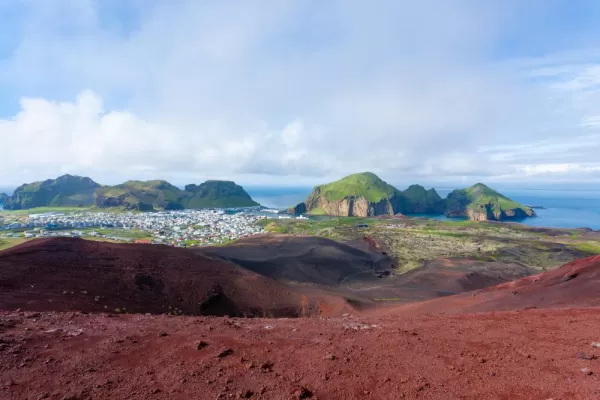
The tour continues to two volcanoes, the 5,000 years old Helgafell, 'Holy Mountain', and the considerably younger Eldfell, 'Fire Mountain', which erupted in 1973 making it necessary to immediately evacuate the islanders to the mainland. Stop here and walk to the viewpoint for a panoramic view, about 10 minutes.
As you continue onwards, drive over the new lava field making your way past the 'Skansinn' – a fort with a wooden church, which was donated to the people of the Westman Islands by the state of Norway to commemorate the millennium of Christianity in Iceland.
Then, visit the new Eldheimar – 'Pompeii of the North' Museum where the history and aftermath of the 1973 eruption is explored. After the visit to the museum, you will head back to your ship.
The team recommend you wear good and comfortable walking shoes and dress in layers. The walk up the viewpoint is very steep and can be slippery.