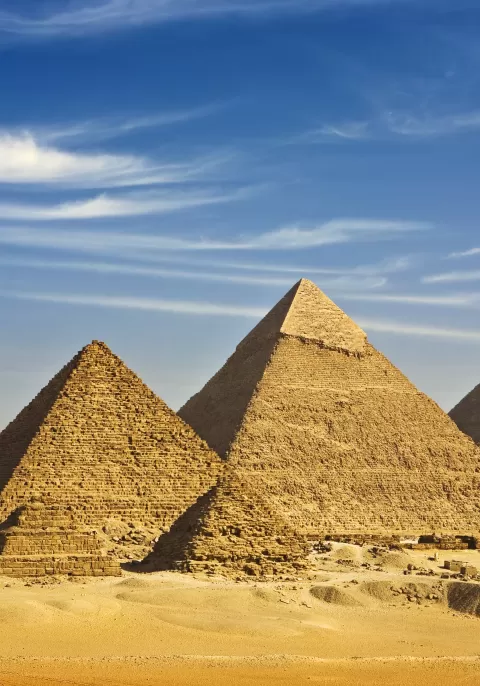
The Pyramids of Giza, a UNESCO World Heritage Site and one of the Seven Wonders of the Ancient World, stand as remarkable monuments to ancient Egyptian engineering and architectural mastery. Built over 4,000 years ago, these pyramids were constructed as tombs for pharaohs and are rooted in the belief that after death, the pharaohs would journey to the afterlife, taking with them their worldly possessions. Within this complex lie the tombs of Egypt’s ancient rulers: the Pyramid of Khufu, the Pyramid of Khafre, the Pyramid of Menkaure, and the Queen’s Pyramids.
Inside the Pyramids
Pyramid of Khufu (The Great Pyramid)
The Great Pyramid features three main chambers connected by steep passageways. The Grand Gallery, a long, high-ceilinged corridor, leads visitors to the "Queen’s Chamber," the King’s Chamber, and the Subterranean Chamber. This grand architectural achievement showcases the advanced engineering skills of ancient Egyptians. Notably, seven large boat pits are located here, believed to have been used to transport the pharaoh’s soul to the afterlife and celestial realms.
Pyramid of Khafre
Though simpler than the Great Pyramid, the Pyramid of Khafre features a single burial chamber constructed from massive granite blocks. This chamber is carved into the bedrock and topped with a gabled limestone roof. Inside, visitors can descend through passageways to witness the pharaoh’s ornately crafted sarcophagus, which is built into the floor—a unique sight to behold.
Pyramid of Menkaure
The smallest of the three main pyramids, Menkaure’s pyramid offers a more complex internal structure with chambers spread over three levels. Inside, decorative panels, six large niches, and a spacious burial chamber await visitors. The pyramid's core and temple foundations are crafted from limestone, with granite floors. Its smaller size compared to its counterparts may allow for a quieter and more intimate experience.
The Queen’s Pyramids
Surrounding the larger pyramids are the Queen’s Pyramids, smaller tombs built for the wives, mothers, and daughters of the pharaohs. Inside, long passageways lead to subterranean burial chambers that contain remnants of tomb artifacts and symbolic architectural features used for religious purposes.
Tips for Visiting the Pyramids of Giza
- Wear comfortable clothing and footwear – The passageways can be steep and narrow.
- Bring water – Ventilation inside the pyramids is limited, and it can get warm and stuffy.
- Consider health conditions – Claustrophobic individuals or those with certain health concerns may find the tight, narrow passageways uncomfortable.
- Time inside – A visit inside a pyramid typically takes about 30 minutes but may take longer during peak tourist seasons.
- Camera restrictions – Cameras are not allowed inside; they can be left with guards at the entrance for safekeeping.
- Avoid flowy dresses – Passageways are narrow, so wearing non-restrictive clothing will make moving around easier.
- No mummies inside – Mummies were moved to the Egyptian Museum in Cairo, which is worth visiting for a closer look at Egypt's preserved history.
- Do not climb the pyramids – Climbing is both illegal and dangerous.
Is It Worth the Visit?
Visiting the Pyramids of Giza is a unique experience, offering awe-inspiring views of one of the world’s most remarkable ancient civilizations. The towering architecture and the deep cultural history in every stone are nothing short of a marvel. Feeling inspired to visit the Pyramids in Egypt? Contact our experienced Trip Planners. They will help in crafting a personalized itinerary that lets you explore this iconic destination.