Polar bear. It's the image that sells Svalbard to the world, and it's not wrong — spotting the Arctic's apex predator crossing a frozen floe is as arresting as wildlife encounters get. But travelers who arrive expecting a single-species safari consistently leave surprised. Beyond iconic sightings and even the distinctive reindeer antlers seen across the tundra, Svalbard is not a showcase for one animal. It's one of the most ecologically dense environments in the High Arctic, and understanding how it works changes everything about how you plan and experience an expedition. Svalbard is not a showcase for one animal. It's one of the most ecologically dense environments in the High Arctic, and understanding how it works changes everything about how you plan and experience an expedition.
The wildlife you're not expecting
A Svalbard Reindeer looking behind. (Kelly Carlin)
The Svalbard reindeer is a good place to start recalibrating expectations. Thousands of years of island isolation have produced a distinct subspecies — short-legged, barrel-bodied, visibly unbothered by human presence. They wander tundra flats as if they own them, because in a meaningful sense, they do. Getting close requires no particular skill or patience.
The Arctic fox is equally at home in the open tundra and equally unconcerned by observers. In summer, its coat shifts from winter white to a grey-brown that blends into the rocky terrain — a small, quick presence that turns up near bird colonies and coastal shorelines, often scavenging below the great seabird cliffs. Catching one in its white winter coat, for travelers who come early in the season, is a genuinely striking encounter. And lucky guests might just spot a rare blue-coated Arctic fox!
Birdlife operates at a completely different scale. The sea cliffs host Brünnich's guillemots and little auks in colonies of hundreds of thousands — a wall of sound and motion that rewards wide-angle lenses as much as telephoto ones. At the edge of the pack ice, the ivory gull appears: entirely white, rarely seen, spending its whole life where ice meets open ocean. It's the kind of bird that serious birders travel specifically to find.
In the water and on the beaches, the density continues. Walruses haul out in tightly packed groups on pebble shores and drifting ice platforms. Blue whales and fin whales move through the nutrient-rich channels, drawn by the same cold upwellings that make this ecosystem so productive.
Where you look determines what you find
A roaring bear's view from afar (Jason Maynard)
Svalbard's wildlife isn't distributed evenly, and the distinction between its two primary environments matters when choosing when and how to travel.
The pack ice edge, reached by pushing north to where solid ice meets open ocean, is polar bear territory. This is hunting ground — a landscape of frozen floes, bearded seals, and the slow, deliberate movements of an animal built for this exact environment. Encounters here are spare, vast, and genuinely wild.
Acrtic Fox running in the white snow. (Jason Maynard)
Artic Walrus (Jason Maynard)
The inner fjords operate differently. Sheltered by massive tidewater glaciers, these are the nursery waters: coastal shorelines, lush tundra flats, nesting seabirds, and walrus haul-outs. The Arctic fox appears here too, working the shoreline margins with quiet, opportunistic efficiency. The atmosphere shifts from frontier to something quieter and more intimate.
Most well-routed expeditions spend time in both.
The season shapes everything
The summer window is short, and the conditions change quickly. In May and June, consolidated sea ice means polar bears are actively hunting seals from the floe edge — the optimal context for observing natural predator behavior. By July and August, the ice recedes, channels open, and ships can circumnavigate the entire archipelago.
The midnight sun complicates the usual logic of wildlife viewing. A blue whale can surface at 2 am under a sky as bright as midday. A guide spots it; guests are on deck in minutes. There's no waiting for dawn.
On distance rules and what they actually mean
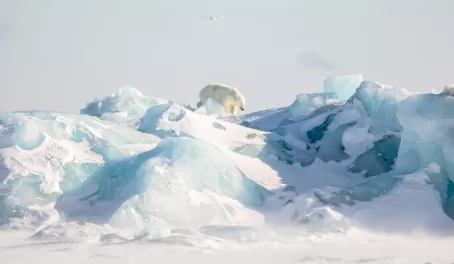
Polar bears in the Arctic (Jason Maynard)
Since 2023, regulations require ships and travelers to stay a minimum of 300 meters from polar bears, extending to 500 meters between March and June. It's one of the first things prospective travelers ask about, usually with concern.
The concern tends to dissolve quickly once you're actually there. What the distance rules changed isn't access — it's framing. A polar bear photographed as a white speck moving through a landscape of blue ice and black mountain is a more truthful image than a tight crop of a stressed animal reacting to human proximity. The context is the story. Natural behavior — hunting, resting, nursing — only happens when animals aren't being disturbed, and that behavior is precisely what makes the encounter worth having.
The regulations didn't diminish Svalbard as a wildlife destination. They clarified what makes it one.
Our team is waiting and ready to talk with you about your next adventure.
So go ahead and book an appointment with one of our specialized trip planners.
Shannon was always quick to reply to my questions and her honest answers helped us identify the right trip for us. Off to a great start!
Lisa Jibson
3 weeks ago
Erin is absolutely THE BEST. She is so knowledgeable and easy to work with. She listens to what we want and taylors her information to suit our needs. She is prompt in replying to my e-mails.
Carla
1 month ago
great travel company. We called for a last minute trip to Svalbard. Kevin gave great advice and worked fast, and emailed promptly. He even got us some last minute discounts. Highly recommend!
We also traveled through Adventure Life on another Arctic cruise, and they supported us through some trying circumstances.
Karen G
1 month ago
It was a great experience arranging our Svalbard wildlife cruise (Around Spitzbergen - in the reals of polar bear and ice, on MV Plancius) with Adventure Life. They are very reliable with information and trustworthy with payment handling. We organised this trip one year ahead and we were kept up to date all the way. Our dedicated travel advisor, Chloe made our travel experience extra convenient and super easy. Very happy with Adventure Life's service and support. Would recommend them 100% to everybody.❤️
Aindrila Chakrabarti
2 months ago
Wonderful and very Memorable trip!
Both me and my wife enjoyed the incredible scenery, excursion and good company or people we met.
Some confusion on Svalbard arrangements but they were eventually resolved.
More than happy to recommend to others