Most people who come to Svalbard for the first time picture a classic expedition vessel: a few hundred passengers, a lecture hall, and a dining room that could seat a small restaurant. That style of polar travel has its merits — but it also has a ceiling. A micro-cruise removes that ceiling entirely. For travelers researching a Svalbard cruise or comparing different Svalbard tours, understanding the advantages of smaller vessels is an important first step.
With just 12 guests aboard, a Svalbard micro-cruise operates less like a ship and more like a private field station that moves. The result is a fundamentally different relationship with the Arctic — one built around proximity, flexibility, and the kind of access that larger vessels simply cannot offer.
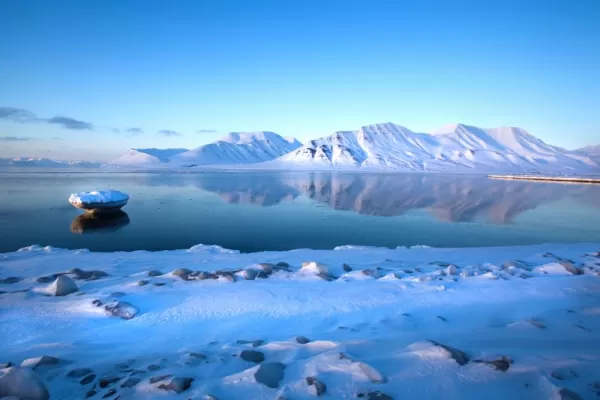
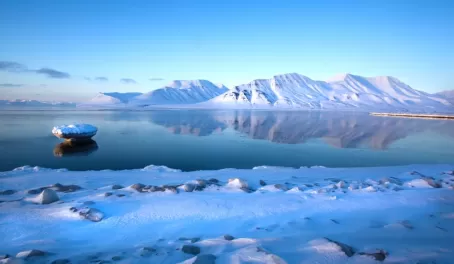
Black and white landscape of the Arctic. (Jason Maynard)
What makes a micro-cruise different
Enjoying the spring sunshine on a zodiac excursion in Svalbard (Maurizio Biancarelli)
Ship sailing through Arctic (Jason Maynard)
Standard polar expedition ships carry between 100 and 200 passengers. At that scale, logistics become a defining constraint. Arctic environmental regulations limit how many people can be ashore at any one site at once, so larger ships must manage rotating shore parties — meaning a significant portion of guests are always waiting rather than exploring.
On a micro-cruise, that constraint disappears. With 12 passengers, the entire group fits into two Zodiacs. Everyone goes ashore together, every time.
The vessels themselves reflect this philosophy. Most are converted research ships or purpose-built ice-strengthened yachts — compact, capable, and designed to go where bigger ships can't follow. They access shallower fjords, tighter anchorages, and more remote coastlines. The experience feels nothing like a floating hotel, and everything like an expedition.
What you'll actually notice on the water
The difference between a 200-person ship and a 12-person vessel isn't felt in the brochure. It's felt on Day 2, when a polar bear appears on a distant shoreline.
On a larger ship, mobilizing a shore party takes time — sometimes over an hour from sighting to landing. On a micro-cruise, you're in the water in under ten minutes. The captain can read the conditions, pivot the route, and chase the encounter. No scheduling committee. No waiting for your color or group to be called.
That spontaneity compounds across an entire voyage. When an ice pack blocks a planned fjord entry, the route changes. When a walrus colony turns up on an unexpected beach, the itinerary shifts. The ship follows the Arctic, not a pre-approved schedule.
For photographers, the difference is just as tangible. Twelve people on two Zodiacs means a clear sightline, room to position a tripod or sandbag, and silence when silence matters. No crowd noise, no competition for the rail.
And because there's no rotation system, time ashore is simply longer. Hours longer, across every landing.
Who this experience is for
Ship traveling in Arctic (Jason Maynard)
A Svalbard micro-cruise is not about adding comfort — it's about removing distance. Distance from the wildlife, from the landscape, from the quality of the experience itself.
If what you're after is a genuine Arctic expedition — one where the ship serves the journey rather than the other way around — this is the format that delivers it. Among the many Svalbard tours available today, a small-ship Svalbard cruise offers some of the closest and most flexible access to the Arctic environment.
Experience Svalbard on a Smaller Scale
A small-ship expedition offers a closer connection to Svalbard's wildlife, landscapes, and ever-changing conditions. Contact us to learn more about Arctic voyages and begin planning your journey.
Our team is waiting and ready to talk with you about your next adventure.
So go ahead and book an appointment with one of our specialized trip planners.
Shannon was always quick to reply to my questions and her honest answers helped us identify the right trip for us. Off to a great start!
Lisa Jibson
3 weeks ago
Erin is absolutely THE BEST. She is so knowledgeable and easy to work with. She listens to what we want and taylors her information to suit our needs. She is prompt in replying to my e-mails.
Carla
1 month ago
great travel company. We called for a last minute trip to Svalbard. Kevin gave great advice and worked fast, and emailed promptly. He even got us some last minute discounts. Highly recommend!
We also traveled through Adventure Life on another Arctic cruise, and they supported us through some trying circumstances.
Karen G
1 month ago
It was a great experience arranging our Svalbard wildlife cruise (Around Spitzbergen - in the reals of polar bear and ice, on MV Plancius) with Adventure Life. They are very reliable with information and trustworthy with payment handling. We organised this trip one year ahead and we were kept up to date all the way. Our dedicated travel advisor, Chloe made our travel experience extra convenient and super easy. Very happy with Adventure Life's service and support. Would recommend them 100% to everybody.❤️
Aindrila Chakrabarti
2 months ago
Wonderful and very Memorable trip!
Both me and my wife enjoyed the incredible scenery, excursion and good company or people we met.
Some confusion on Svalbard arrangements but they were eventually resolved.
More than happy to recommend to others