The west coast seaside town of Galway plays host to Douglas Mawson today when you anchor in its bay and tender ashore. Attracting a year-round flow of local visitors, Galway has the vibe of a traditional Irish resort town with plenty of pubs, restaurants and shops selling traditional products.
Today County Galway invites you to hear more about the resilience of the Irish. Those joining the locally guided walking tour will hear the stories of the city’s past, traced in the streets, buildings, and spaces that still bear witness to its transformation, before enjoying an afternoon at leisure in Galway, while those travelling inland to Ireland’s most authentically preserved Workhouse will encounter a more confronting reminder: the human cost of political power, and the stark realities faced by those with nowhere left to turn.
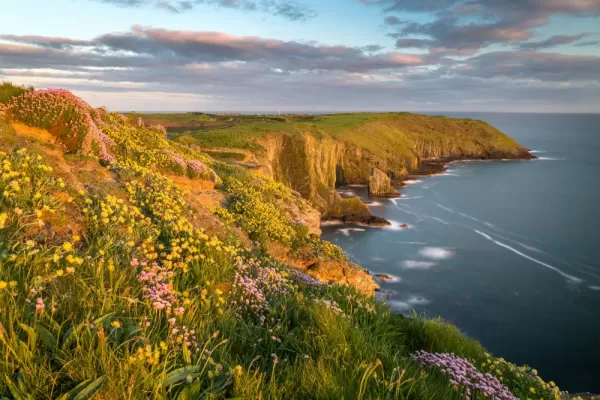
As you set sail in the early evening, prepare for a breathtaking finale — panoramic views of the legendary Cliffs of Moher, rising dramatically from the Atlantic Ocean. Towering over the West Clare coast, the Cliffs of Moher are best seen in the early morning, and from the sea. Visually spectacular, they sit astride the striking landscape of the Burren on one side and the Atlantic Ocean on the other. At a height of over 700 feet at O’Brien’s Tower, and following the coast for almost eight miles, these ancient cliffs were formed over 320 million years ago and today form part of the Burren and Cliffs of Moher UNESCO Global Geopark.
Personalize your exploration with the included ‘Your Choice’ experiences.
Option 1 - Morning experience: Getting to Know Galway
Trace Galway’s transformation from a fortified medieval outpost to a vibrant cultural center on this engaging 2-hour walk. You witness Eyre Square, once backed by the city’s defensive walls, where you uncover a town shaped as much by conflict as by trade. Shop Street and Lynch’s Castle who stand as a reminder of the powerful merchant families who governed Galway, and the stark justice they upheld, captured in the story of a mayor said to have executed his own son, while nearby, the hidden Hall of the Red Earl reveals a rougher early Galway, marked by rivalry and clan power. And of course, you can view the medieval wonders of St. Nicholas’ Church still in use today, where the past upheavals remain etched in stone. After your walk, choose to return to the ship, or linger in Galway where you may wish to experience another side of the city’s character, by trying a whisky tasting at one of the local bars or distilleries where centuries of craft and tradition are distilled into every glass, or simply follow the sound of music. In Galway, it often needs no stage or set time, step into the right pub, even in the afternoon, and you may find a ‘trad session’ already in full flow.
Option 2 – Morning experience: Voices from The Workhouse
An hour or so inland, in the countryside of County Galway, you encounter a stark testament to some of Ireland’s darkest years. From the 17th through to the 19th centuries, Ireland was repeatedly wracked by poverty, displacement, and famine. For those who could not afford passage to the so-called “New World,” there was often only one option left: to enter an institution known simply as the workhouse. Across Ireland, a network of 163 workhouses was established in the 19th century under the Poor Law system. At their height during the Great Famine of the 1840s, these institutions held over 100,000 inmates at any one time, and across their decades of operation, hundreds of thousands—indeed millions—of people passed through their gates in desperation.
As the name suggests, life inside was harsh. Inmates were required to work long hours in exchange for the barest provision of food and shelter, often in overcrowded and unsanitary conditions. The system was deliberately severe, designed to deter all but the most destitute, with one of the cruellest aspects of the workhouse being the systematic separation of families who frequently never saw one another again.
Today, you visit a museum housed within one of Ireland’s best-preserved workhouses, a place that allows you to step inside this history. Its rooms and corridors offer a powerful insight into the choices people faced, when entering the workhouse, harsh as it was, could mean the difference between life and death. The artefacts on display, simple possessions, fragments of daily life, are more than objects. In many cases, they are the only surviving traces of the individuals who lived and died here, a quiet reminder of the human stories behind a system built on survival at its most desperate.