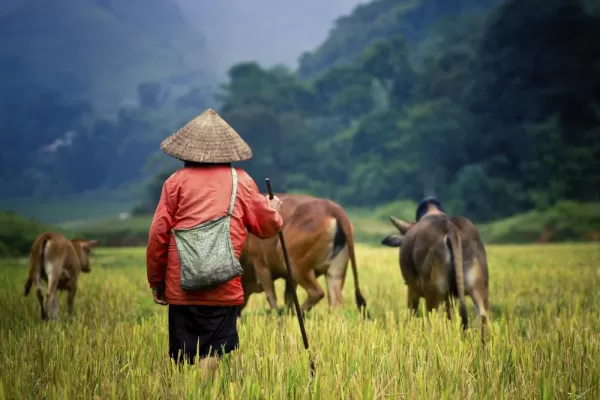
Traveling through Vietnam requires more planning and logistics than many first-time visitors expect. While the country may look narrow on a map, distances between key destinations can be significant, and infrastructure varies throughout the country. Understanding the differences between northern Vietnam and southern Vietnam can help travelers set realistic expectations for transportation, culture, cuisine, and travel pace.
Starting in the North: Hanoi, Sa Pa, and Ha Long Bay
Most journeys begin in Hanoi, the cultural and historical heart of the country. Travelers typically spend a few days here adjusting to the pace, exploring the Old Quarter, and enjoying Vietnam’s renowned street food scene.
From Hanoi, many head north to Sa Pa, known for its terraced rice fields and mountain landscapes. Getting there is part of the adventure.
Overnight train station that will be traveling from Hanoi to Lao Cai (Franny Friesz) Inside the overnight train from Hanoi to Lao Cai Vietnam (Franny Friesz) Inside the overnight train from Hanoi to Lao Cai Vietnam (Franny Friesz) Inside the overnight train from Hanoi to Lao Cai Vietnam (Franny Friesz)
Many travelers take an overnight train from Hanoi to Lao Cai for a unique and memorable experience, followed by a scenic one-hour drive through the mountains to reach Sa Pa. Those returning by road instead of train should plan for a transfer of approximately 5.5 hours.
This journey highlights how travel in Vietnam is often as much about the experience as the destination.
Another must-visit destination in the north is Ha Long Bay. Located about two to three hours east of Hanoi, it is famous for its limestone karsts and emerald waters.
Iconic limestone island scenery of the Ha Long Bay (Franny Friesz)
Getting there is straightforward, with most travelers taking comfortable limousine vans that offer extra legroom for the journey. Once you arrive, boats become the primary way to explore the bay, its hidden coves, and surrounding islands. Many travelers choose to spend one or two nights on a cruise, allowing more time to experience the scenery and enjoy the bay at a relaxed pace.
Inside interior of the limousine van service (Franny Friesz)
Heading South: Covering Greater Distances
As one moves further south, distances increase and travel times become more significant. Destinations like Hue and Ho Chi Minh City are much farther apart, making flying the most practical option. Driving between central and southern Vietnam can take an entire day or more. Domestic flights are widely available and save valuable time. Trains are also an option for travelers who prefer a scenic, slower-paced journey.
In southern Vietnam, waterways once again become an important mode of travel, especially in regions like the Mekong Delta, where boats are essential for exploring floating markets and rural communities.
A Culinary Journey from North to South
a cup of Vietnam's famous egg coffee (Franny Friesz)
One of the most rewarding aspects of traveling through Vietnam is how the food evolves as you move from region to region. Each area has its own flavors, specialties, and even variations of the same dish. In the north, the cuisine tends to be simpler and more subtle, with dishes like pho, Vietnam's iconic noodle soup made with a flavorful broth, rice noodles, herbs, and typically beef or chicken, reflecting the region's focus on balanced, delicate flavors. As you travel south, the cuisine becomes sweeter and more complex, often featuring a greater variety of fresh herbs, vegetables, and bold seasonings. Coffee culture also changes from region to region, with local specialties such as rich egg coffee in the north, creamy salt coffee in central Vietnam, and refreshing coconut coffee in the south, each offering a distinct taste of the country's diverse culinary traditions.
A bowl of Vietnamese Pho (Franny Friesz)
Embracing the Journey
Traveling through Vietnam is not just about moving from one destination to the next; it is about embracing the journey itself. Whether you are riding an overnight train into the mountains, cruising through Ha Long Bay, or flying south to maximize your time, each mode of transport adds a new layer to the experience.
With thoughtful planning and the right expectations, navigating Vietnam becomes part of the adventure. The variety of landscapes, cultures, and cuisines you encounter along the way makes every mile worth it.
Our team is waiting and ready to talk with you about your next adventure.
So go ahead and book an appointment with one of our specialized trip planners.
My trip planner was the best. Thank you Karilyn for all of your help with planning everthing.
Larnell Carr
4 months ago
This is our third trip with Adventure Life and they make the process so easy. I love the willingness to tailor make a trip for us based on our needs and desires. Thank you Kassandra, Jess and Juliane for always going the extra mile for us. We’ve tried other travel planning companies but always come back to Adventure Life!
Deborah Prosek
5 months ago
Adventure Life helped us plan a 23 day trip to Thailand, Cambodia and Vietnam. The trip was fabulous! Tour guides were knowledgeable, helpful and responsive to our needs. Transportation from point to point went smoothly in all cases. The sites visited were amazing. Adventure Life delivered in a huge way. Thank you Adventure Life!!!
Mary Westphal
5 months ago
You make it easy!
Planning a trip can be daunting and time consuming with all the logistics. I worked with Jeff and he listened to what I wanted and can back with great suggestions. I especially appreciate the ideas for going to less touristed places. Those can be hard to find if you’re on the other side of the world and often aren’t in guidebooks, so getting advice from people on-the ground is invaluable.
Thank you for making it come together quickly and painlessly.
Suzanne.
Suzanne M.
8 months ago
I have traveled with Adventure Life multiple times now. The staff is super friendly and very knowledgeable on the country you are interested in. It is white glove service from start to finish. We have had to use their emergency hotline a couple of times for a missed flight and potential weather problem. You always worry if someone is going to pick up, but not with Adventure Life. Someone answers the phone every time! If you have to have a problem, I know they are there to help. I highly recommend allowing Adventure Life to plan your next adventure. We are thinking about where they will take us next!