Excerpted from Belize and Northern Guatemala: The Ecotravellers' Wildlife Guide
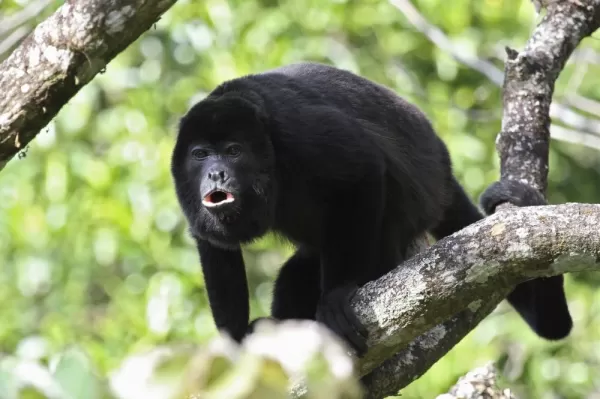
The Community Baboon Sanctuary, near Bermudian Landing, is located just 43 km (27 miles) from Belize City. This sanctuary is located along a 33 km (20 mile) length of the Belize River. The Community Baboon Sanctuary Belize has become one of the most visited wildlife sites in the country because of its focus on protecting Black Howler Monkeys and promoting community-based conservation.
The Community Baboon Sanctuary is a cooperative venture of private landowners (many of whom are subsistence farmers), conservationists and their organizations, and biological researchers. Their common aim is, by attracting and charging small fees to environmentally-aware visitors, to preserve extensive forest habitat for a large population of wild primates (the so-called "baboons," actually Black Howler Monkeys) and, coincidentally, for all the other wild animals and plants that inhabit the region.
Howler Monkey in the rainforest canopy
History and Establishment
Dr. Robert Horwich, a biologist from the USA, was instrumental in establishing the sanctuary. He arrived in the area in 1981 to study the howler monkeys, and quickly became aware of the shrinking populations of the species (which is limited to Belize, northern Guatemala, and Mexico's Yucatán region). The obvious cause: continued cutting and burning of the forest habitat in which the monkeys lived.
In 1984 Horwich and colleagues approached villagers in the area with the idea of forming a cooperative wildlife sanctuary in which all participants might benefit: the local landowners would agree to preserve their remaining forested lands for the benefit of wildlife and to practice farming methods consistent with habitat preservation in return for help with farming, soil erosion control, healthy water management, and participation in ecotourism.
Benefits for People and Wildlife
Thus, the local people benefit by learning better farming practices, by helping to preserve wildlife and natural habitats, and, for some, by providing paid services (guided tours, restaurants, bed-and-breakfast-style accommodations) to visitors. The animals benefit because their living space is preserved, and researchers and ecotourists benefit because the animals and habitats are available for study and viewing.
The Community Baboon Sanctuary Belize has also become a model for other conservation areas, showing how local communities can directly benefit from protecting wildlife.
Growth and Conservation Impact
Formally established in 1985 with only 11 landowners participating, the Community Baboon Sanctuary now includes lands owned by more than 100 families and involves about 8 villages along about 32 km (20 miles) of the Belize River. Each participating landowner agrees to follow a customized plan for using their lands. The main agreement is to leave enough bits of forest standing, particularly along waterways and between properties, for howler monkeys and other wildlife to survive and prosper.
Trees the animals feed in must be left standing and continuous bands of trees must be left intact so that the monkeys can travel in the trees from one place to another. The efforts are paying off: the sanctuary, which held perhaps 800 howler monkeys at its inception, now has an even larger population (more than 2000 individuals during the mid-1990s) – a population so healthy that monkeys are taken from this area for reintroduction to other parts of Belize – most notably, to the Cockscomb Basin Wildlife Sanctuary in southern Belize. Monkey in the trees (Kim Clark)
Future Plans
Sanctuary plans are eventually to extend its brand of habitat self-preservation to enough land to link the sanctuary with other reserves to the north (Crooked Tree Wildlife Sanctuary) and east. The Community Baboon Sanctuary Belize has four goals: conservation, education, research, and tourism.
Visitor Experience
Visitors to the sanctuary, including many local school classes and travelling school groups from other countries, as well as tour groups and independent ecotravellers, are given guided tours during which wildlife and vegetation are pointed out and local culture discussed. A small museum describes local ecological communities and shows off some of the animals and plants found in the sanctuary.
Researchers use the site to study the howler monkeys, as well as other species. Volunteers from around the world, living with local families, help to staff the sanctuary and assist the researchers.
The Community Baboon Sanctuary is not just a wildlife reserve—it is also a living example of ecotourism in action, combining conservation with cultural exchange.
Conclusion
All-in-all, it's a successful – and by now much imitated – example of how mutually-beneficial partnerships between local communities and conservationists, with the crucial ingredient of ecotourism thrown into the mix, can be established to preserve wildlife and habitats. The Community Baboon Sanctuary Belize continues to inspire similar projects across Central America and remains one of the top attractions for visitors interested in sustainable travel and wildlife encounters.
This is an excerpt from the author's Belize and Northern Guatemala: The Ecotravellers' Wildlife Guide, (Academic Press, 1998). Contact the author via email at ecotravel8@aol.com.
Our team is waiting and ready to talk with you about your next adventure.
So go ahead and book an appointment with one of our specialized trip planners.
I am booking a trip to Belize. We are staying at more upscale resorts and my standard AAA travel team was not able to access and book. Adventure Life has been responsive, fair in price and extremely helpful in booking a trip at the preferred resorts, provided excellent knowledge and experience for Belize and put together all our transportation so we can relax and enjoy!
Kris Mathison
2 months ago
Kassi Magruder -
Sandi Costa
4 months ago
The trip booking process was smooth and easy due to the trip planners' courteous, quick assistance. I made inquiries at pretty much the 11th hour for a particular trip date, and the planners were able to respond promptly with a customized itinerary that alleviated a concern I had about a particular day trip. Thank you, Adventure-Life trip planners for your help!
Annelise Judd
6 months ago
They have good first hand experience with the locations and excursions. All the guides they have arranged for us are super knowledgeable, personable, and great. The group excursions they arrange for us are almost always a very small group, often just us.
Keiko
1 year ago
It wasna great experience. The travel agent was very helpful and understanding. I would recommend them for all travels.