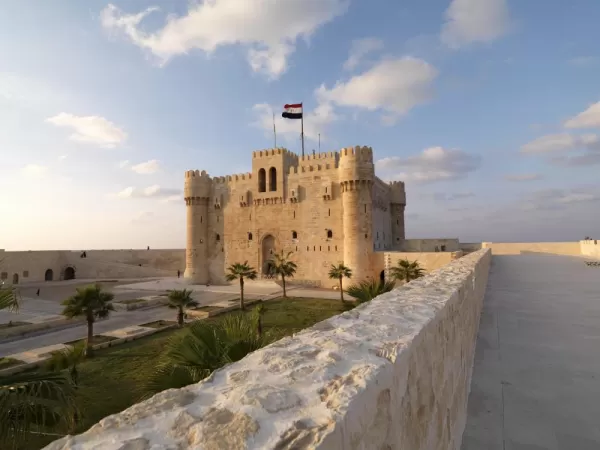
There is a wonderful Italo Calvino story about a city so removed from its own history that it is as if the modern metropolis sits on the site of an unrelated ancient city that just happens to bear the same name. At times Alexandria, which Alexander the Great founded in the 4th century BC, feels like that. Yet the fallen Alexandria of the ancient Greeks, of Ptolemy, Cleopatra, Julius Caesar, and the Romans, and of pagan cults and the Great Library is underfoot, quite literally, as all of modern Alexandria has been built on the ruins of the old, a city that was capital of Egypt from the 3rd century BC until AD 642, when the Arabs first arrived. Overlay a map of the contemporary city with one from antiquity, and you see that many of the streets have remained the same: Shar'a al-Horreya runs along the route of the ancient Canopic Way, and Shar'a Nabi Daniel follows the route of the ancient Street of the Soma. Near their intersection once stood the Mouseion, a Greek philosophic and scientific center that had at its heart the collection of the Great Library. Yet only fleeting glimpses of this ancient city peak through the modern crust. By the early 20th century, Alexandria was a wealthy trading port. The merchants were fantastically rich - cosmopolitan without being intellectual - and they enjoyed the sort of idle existence that is born of privilege, a privilege not of high birth but rather of colonial rule, which shielded foreigners from Egyptian law. They lived in villas with extravagant gardens, frequented luxurious shops, gossiped over tea in grand cafés, and lounged on the beach in private resorts along the coast. The population was a multicultural mix of Greeks and Arabs, Turks and Armenians, French and Levantines, Jews and Christians, and this spawned a unique atmosphere. It was this city that belonged to Constantine Cavafy, now regarded as the greatest Greek poet of his era. It was this city to which the novelist E.M. Forster, author of A Passage to India, was posted during World War I. And it was this city that gave birth to Lawrence Durrell's Alexandria Quartet, which captivated a generation of American readers when the books were published in the late 1950s. Then quite suddenly everything changed. The intellectuals and merchants fled, driven out of Egypt by the nationalist revolution of the 1950s, the wars with Israel, and the nationalization of their businesses. It's been five decades since most of the foreigners left - some Greeks and Armenians remained. But if you take the city as it is today and not as a faded version of what it once was, you can find that Alex (as it's affectionately known) remains an utterly charming place to visit. The Mediterranean laps at the seawall along the Corniche, and gentle sea breezes cool and refresh even in the dead of summer. Graceful old cafés continue to draw lovers and friends - Egyptians now, rather than foreigners - while the streets remain as lively and intriguing as ever. Alexandria is still a great city, even now, shorn of its many pasts.
3 Included Shore Excursions
Roman Alexandria- Activity Level - Extensive
- Please note: This tour requires an extensive amount of walking for approximately 1.2 kilometers (.75 miles) over sometimes unpaved surfaces, with approximately 130 steps to negotiate throughout. Please use caution inside the catacombs. A low ceiling in some places requires walking in a bent position; the ground may be slippery and uneven. Cameras and video cameras are not allowed inside the catacombs. This tour is not suitable for guests suffering of claustrophobia, guests with limited mobility, or those who utilise a wheelchair. Wear flat, walking shoes with non-slip soles and bring a cardigan with sleeves to wear in the catacombs, as it may be cool. The tour sequency may vary.
Alexandria Orientation- Activity Level - Minimal
- Please note: This tour involves a minimal amount of walking and is suitable for guests with limited mobility and those who utilise a wheelchair. The tour sequence may vary. Actual duration of tour may vary due to traffic congestion.
Alexandria Greco Museum & Citadel- Activity Level - Moderate
- Please note: This tour requires a moderate amount of walking for approximately 0.6 miles (about one kilometer), with a few steps to negotiate to get on/off the coach, 30 steps at the Citadel, and few steps at Alexandria Greeco Roman Museum. This tour is not suitable for guests with limited mobility and guests who utilize a wheelchair. Guests are advised to wear lightweight, comfortable clothing with flat, closed-toe walking shoes, and bring sun protection, a sweater or light jacket, bottled water, and US Dollars, Euros, British Pounds, local currency, or credit cards for purchases and tipping from the ship. Guests must be at least 18 years old to be served alcoholic beverages. Guests must carry them passports and ship's ID at all times. Cell phone camera photography is permitted at all venues. Infrastructure in Alexandria may be basic, and local conditions may be challenging; coaches, guides, hotels, restaurants, equipment, and services are the best-available in the area, but may not be up to the standards of those found on other ports. Flexibility and understanding are encouraged when visiting unique, less touristic destinations. The cost of providing a tour program in this area is proportionately more expensive than in neighboring regions, as vehicles and guides are brought in from the whole region. This may be reflected in the tour prices, and understanding is appreciated. The tour sequence may vary.