Costa Rica is a world-famous haven for birds, boasting more species than all of North America combined in a much smaller area. This incredible diversity is thanks to the country's varied landscapes, from rainforests to coasts, making it a crucial stop for migrating birds and home to many unique, colorful residents.
Jabiru Stork
Standing nearly 4 feet tall with a black featherless head, the Jabiru stork is an unmistakable bird. These birds are known for building nests up to 6 feet in diameter, though they are rare in Costa Rica, with fewer than 100 individuals estimated.
Scarlet Macaw
Nesting and living in colonies of 300 or more, the scarlet macaw is a highly social parrot. Conservation efforts have extended its range into the Caribbean and northern regions of Costa Rica.
Resplendent Quetzal
With iridescent green plumage and tail feathers growing up to 30 inches, the resplendent quetzal is a photogenic bird found mainly in Costa Rica's cloud forests.
Rufous Motmot
Found in the dense undergrowth of rainforests and along riverbanks, the Rufous Motmot is known for its distinctive racket-shaped tail and vibrant plumage.
Lesson’s Motmot
Once called the blue-crowned motmot for its electric blue ring on its crest, this bird prefers to sit still, making it a challenge to spot. However, they are frequent visitors to gardens for easy meals of fruit and insects.
Turquoise-browed Motmot
With its vibrant turquoise brow and racket-shaped tail feathers, this motmot is a favorite among bird enthusiasts. It's often seen perched quietly in open areas.
Keel-billed Toucan
Known for its brightly colored bill, the keel-billed toucan is a common sight across Costa Rica's jungles and inhabited areas.
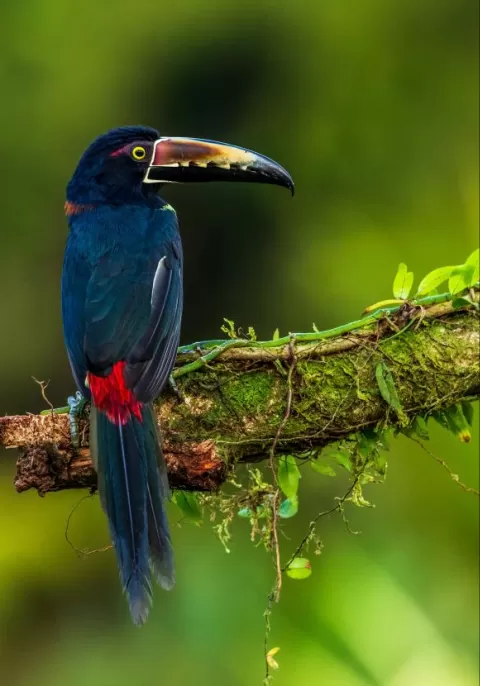
Collared Aracari
This small toucan species has a distinctive colorful bill and a black collar across its chest. It's social and often seen in small groups in forest canopies.
Black-crested Coquette
At just 3 inches, the black-crested coquette is one of the smallest hummingbirds in Costa Rica. Its vibrant plumage makes it a delightful sight for birdwatchers.
Fiery-throated Hummingbird
This hummingbird boasts a dazzling array of colors, with a fiery throat that glows in the sunlight. It's commonly found in the highland forests of Costa Rica.
Snowcap Hummingbird
The snowcap hummingbird is easily recognized by its brilliant white cap contrasting with its dark body. It's a rare species, typically found in the Caribbean lowlands.
Rufous-tailed Jacamar
Resembling a hummingbird, the rufous-tailed jacamar has a long bill and iridescent green plumage. It prefers forest edges and clearings for hunting insects.
Great Curassow
A large, ground-dwelling bird, the great curassow is known for its curly crest and striking black and white plumage. It's typically found in undisturbed forests.
Sunbittern
The sunbittern is a unique bird with no close relatives, displaying spectacular wing patterns with vibrant red, yellow, and black eyespots when threatened.
Green Honeycreeper
This small bird has bright green plumage and a slender, curved bill. It's often spotted in the forest canopy feeding on fruits and insects.
Red-legged Honeycreeper
With its vivid blue body and contrasting red legs, this honeycreeper is a striking sight. It frequents forest edges and gardens.
Blue-gray Tanager
The blue-gray tanager is a common and cheerful bird with soft blue and gray feathers. It's adaptable and often seen in urban areas.
Golden-browed Chlorophonia
This small bird is adorned with bright green and yellow plumage, making it a gem of the highland forests. It's known for its melodious songs.
Three-wattled Bellbird
Named for the three fleshy wattles hanging from its beak, this bird has a loud, bell-like call that resonates through the cloud forests.
Bare-necked Umbrellabird
This rare bird has a distinctive umbrella-like crest and a bare, red neck pouch. It's elusive and primarily found in the Caribbean slope's wet forests.
Long-tailed Manakin
Known for its elaborate courtship dances, the long-tailed manakin has striking black and red plumage with elongated tail feathers.
Kingfishers
Keep an eye on riverbanks and mangroves, especially in the Pacific and Caribbean coastal regions, for a chance to spot various kingfisher species.