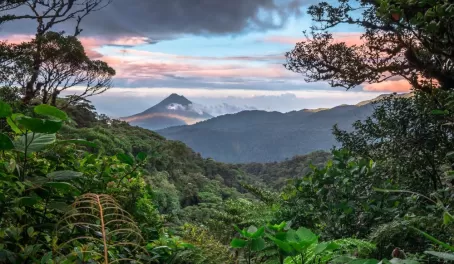
Costa Rica packs an unusual range of landscapes, wildlife, and culture into a country roughly the size of West Virginia — active volcanoes, cloud forests, two distinct coastlines, and a national park system that protects about a quarter of its land. Here's what to know about the country's culture, history, geography, and the adventures on offer, before you start planning a trip.
The Culture of Costa Rica
Religion in Costa Rica remains predominantly Christian, though the country is less uniformly Catholic than it once was: roughly half the population identifies as Catholic, about 31% as Protestant or Evangelical, and around 16% as non-religious. Costa Rican identity draws on a mix of Spanish colonial heritage, Indigenous roots, and — particularly along the Caribbean coast — Afro-Caribbean culture brought by Jamaican and other West Indian workers who arrived to build the railroad and work the banana plantations in the late 1800s and early 1900s. Ticos, as Costa Ricans call themselves, are known for pura vida — less a tourism slogan than an everyday expression of an easygoing, community-oriented outlook that shows up in how visitors are welcomed.
Explore beautiful Costa Rica
Modern History of Costa Rica
Costa Rica's most consequential modern turning point came in 1948, when a brief civil war ended with José Figueres Ferrer's government abolishing the military entirely — a decision that still defines the country today, since Costa Rica has redirected the budget a standing army would consume toward education, healthcare, and conservation ever since. The same government extended citizenship and voting rights to women and to Costa Ricans of Afro-Caribbean descent, both previously denied full rights, and nationalized the banking system. That combination of stability and social investment helped set up the tourism and conservation economy the country is known for today.
City of La Fortuna, Costa Rica (@drinkteatravel)
Ancient History
Costa Rica's best-documented pre-Columbian site is Guayabo National Monument, inhabited from roughly 1000 BCE until it was abandoned around 1400 CE, centuries before Spanish contact. What survives there — stone mounds, paved roads, and stone aqueducts — points to a settled, organized society long before Columbus arrived on the Caribbean coast in 1502, an event popularly (if not entirely provably) credited with giving the country its name: "Costa Rica," or "rich coast," after the gold ornaments local accounts say his expedition encountered. Long before that, the region was home to autonomous Indigenous chiefdoms, including the people who left behind Costa Rica's stone spheres, or bolas de piedra — a UNESCO World Heritage site in the Diquís Delta. Archaeologists have proposed several theories for what the spheres represented, from social status markers to astronomical alignment, but none is conclusively proven.
Tico Cuisine and What to Eat in Costa Rica
Costa Rica adventures (Jenny Johnston) Costa Rica adventures (Jenny Johnston) Costa Rica adventures (Jenny Johnston)
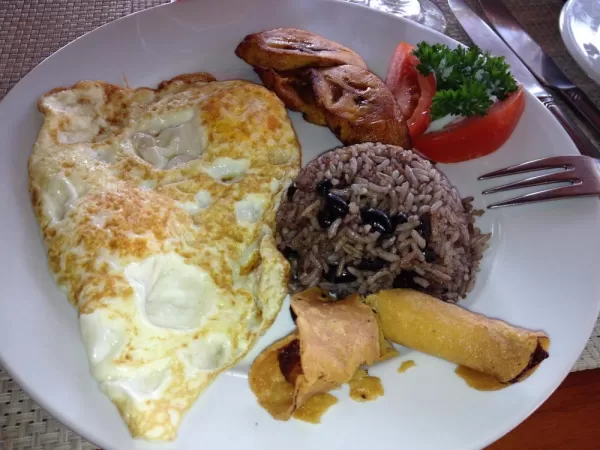
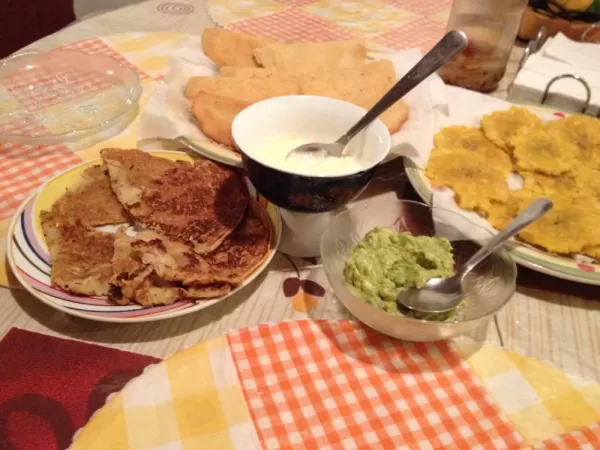
Costa Rican food centers on rice and beans in different forms depending on the meal and the coast. Gallo pinto — rice and beans stewed together, usually with a Salsa Lizano finish — is the standard breakfast nationwide, while the Caribbean side favors a coconut-milk version closer to Jamaican-style rice and peas. A casado (rice, beans, salad, plantain, and a protein) is the everyday lunch plate across the country, and fresh tropical fruit — mango, papaya, pineapple, guanábana — shows up everywhere from roadside stands to hotel breakfasts.
Politics in Costa Rica
Costa Rica is a presidential representative democracy, and one of the more stable in Latin America: the country has held uninterrupted democratic elections since 1949, following the brief civil war that led to a new constitution and the abolition of the military the year before. General elections for president and the unicameral, 57-seat Legislative Assembly are held together every four years, on the first Sunday of February, with a runoff in April if no presidential candidate clears 40% of the vote; the new administration takes office on May 8. Presidents serve a single four-year term and cannot run for immediate re-election, though a former president may run again after sitting out two full terms.
Costa Rican politics was dominated for decades by two parties, the National Liberation Party (PLN) and the Social Christian Unity Party (PUSC), but the system has fragmented into a genuine multi-party landscape since the early 2000s, with no single party holding a majority in the legislature in most recent cycles. An independent judiciary, including a Constitutional Chamber empowered to strike down laws and executive actions, checks both branches, and Costa Rica is consistently rated a "full democracy" by the Economist Intelligence Unit's Democracy Index — among the highest ratings in the region.
Geography of Costa Rica
Costa Rica sits between Nicaragua and Panama, with coastline on both the Pacific and Caribbean, and a mountainous spine running down its center that includes several active volcanoes. That geography compresses an unusual range of ecosystems into a small area — rainforest, cloud forest, dry tropical forest, and both coastlines are all within a few hours' drive of each other in most of the country.
Costa Rica Weather
Costa Rica runs on two seasons rather than four: a dry season (roughly December through April) and a green or rainy season (May through November), though timing and intensity vary meaningfully by region and elevation — the Caribbean coast, for instance, sees rain more evenly spread across the year than the Pacific side.
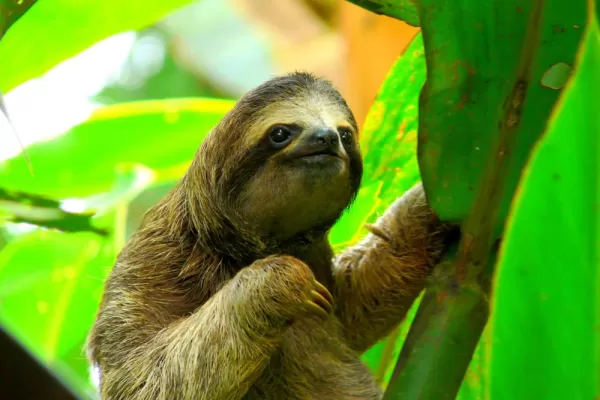
Costa Rica's protected areas hold an outsized share of the wildlife you can realistically see in a single trip. Corcovado National Park, on the remote Osa Peninsula, gives visitors the country's best odds of spotting large mammals — tapirs, anteaters, and, with real luck, jaguars — and entry requires a permit and an authorized guide, both of which Adventure Life arranges as part of your itinerary. Tortuguero National Park, reachable only by boat or small plane, is one of the country's principal sea turtle nesting sites, with green turtles nesting from June through October and peaking in July and August.
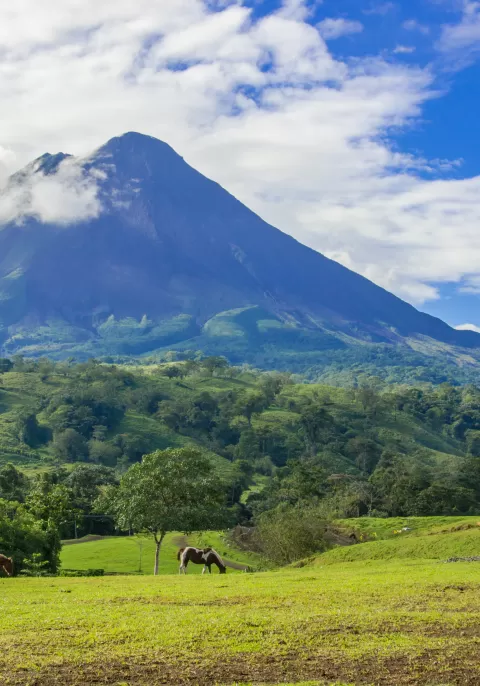
Monteverde Cloud Forest Reserve, established in 1972, protects six distinct ecological zones and is home to more than 100 mammal species, 400 bird species — including the resplendent quetzal — and over 1,500 plant species, connected by a network of suspension bridges that move visitors through several forest layers at once. Arenal Volcano erupted unexpectedly in 1968 after centuries of dormancy, and the surrounding national park still shows lava fields from that eruption and later activity, alongside natural hot springs fed by the volcano's geothermal heat.
Monteverde Cloud Forest Reserve, established in 1972, protects six distinct ecological zones and is home to more than 100 mammal species, 400 bird species — including the resplendent quetzal — and over 1,500 plant species, connected by a network of suspension bridges that move visitors through several forest layers at once. Arenal Volcano erupted unexpectedly in 1968 after centuries of dormancy, and the surrounding national park still shows lava fields from that eruption and later activity, alongside natural hot springs fed by the volcano's geothermal heat.
Adventure Activities in Costa Rica
Beyond wildlife-watching, Costa Rica's terrain supports hiking, horseback riding, snorkeling, zip-lining, and whitewater rafting, often within the same week-long itinerary given how close the country's ecosystems sit to each other. The Pacuare River is the standout for rafting: it's regularly ranked among the best whitewater rivers in the world, cutting through a rainforest canyon on its way to the Caribbean coast, with rapids ranging from beginner-friendly to genuinely challenging depending on the stretch and season. Adventure Life builds a Pacuare rafting day into several multi-activity Costa Rica itineraries, typically paired with stops like Arenal, Monteverde, or the Caribbean coast rather than sold as a standalone trip.
Costa Rica rewards travelers who want more than a checklist of stops — the country's small size means a single trip can reasonably combine volcano hikes, cloud forest, wildlife-rich national parks, and time on either coast. Adventure Life's trip planners build itineraries around what matters most to you, handling the guides, permits, and logistics that some of Costa Rica's best destinations require. Contact a Trip Planner today to start planning your next Costa Rica adventure.
By submitting your email address, you are agreeing to opt in to marketing communications. We hold your information private and do not share it with third parties.
Jenna F.
Costa Rica
Chat Costa Rica with a specialist
Our team is waiting and ready to talk with you about your next adventure.
So go ahead and book an appointment with one of our specialized trip planners.
I have worked with Jess in the past and enjoyed working with her again on a fun adventure. We were able to create a custom itinerary that worked within our timeline and budget.
Suzy Horvath
2 months ago
Kassandra is so knowledgeable and makes appropriate recommendations for what is suitable to our needs.
customer
4 months ago
Erin is super at helping with travel, this is the second trip she has arranged for us.
BBachmayer
4 months ago
Karilyn was very helpful with suggestions and very easy to work with. She was able to combine two different trips in Costa Rica into one that seems to be just perfect for us. I recommend her highly and will hopefully do another trip she puts together for us!
David Strommen
5 months ago
It was easy and quick Love working with everyone here.