Plitvice Lakes National Park sits in central Croatia, about 2 hours by road from Zagreb or Zadar. You can see the highlights in half a day or walk the boardwalks all day, past 16 named lakes and Croatia’s tallest waterfall. Spring brings the fullest falls, and Adventure Life Trip Planners can fit the park into Croatia land tours.
Where Is Plitvice Lakes National Park?
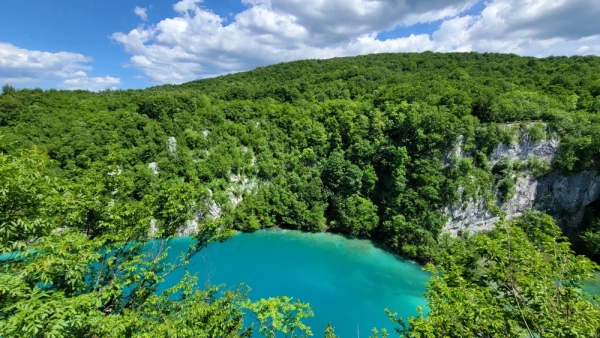
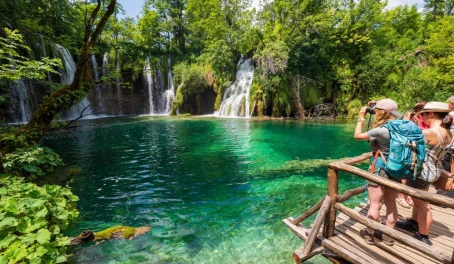
One of the upper viewpoints overlooking the Donja jezera (Lower Lakes) area of Plitvice Lakes National Park, Croatia. (Sherry Ott)
Plitvice Lakes National Park lies in the mountains of central Croatia, roughly halfway between Zagreb and Zadar and inland from the Dalmatian Coast. Most of the park falls within Lika-Senj County, between the Mala Kapela and Lička Plješivica ranges, so it fits neatly into a drive from the capital down to the coast.
Declared in 1949, Plitvice is Croatia’s oldest and largest national park, covering about 115 square miles (just under 300 km²). Forest covers most of it, and the lakes fill less than 1% of the area. UNESCO added the park to its World Heritage List in 1979 for its tufa barriers, natural dams of mineral deposits that created the 16 named lakes, which step down from one to the next. The park is open every day of the year, though hours and open areas change with the seasons.
Getting to Plitvice from Zagreb, Zadar, and Split
Plitvice has no airport or rail line, so you arrive by road, about 1.5 to 3 hours from Zagreb, Zadar, or Split. The park has 2 main entrances about 2 miles (3 km) apart, both on the state road that runs between Zagreb and Zadar.
From Zagreb
The park is about 80 miles (130 km) south of the capital, roughly 2 hours by car. The route runs southwest to Karlovac, then south on the state road past Slunj to Entrance 1, the park’s north entrance. Plitvice works as a full day out from Zagreb or as a stop on the way south to the coast.
From Zadar
Zadar is the closest coastal city, about 75 miles (120 km) away, or 1.5 to 2 hours by road. The drive climbs inland from the Adriatic into the Lika highlands, so you can visit from a base in Zadar or stop on the way north from Dalmatia.
From Split
Split is farther, about 155 miles (250 km), or around 3 hours by road, mostly on the motorway north along the coast before turning inland. Because Krka National Park lies close to this route near Šibenik, the 2 parks can share a long transfer day, though seeing both means less time on the trails at each.
On a Croatia tour
On land tours that include Plitvice, the drive is part of the route, usually as a stop between Zagreb and the Dalmatian Coast. Transfers are arranged for you, so your time at the park goes to the boardwalks and viewpoints.
The Lower and Upper Lakes and Walking Routes
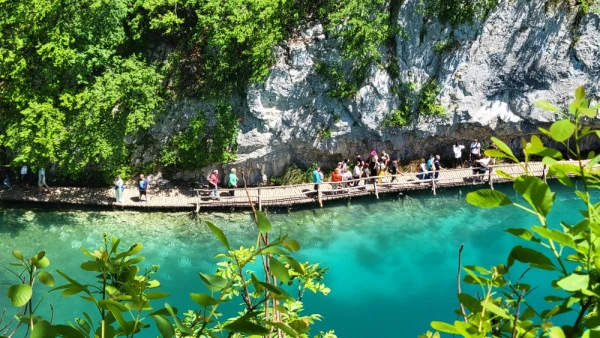
Boardwalks that wind through the Donja jezera (Lower Lakes) area of Plitvice Lakes National Park, Croatia. (Sherry Ott)
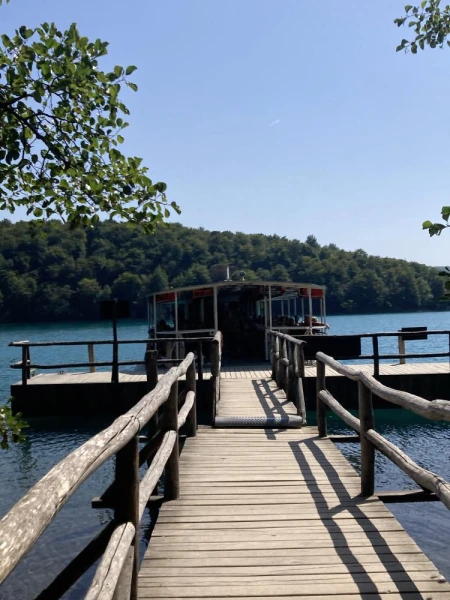
Plitvice’s lakes divide into 2 sections: the 4 Lower Lakes in a limestone canyon with the park’s biggest waterfall, and the 12 Upper Lakes, which are larger and sit among gentler, wooded slopes. Most routes link the 2 with an electric boat across Lake Kozjak, the largest lake in the park.
The Lower Lakes
In the Lower Lakes, you walk boardwalks just above the dark blue water at the bottom of a steep canyon, then climb to viewpoints on the eastern rim that look straight down on the pools. The canyon ends at Veliki Slap, the Great Waterfall, which drops about 255 feet (78 m). Nearby, the Sastavci falls mark the spot where the Korana River begins.
The Upper Lakes
Above Kozjak, the 12 Upper Lakes formed on dolomite rock, which gives them wider basins and softer shorelines than the canyon below. Trails follow the water upstream past many small cascades and the Veliki and Mali Prštavac falls toward Prošćansko, the uppermost lake. With forest right to the water’s edge and wider lakes, this section feels calmer than the canyon.
Walking routes and how long you need
The park marks 8 lake routes (it calls them programs), 4 from each entrance, and your ticket covers the electric boats and panoramic trains that connect them. Route letters and times can change from season to season.
Half day, 2 to 4 hours: Routes A and B from Entrance 1 cover the Lower Lakes and the Great Waterfall, while E and F from Entrance 2 focus on the Upper Lakes or take the boat to the Lower Lakes canyon.
Full day, 4 to 6 hours: Routes C and H combine both sections with boat and train rides.
Long walks, 6 to 8 hours: Routes K1 and K2 cover about 10 to 11 miles (16.5 to 17.5 km), including the Tomićevo Pogledalo viewpoint.
Best Time to Visit Plitvice Lakes
The best time to visit Plitvice Lakes is late April through May or September through October, when both lake sections are typically open and crowds are lighter than in summer. Inland Plitvice has a cooler continental climate than the coast, so match this timing with the best times to visit Croatia for beaches and island days.
Spring
Spring brings the fullest waterfalls and fresh green forest. The Upper Lakes usually reopen in early April, depending on the weather, so late April and May give you the whole park with plenty of water pouring over the tufa barriers.
Summer
Summer gives you long days, warm weather, and boats and panoramic trains on their regular schedules. It’s also peak season at Croatia’s most visited national park, with August especially crowded, so arriving when the entrances open in the morning puts you on the boardwalks before the busiest hours.
Autumn
Autumn turns the forest red and gold, and visitor numbers fall after the summer peak. September and October usually keep both lake sections open, with cooler weather that suits the longer routes.
Winter
In winter, snow and icy cascades make for the park’s quietest days. The Lower Lakes, including the Great Waterfall, usually stay open, while the Upper Lakes close until conditions allow. Boat and train service is reduced, and most park restaurants and lodging close for the season.
Park Tickets, Entry Times, and Rules
Plitvice tickets are sold for a set entrance and entry time, and most park rules come down to protecting the lakes: no swimming, and keep to the marked trails and boardwalks. Each ticket also includes rides on the electric boats and panoramic trains.
You can’t enter before the time on your ticket, though you may arrive up to an hour late. Prices change by season and time of day. The trails include steps and uneven ground, so not every path suits a wheelchair or limited mobility; staff at the entrances can suggest the most accessible route. Inside the park, these rules apply:
No swimming anywhere in the park, and no fishing
Stay on the marked paths and boardwalks
Don’t feed or disturb wildlife, pick plants, or take natural souvenirs
No drones, cycling, or campfires, and dogs must stay on a leash
Plitvice Lakes or Krka National Park?
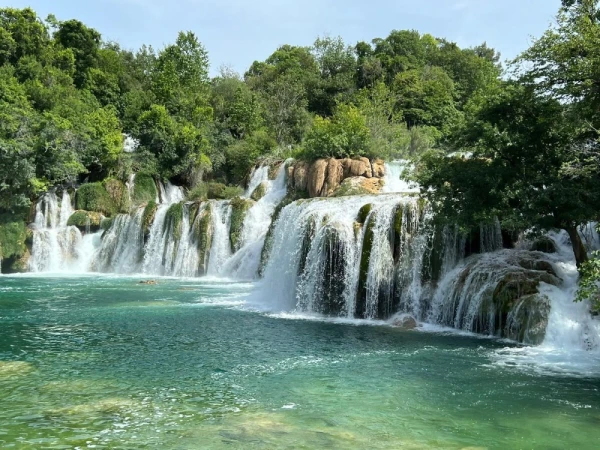
The Krka Waterfalls in Krka National Park, Croatia. (Sherry Ott)
If you only have time for one park, the choice comes down to where you’re staying and how much time you have. Krka National Park follows the Krka River near Šibenik, a short drive from the coast, while Plitvice sits inland and covers nearly 3 times the area.
Krka spreads across about 42 square miles (109 km²) along a river canyon with 7 tufa waterfalls, the best known being Skradinski Buk. It fits easily into a stay in Split, and some small ship cruises sailing north from Trogir call at Šibenik with time at Krka. Plitvice needs more time, both to reach and to walk, for 16 lakes and miles of forest boardwalk. Neither park allows swimming: Krka banned it for visitors in 2021, and Plitvice prohibits it throughout.
Where to Stay Near Plitvice
An overnight near Plitvice lets you start early, when the boardwalks are less crowded, and split the Lower and Upper Lakes across 2 days. Lodging sits in the small villages around the park entrances, including Plitvica Selo, where Adventure Life’s Croatia hotel selection includes a resort-style property in a quiet part of the park. In the colder months, most hospitality facilities in and around the park close, so an overnight works best from spring through autumn.
Croatia Tours That Include Plitvice Lakes
A boat in Lake Kozjak, Plitvice Lakes National Park ferrying visitors across the large lake. (Clara Tort)
Plitvice is usually visited on a land tour, since the park sits between Zagreb and the coast, well away from cruise ports. Itineraries that visit the lakes typically stop there on the way from Zagreb toward Zadar, Split, and Dubrovnik, then continue to coastal towns and islands such as Trogir, Hvar, and Korcula. If you’d also like time on the water, a land portion that includes the park can be paired with a cruise along the Dalmatian Coast.
Plitvice looks very different in April than in October, and Adventure Life Trip Planners can tell you which months and Croatia trips fit the walks and waterfalls you most want to see.
Plan on 3 to 6 hours for a full visit. The shorter marked routes take 2 to 4 hours and cover either the Lower Lakes and Great Waterfall or the Upper Lakes, while routes through both sections take 4 to 6 hours. The longest walking routes take 6 to 8 hours.
Can you swim at Plitvice Lakes?
No. Swimming is prohibited everywhere in the park to protect the lake system. Fishing, drones, and walking off the marked trails aren’t allowed either, so you enjoy the water from the boardwalks and from the electric boat that crosses Lake Kozjak.
Can you visit Plitvice on a Croatia cruise?
Croatia small ship cruises sail the Dalmatian Coast and islands, and Plitvice sits about 2 hours inland, so the park isn’t a port stop. The way to see both is a trip that pairs days on land, including Plitvice and Zagreb, with aCroatia cruise before or after.
Is Plitvice worth visiting in summer?
Yes, if you plan around the crowds. You get long days, full green forest, and both lake sections open, but it’s the park’s busiest season, especially in August. Arriving when the entrances open, or spending a night nearby for an early start, helps you stay ahead of the midday crowds.
Our team is waiting and ready to talk with you about your next adventure.
So go ahead and book an appointment with one of our specialized trip planners.
Ship, cabin, crew, meals, drinks, excursions, guides and shipmates - all excellent. Even the weather cooperated - mostly, with just one rainy day. And swim-stops on 5 of the 6 days.
It helped that the ship was only half full (18 people v 36 max, & on the 2nd run of the season).
[A neighbour told us that their Adriatic cruise last summer was their best vacation ever, so we decided to check it out. Now we know.]
Alex H
7 months ago
Very short turn around and ability to talk to a real person. Jane took our conversation and turned it into a wonderful trip
PJ Anderson
9 months ago
We were 4 sisters all living in different states. Clara and Jeremy were so patient with us and communicafed via phone, Zoom, numerous times as well as emails to address all our concerns. This is my second trip with Adventure Life. Even Kevin responded to a question.
Alice Bova
10 months ago
The planners at Adventure Life are very helpful and super willing to customize your trip to fit your preferences.
Leslie
1 year ago
Our overall experience sailing on the MS Ambassador was first rate! From the crew, the cruise director, the itinerary, the food and the accomodation, we couldn't have been more satisfied!