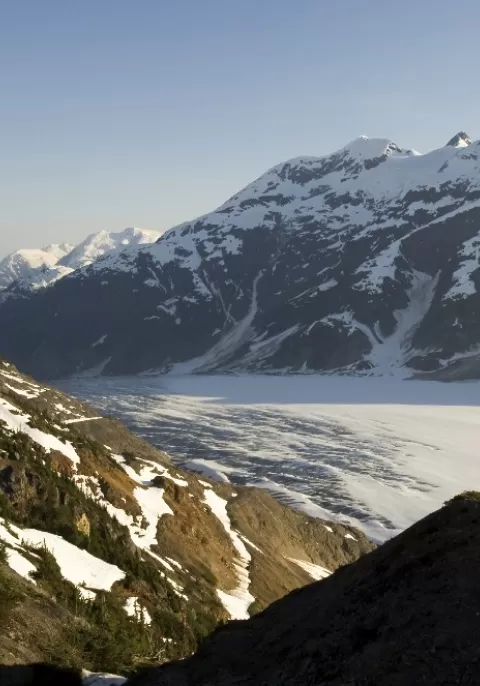
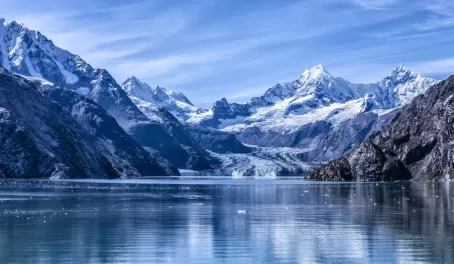
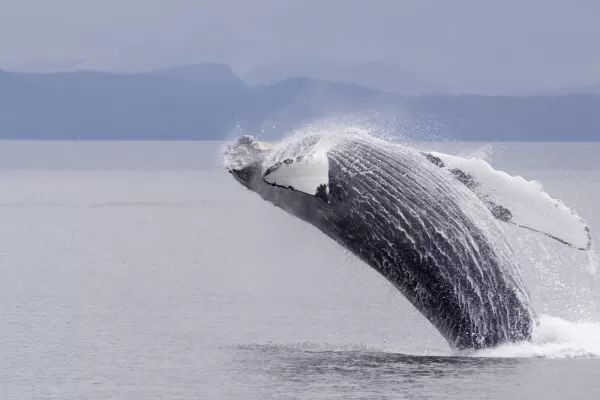
Glacier Bay National Park covers 3.3 million acres of tidewater glaciers, fjords, and temperate rainforest in Southeast Alaska, and most people who visit never set foot on land. Nearly all visitors see the park from a ship, and the size of that ship shapes the day. Large cruise ships typically spend part of a day in the bay with thousands of passengers on board. Small ships carry far fewer passengers, can take their time, and on some itineraries stop for kayaking, skiff rides, or a walk ashore.
Much of a Glacier Bay day is spent on deck or at the windows, watching for wildlife and waiting for ice to calve, so it suits travelers of nearly every fitness level. Here are nine things to look for on a small-ship visit to Glacier Bay.
1. Margerie Glacier
At the head of Tarr Inlet, at the far northwestern end of the bay, Margerie Glacier is the turnaround point for most ships and the moment many passengers wait for. The glacier is about 21 miles long and a mile wide, with an ice face rising roughly 250 feet above the water and another 100 feet below it. Ships hold position near the face, and as you wait you’ll hear the ice crack and see sections fall into the water.
Margerie is also notable for what it isn’t doing. While many glaciers in the park have retreated dramatically, Margerie’s terminus has stayed relatively stable for decades. Ask the ranger aboard why.
Tip: Bring layers, a hat, and gloves. Air coming off the ice is cold even on a sunny day in July.
2. Grand Pacific Glacier
Right next to Margerie, Grand Pacific Glacier looks nothing like its neighbor. Its face is dark with rock and gravel carried down from the mountains, about two miles wide and roughly 150 feet high. Around 1990, the two glaciers were joined. Since then, Grand Pacific has pulled back, leaving them separated.
Tip: Look at the two side by side. The contrast between Margerie’s clean blue ice and Grand Pacific’s rock-covered face shows how differently glaciers in the same inlet can behave.
3. Lamplugh Glacier
On the way to or from Tarr Inlet, many ships pass Lamplugh Glacier near the mouth of Johns Hopkins Inlet. It’s about three-quarters of a mile wide, with a face 150 to 160 feet high, and is often noted for the deep blue color of its ice.
4. South Marble Island
This small island in the lower bay is one of the busiest wildlife stops of the day. Steller sea lions crowd the rocks, often loudly, and in summer the cliffs fill with seabirds, including tufted puffins and black oystercatchers. Ships slow down or idle offshore so passengers can watch from the deck.
Tip: Binoculars make a large difference here. A pair for each person in your group is worth packing.
5. Wildlife from the Deck
Glacier Bay is one of the better places in Southeast Alaska to see a range of wildlife in a single day. From the ship, passengers commonly spot humpback whales, sea otters, harbor seals, and bald eagles. Brown and black bears forage along the shoreline, and mountain goats move across the cliffs in quieter inlets. Wolves and moose are present but seen less often. For more on what lives here, see our guide to
wildlife in Alaska.
Tip: Keep a camera with a zoom lens ready all day. Some of the best sightings happen between the main stops, not at them.
6. Park Rangers and Huna Tlingit Interpreters Aboard
When a ship enters Glacier Bay, National Park Service rangers come aboard and stay for the visit, pointing out wildlife, explaining how the glaciers formed and retreated, and answering questions. Huna Tlingit cultural interpreters also share the bay’s significance as their ancestral homeland. Glacier Bay is the core homeland of the Huna Tlingit, who lived here until advancing ice forced them out several centuries ago. Hearing that history while you sail through the same landscape adds a dimension that scenery alone can’t. Our
Alaska cultural tours include more opportunities to learn about Tlingit culture.
7. Kayaking and Skiff Outings
On some small-ship itineraries, Glacier Bay isn’t only a view from the deck. Ships carry kayaks and inflatable skiffs, and guides lead outings into quiet coves and along the shoreline, often with seals or seabirds nearby. Large cruise ships don’t offer this. Ask which itineraries include it when you book.
8. Bartlett Cove and the Huna Tribal House
Bartlett Cove, near the park’s entrance, is the only developed area in Glacier Bay and the only place most visitors can go ashore. Some small-ship itineraries stop here for a walk. The easy Forest Loop Trail winds through spruce and hemlock forest growing on an old glacial moraine. The Bartlett River Trail follows an intertidal lagoon to the river’s estuary, about five miles round trip. The shoreline trail leads to Xunaa Shuká Hít, the Huna Tribal House, which opened in 2016 as a gathering place for Huna Tlingit clans to reconnect with their homeland. Visitors can see its carved and painted house front and the totem poles nearby.
9. Quiet Inlets Away from the Main Route
Large ships follow the main channel to the glaciers and back. Small ships can spend time in side inlets and bays that see far fewer visitors, such as Tidal Inlet, where bears, mountain goats, and eagles are often seen, or the more remote coves of the park’s outer coast. These quieter stretches are often where the day’s most memorable wildlife sightings happen.
Beyond Glacier Bay
Glacier Bay is one of several highlights on a typical Inside Passage route. For the towns you’ll visit along the way, from Ketchikan and Sitka to Petersburg and Skagway, see our
guide to ports along the Inside Passage.