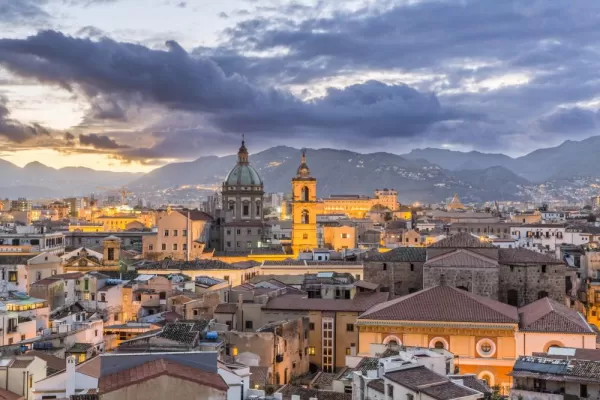
Palermo is the guardian of the Sicilian soul. Many have been attracted to this city, the largest capital of the Italian islands. Phoenicians, Carthaginians, Romans, Byzantines, Arabs, Normans... Palermo is a rich culmination of so many cultural influences as seen in the Moorish designs on the cathedral, and the Byzantine mosaics of the Palatine chapel, which is itself housed within the precincts of the Norman palace. You fall under the spell of the palaces, baroque splendors that grace the town with their obsolete beauty. It is thrilling to stumble upon one of those fabulous markets, high in color, and headily picturesque.
Included excursions:
Palermo & Monreale
Dive into the fascinating history of Palermo and Monreale, two emblematic Sicilian towns, and explore their unique cultural, religious and artistic heritage.
The adventure begins in Palermo. Aboard your bus, you discover its pretty and lively streets as well as its architecture, which lies at the crossroads of Byzantine, Arab and Normand influences, bearing witness to its multicultural past. You visit the famous Palatine Chapel, a 12th-century masterpiece, located in the Norman Palace, today seat of the Sicilian Regional Assembly. Its golden mosaics, its ornamental candelabra and its finely sculpted ceiling perfectly illustrate the Arab-Norman style that is so emblematic of Sicily.
You then leave for Monreale, 8 kilometers (5 miles) from Palermo, to discover its cathedral, part of a UNESCO World Heritage Site. Completed in 1174 by William the Good, it is considered to be the most beautiful Norman church in Italy. While the austere exterior is reminiscent of a fortress, the interior reveals splendid Byzantine mosaics, colored marble and granite columns. You then explore the cloister of the former Benedictine Monastery, where a majestic arcade supported by 216 decorated columns surrounds the courtyard. To finish your escapade, you are able to visit Monreale by yourself.
You are advised to wear comfortable shoes and cover your shoulders and knees when visiting the religious sites. This excursion, which includes steps and is on foot, is not recommended for persons with reduced mobility or in a wheelchair.
Cefalu
From the pier, embark your coach and start your panoramic drive through the historical center of Palermo, before reaching the coastal highway which brings you to the charming fishing village of Cefalù.
Cefalù is a haven of tranquillity, a refuge and a sanctuary of religious inspiration. A city of facets, levels, and epochs. The name, which translated means "head", probably referring to the shape of the hill and huge rock crowned with an ancient castle, rising above the town, was given to the town by the Greeks. Cefalù's origins are surrounded in mystery.
Legend tells that Roger II, the well-known Norman sovereign of Sicily, in gratitude to God for sparing his life in a violent storm at sea, commissioned the building of a Cathedral at Cefalù, where he landed after the tempest.
Its characteristics, as well as its position, so close to the sea, make it something of a fortress from the outside as much as it is a church on the inside. The Cathedral was begun on a site in which Roman buildings had already existed. However, after unforeseen circumstances, and changes in construction plans, the original building was never finished. The remains of this building project are three roofs which testify to past ages and building techniques. Inside the cathedral, you see the paintings and gold Byzantine mosaics the Cathedral is known for.
Continue your walking tour with a photo-stop at the medieval wash-house and the Osterio Magno. Per the tradition, it was built by Roger II as his mansion, but it probably dates from the 14th century. Traces of the medieval tower and decoration can be seen. Excavations held in the interior have showed the presence of ancient edifices and ceramics.
Before returning to the ship, a refreshment is served, and you have some free time to explore Cefalù on your own and browse the quaint boutiques.
This excursion involves approximately 1 mile (1.5 km) of walking mostly over cobble-stone streets with some steps. You are advised to wear comfortable walking shoes and protect yourself from the sun. Appropriate dress is recommended to enter religious sites (shoulders and knees must be covered).