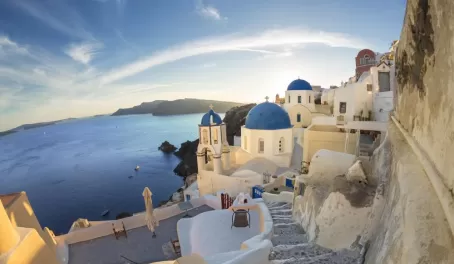
Greece has more archaeological museums than any other country in the world. That alone hints at how much history is woven into everyday life here. From islands scattered across bright blue seas to traditions that stretch back thousands of years, Greece continues to surprise even repeat visitors. In this post, you’ll uncover fun facts about Greece that go beyond the obvious—covering geography, culture, ancient achievements, and modern life. These interesting facts about Greece are grouped by theme to make them easy to explore and helpful for anyone curious about the country.
Photo by Jan Curamen
Geography & Nature Facts
How many islands does Greece have?
Greece has around 6,000 islands and islets, but only about 200 are inhabited.
Is Greece mountainous?
Yes. Roughly 80% of Greece is mountainous, making it one of Europe’s most rugged countries.
How long is Greece’s coastline?
Greece has nearly 16,000 km of coastline, one of the longest in the world.
How sunny is Greece?
Many Greek islands receive close to 300 sunny days per year, making Greece one of Europe’s sunniest destinations.
What wildlife lives in Greece?
Greece is home to monk seals, sea turtles, reptiles, and over 100,000 migratory birds that visit wetlands each winter.
These interesting facts about Greece explain why the country is ideal for island hopping, hiking, and nature travel.
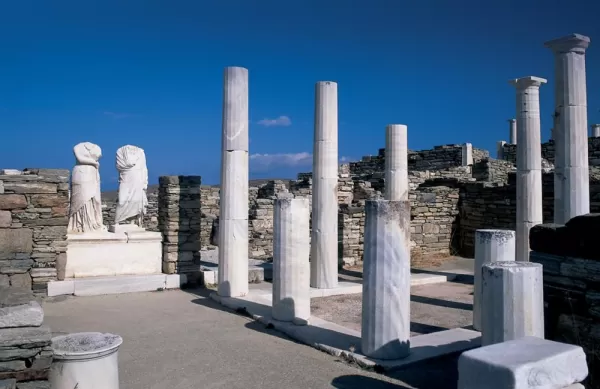
Columns found at Delos
Greece FAQs for History, Culture & Heritage
How many UNESCO sites are in Greece?
Greece has 19 UNESCO World Heritage Sites, including the Acropolis, Meteora, and Corfu Old Town.
What is Greece’s official name?
Greece’s official name is the Hellenic Republic, and Greeks call it Hellas.
What did ancient Greece invent?
Democracy, theater, philosophy, and the Olympic Games all began in ancient Greece.
How old is the Greek alphabet?
The Greek alphabet is over 2,500 years old and influenced many modern alphabets.
Where were the first Olympics held?
The first Olympic Games took place nearly 2,700 years ago in Olympia.
Why is Mount Olympus famous?
At 2,917 meters, Mount Olympus was believed to be the home of the Greek gods.
Why is Greek culture still influential?
Philosophers like Socrates, Plato, and Aristotle shaped Western thought, while Greece maintains 4,000+ traditional dances and more theaters than any city worldwide.
These are some of the most lasting Greek facts still shaping modern life. Beautiful buildings of Santorini, Greece (Shannon Kendro)
Economy, Demographics & Modern Fun Facts
How many olive trees are in Greece?
Greece has over 120 million olive trees, some centuries old and still producing fruit.
How important is tourism to Greece?
About 33 million tourists visit Greece each year, and tourism makes up around 20% of the economy.
How museum-rich is Greece?
Greece has 110+ archaeological museums, more than any other country.
Modern milestones:
Greece joined the EU in 1981 and adopted the euro in 2001.
Bonus Lesser-Known Facts
Greece has black, red, and white beaches, especially on Santorini.
Greek is one of the longest continuously used languages in the world.
Conclusion
From geography to philosophy, these facts about Greece show why the country feels endlessly layered. If you enjoy learning through Greece fun facts, explore related guides on Greek islands, cuisine, and culture—and share this with someone planning a trip to Greece.
Ready to explore Greece yourself? Plan your next personalized trip to Greece through our Trip Planners. Share these Greece fun facts with a friend who loves travel, and start planning your unforgettable Greek journey today!
Our team is waiting and ready to talk with you about your next adventure.
So go ahead and book an appointment with one of our specialized trip planners.
Quick response and very helpful. Answered my questions and adjusted the trip
Andrew Smith
2 months ago
The website was easy to navigate, and my trip planner was helpful, available, and creative. I was able to customize my trip as needed.
Wanderwegger
3 months ago
We loved the experience on Atlas. It was 5 star in every way. Best food I have had in my life
customer
6 months ago
Kassandra is prompt, knowledgeable, helpful, and generally lovely to work with. Makes the trip all the more exciting to look forward to when you feel you are in trusted hands.
Not my first time using Adventure Life, and certainly not my last!













/454x264.webp)