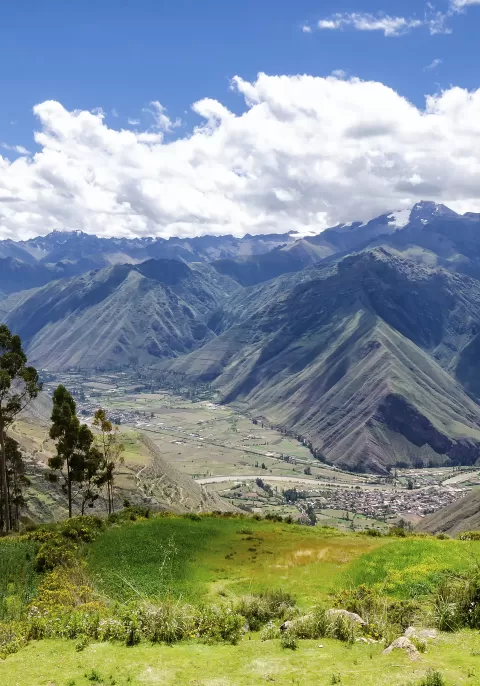
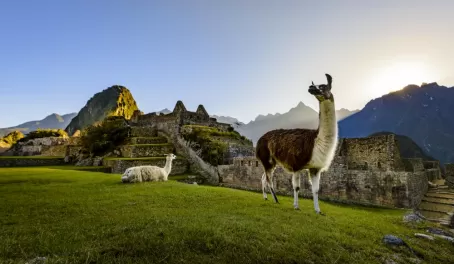
Peru is synonymous with mountains. Seen from above, Peru's territory resembles a colossal sheet of wrinkled paper. The reason is the presence of the magnificent Andes that, like a giant backbone of rock and snow, cut across Peru from north to south and mold its geography and with it, the landscape and the people. The Andes spread across Peru, forming the largest concentration of snow peaks of the Americas. They are an intricate system of large and small mountain ranges—approximately 20 of them—crowned by a thousand summits that tower over 5,000 meters and more than thirty that rise above 6,000 meters. Mountains in Peru are so pervasive that it is almost impossible to imagine a landscape without soaring peaks looming in the horizon. Only in the Amazon plain and some areas in the arid coastal desert does the land flatten out.
Such unique mountainous areas are home to an impressive succession of landscapes and exceptional animal and plant wildlife. These include the Puya Raimondi, a plant with the largest number of flowers in the world (more than 10,000) which blooms only once every 80–100 years; queñual forests that grow almost on the edge of the snow line; century-old yaretas that grow scarcely one millimeter a year; small herds of graceful vicuña whose wool is considered the world's finest; majestic Andean condors that dominate the skies; and dozens of tiny hummingbirds that feature all the colors of the rainbow.
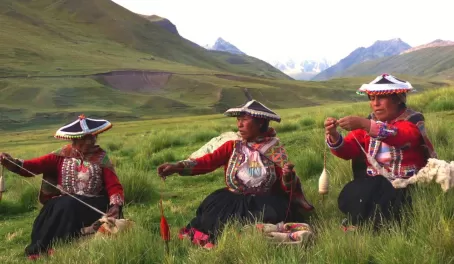
Several high-Andean civilizations of farmers and livestock herders—who follow millenary mountain traditions of paying homage to the sacred Apus, or sacred mountain guardians—add to the attractiveness of the area. So come and see for yourself!
The Inca Trail to Machu Picchu
In the heart of South America lies Peru, a land celebrated for its breathtaking mountainous landscapes that allure outdoor enthusiasts and adventure seekers from around the world. Among its treasures are the mighty Andes, a mountain range spanning 23,000 kilometers (approximately 14,000 miles), and home to Peru's most famous trekking route—the legendary Inca Trail.
The Inca Trail is an awe-inspiring 43-kilometer stone-paved road built by the Incas, annually attracting some 25,000 hikers who embark on this arduous but spectacular journey. This historic trail leads to the enigmatic citadel of Machu Picchu, hidden amidst the lush Cusco cloud forest.
A Trail of Altitude and Ecological Diversity
Beginning at the village of Qorihuayrachina, at kilometer 88 of the Cusco-Quillabamba railway, the Inca Trail spans three to four days of strenuous hiking. Along the way, adventurers traverse a remarkable variety of altitudes, climates, and ecosystems, from the high Andean plain to the enchanting cloud forest. The journey entails crossing two high-altitude passes, the highest being Warmiwañuska, standing tall at 4,200 meters. The appeal of the Inca Trail lies in its harmonious blend of Inca ruins, majestic mountains, exotic vegetation, and extraordinary ecological variety. The trail meanders over high passes, through cloud forests, and into subtropical vegetation, offering glimpses of over 250 orchid species, rare birds, and endangered animals like the spectacled bear.
Peru's Breathtaking Mountain Ranges and Iconic Peaks
Peru is a country that captivates the hearts of outdoor enthusiasts and adventure seekers with its stunning and diverse mountainous landscapes. From majestic snow-capped peaks to vibrant, mineral-rich summits, these mountains are a paradise for nature lovers. Below are some of Peru's most visited ranges. Explore the Machu Picchu ruins or climb Huayna Picchu - Young Mountain - on your trip to Peru (Allison De Jong)
Peru Mountain Ranges
Chila Mountain Range – Known for the source of the Amazon River and high volcanic landscapes.
Chonta Mountain Range – A rugged and less-visited range with isolated trails.
Cordillera del Cóndor – Famous for cloud forests and borderland biodiversity.
Cordillera Apolobamba – Home to remote peaks straddling Bolivia and Peru.
Cordillera Blanca – The crown jewel of Peruvian mountaineering, with snow-clad giants like Huascarán.
Cordillera Carabaya – Known for glacial lakes and untouched wilderness.
Cordillera Central – A vital range connecting Peru’s heartland.
Cordillera de Rentema – Remote and biologically rich.
Cordillera Huayhuash – Renowned for dramatic peaks and one of the world’s top trekking circuits.
Cordillera Negra – A striking contrast to the Blanca, without glaciers but with panoramic views.
Cordillera Occidental & Cordillera Oriental – Major Andean backbones running north to south.
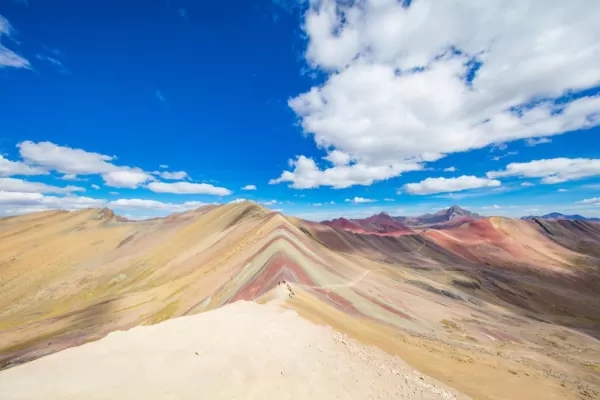
Cordillera Vilcanota – Home to Ausangate and Rainbow Mountain.
Huaguruncho, Huallanca, Huanzo, Huaytapallana, La Raya, Pariacaca, Puwaq Hanka, and Raura Ranges – Each unique with isolated peaks and cultural significance.
Serra do Divisor – Dense rainforest mountains on the Peruvian–Brazilian border.
Urubamba & Vilcabamba Ranges – Rich in Inca history and trekking routes to Machu Picchu.
Rainbow Mountain hike in Peru
The Highest Peaks in Peru
Nevado Alpamayo
Altitude: 5,947 m (19,511 ft)
Range: Cordillera Blanca
Trek: Alpamayo Circuit
Known as one of the world’s most beautiful peaks due to its perfect pyramid shape.
Nevado Huascarán
Altitude: 6,768 m (22,205 ft) – the tallest mountain in Peru.
Range: Cordillera Blanca
Treks: Santa Cruz, Huayhuash circuits
A bucket-list summit for serious climbers.
Pisco Peak
Altitude: 5,752 m (18,871 ft)
Range: Cordillera Blanca
Trek: Ishinca Valley
Popular with trekkers for panoramic summit views.
Mateo Peak
Altitude: 5,150 m (16,896 ft)
Range: Cordillera Blanca
A classic training peak for mountaineers.
Ausangate
Altitude: 6,384 m (20,945 ft)
Range: Cordillera Vilcanota
Trek: Ausangate Circuit
Sacred mountain of the Quechua, linked to traditional rituals.
Nevado Salkantay
Altitude: 6,271 m (20,574 ft)
Range: Vilcabamba Range
Trek: Salkantay Trek (alternative to Inca Trail)
A challenging climb with cultural and spiritual importance.
Trek: Short but steep climb, famous for views of Machu Picchu citadel.
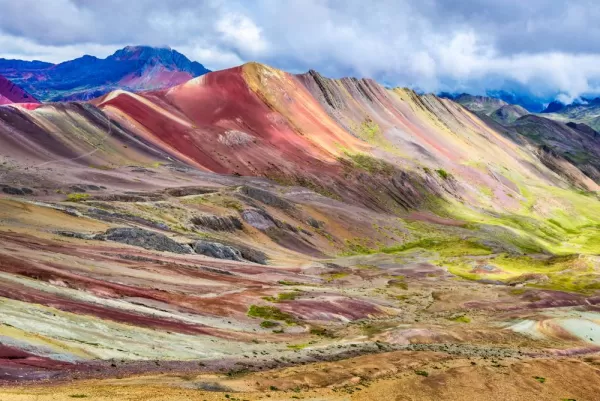
Rainbow Mountain hike in Peru Vinicunca (Rainbow Mountain)
Altitude: 5,200 m (17,060 ft)
Range: Andes
Known for its colorful mineral-rich slopes, attracting day trekkers.
Nevado Chachani
Altitude: 6,057 m (19,872 ft)
Range: Andes near Arequipa
Considered one of the easiest 6,000-meter peaks to climb.
Misti Volcano
Altitude: 5,822 m (19,101 ft)
Range: Andes near Arequipa
Trek: Accessible climb with sweeping desert-and-mountain views.
Vicunya in front of Misti Volcano (Andrea Edwards)
What to Know About the Cordillera Blanca in Peru
The Cordillera Blanca, aptly named "white range" in Spanish, stands as a remarkable mountain range within the larger Andes range, stretching over 200 kilometers in a northwesterly direction. Nestled in the Ancash region, this awe-inspiring range runs parallel to the Santa River valley, also known as Callejón de Huaylas. Its prominence is crowned by several peaks soaring beyond 6,000 meters (19,690 feet), encompassing a total of 722 glaciers, with the pinnacle being the highest mountain in Peru—Huascarán. This extraordinary region, known as "Yurak Janka" in the Quechua language, was designated as Huascaran National Park in 1975, and later recognized by UNESCO as a Biosphere Reserve and World Natural Heritage Site.
The breathtaking valleys, adorned with turquoise glacial lakes, cradle treks that traverse the Cordillera Blanca's dramatic peaks. From trekking and hiking to climbing, biking, and horseback adventures, the region is a playground for explorers.
May to September is the prime climbing season, offering stable weather and dry conditions. With its proximity to the Pacific, the range features glaciated valleys and easy access from Huaraz to base camps within a day.
Packing Guide for a Journey to the Peruvian Andes
Clothing
Warm layers like fleece and thermals for fluctuating temperatures.
Waterproof jackets and pants for sudden rains.
Gloves, hats, and sturdy boots to handle rugged trails.
Gear for Hiking
Backpack, trekking poles, headlamp, and sunglasses.
Passport, visa, insurance, money, maps, and camera gear.
Pack light but smart to ensure comfort while exploring the dramatic peaks of the Andes.
Preparation for an Unforgettable Experience
Trekking the Inca Trail requires planning. Permits are capped at 500 per day and sell out quickly, often a year in advance. Acclimatization is crucial, with time spent at high altitudes recommended before hiking.
Highlights of the Inca Trail
Day 1: Start at Kilometer 82, follow the Urubamba River, and camp at Huayllabamba.
Day 2: Tackle Warmiwañuska Pass, then descend to Pacaymayo camp.
Day 3: Cross two passes, see Runkuracay and Sayacmarca ruins, and camp at Phuyupatamarca.
Day 4: Sunrise at Inti Punku (Sun Gate) before entering Machu Picchu.
Ready to experience the beauty of the mountains of Peru for yourself? From the Cordillera Blanca to the Inca Trail and Ausangate, every Peru mountain range offers a new adventure. Connect with our Trip Planners to design your perfect journey through the Andes.
Our team is waiting and ready to talk with you about your next adventure.
So go ahead and book an appointment with one of our specialized trip planners.
We had a fabulous trip to Peru thanks to Adventure Life and their local partner guides. We are so grateful for the smooth transitions from place to place and the ease with which we were shepherded and informed and had our own needs and idiosyncrasies accommodated for throughout this once in a lifetime trip.
Patricia Talbot
4 weeks ago
Timely responses and great follow up. Trying to figure out what was best for us is a great attribute for Jane and her team.
Neil Chernin
1 month ago
This is my fourth trip with Adventure Life and, as in the past, the staff was very knowledgeable and helpful. they talk with you about your desires and provide excellent suggestions.
Robert Thompson
2 months ago
AL was both responsive and patient as I worked through scheduling issues and changes.