In a country with a 10,000-year human timeline, the history of the Galapagos Islands is relatively recent. Born of fire, these volcanic islands 600 miles from mainland Ecuador emerged layer by layer from the ocean floor over millions of years. If you’ve ever wondered how old are the Galapagos Islands, the eastern islands are the oldest, at over four million years old, while the younger western islands average around 700,000 years old.
Despite their youth in geological terms, the islands have played a fascinating role in human exploration and science over the past 500 years. From pirates and whalers to naval operations and Charles Darwin himself, Galapagos history has shaped not only the islands but also global science and conservation.
Geological History
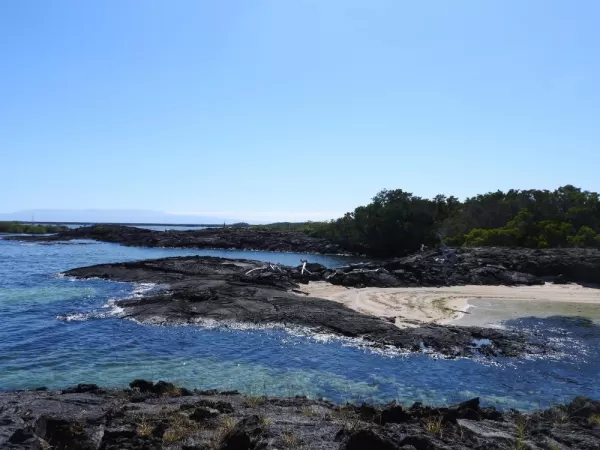
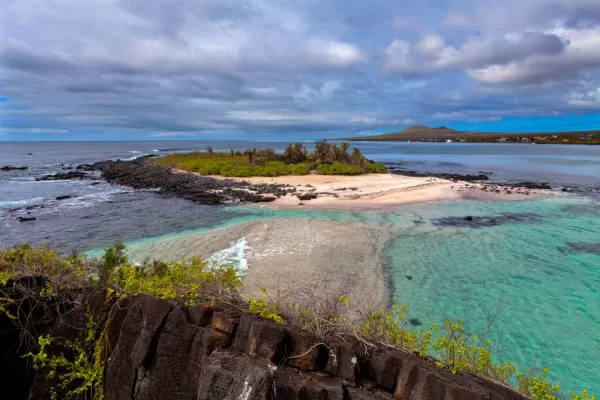
The Galapagos Islands' history begins with fire and lava. Entirely volcanic, the islands sit on the Nazca tectonic plate, over a hotspot that fueled eruptions for millions of years. As the plate drifts east, older islands erode and sink, while new ones form in the west.
Their remote location at the meeting of three major currents—the Humboldt, Cromwell, and Panama—has made the Galapagos an ecological crossroads, fostering incredible biodiversity on land and at sea.
Isabela Island in the Galapagos (Lina Miranda)
The First Settlers
Do people live on the Galapagos Islands today? Yes—though only four are permanently inhabited: San Cristobal, Santa Cruz,Isabela, and Floreana. About 25,000 residents call the islands home.
Historically, between the 17th and 18th centuries, pirates and whalers used the islands as sanctuaries. Sites such as Buccaneer Cove on Santiago and Tagus Cove on Isabela still evoke this early period of Galapagos island history. Permanent settlement didn’t begin until the mid-19th century, with small communities struggling to take root on the arid volcanic land. By the end of the 1800s, several small populations had been established in Santa Cruz and San Cristobal.
Ecuador Claims the Islands
In 1832, Ecuador formally annexed the Galapagos, only a few years after gaining independence from Spain. General José de Villamil established the first penal colony on Floreana, beginning a long chapter of colonial and penal use that would leave a haunting mark on Galapagos history.
Darwin’s visit in 1835Darwin’s Visit in 1835
One of the most pivotal moments in Galapagos islands history came in 1835, when Charles Darwin arrived aboard the HMS Beagle. His observations of finches and other species across the islands became the foundation of his theory of evolution by natural selection, published decades later in On the Origin of Species.
Darwin’s visit elevated the islands from a remote outpost to a cornerstone of modern science, making Galapagos history inseparable from the history of biology.
View of the ocean from Floreana Island
Great Galapagos Mysteries
The history of the Galapagos Islands also includes dramatic tales, none more famous than those of Floreana Island in the 1930s. Rivalries between settlers—including Friedrich Ritter, Dora Strauch, the Wittmer family, and the self-proclaimed Baroness Eloise von Wagner—led to mysterious disappearances, deaths, and conspiracy theories that remain unsolved.
Isabela Island also holds reminders of its darker past: from 1944 to 1959, it hosted one of the archipelago’s three penal colonies, where prisoners labored under brutal conditions to build the infamous Wall of Tears.
World War II and Beyond
During World War II, the U.S. used Baltra and Santa Cruz for military bases in the Pacific theater. Today, remnants of this period in Galapagos island history can still be seen in abandoned barges and military structures.
By the 1960s, tourism began to grow, and since the 1990s, it has become the islands’ primary industry. Over 200,000 travelers now visit each year, drawn by both the pristine environment and the rich Galapagos history that permeates every island.
Modern Galapagos History
Tourism, conservation, and research now define the history of the Galapagos Islands in the modern era. Strict regulations by the Galapagos National Park ensure that tourism growth does not overwhelm fragile ecosystems. The Charles Darwin Research Station continues to lead scientific and conservation work, making sure that both natural and cultural legacies endure.
From volcanic birth to Darwin’s theories, from penal colonies to conservation triumphs, the Galapagos Islands' history tells a story of resilience, discovery, and transformation.
By submitting your email address, you are agreeing to opt in to marketing communications. We hold your information private and do not share it with third parties.
Franny F.
Galapagos
Chat Galapagos with a specialist
Our team is waiting and ready to talk with you about your next adventure.
So go ahead and book an appointment with one of our specialized trip planners.