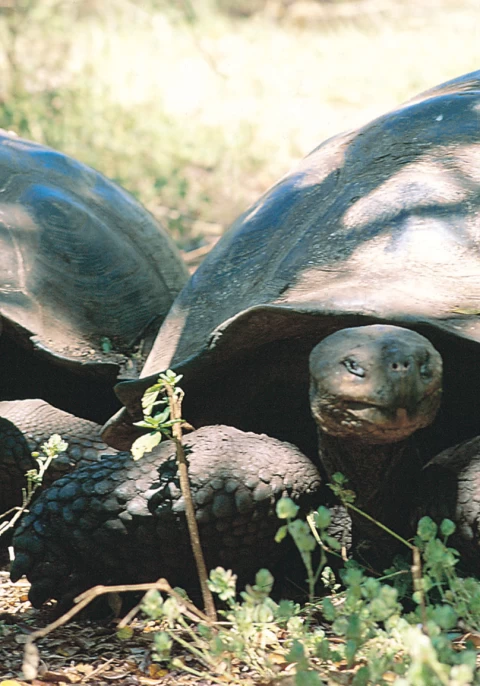
The Galapagos giant tortoise is one of the most iconic species of the archipelago, symbolizing the uniqueness and ecological importance of these islands. Found only in the Galapagos Islands and the distant Aldabra Atoll in the Indian Ocean, these remarkable reptiles can weigh up to 270 kilograms and live well over a century. Their presence has not only shaped the name of the islands—“galápago” meaning “saddle” in Spanish, inspired by their shells—but also the way the world views conservation and biodiversity.
When asking where giant tortoises live, the answer reveals the diversity of the Galapagos. Each island hosts distinct populations, adapted to its environment. On drier, lower islands, tortoises evolved saddle-backed shells and longer necks, allowing them to stretch toward higher shrubs and cactus pads. On more fertile, highland islands, dome-shelled tortoises thrive on grasses, fruits, and lush vegetation. In total, 14 subspecies of Galapagos giant tortoises once roamed the archipelago, nine of which evolved in isolation on separate islands, while five developed on the volcanic slopes of Isabela. Today, only 11 remain, with three extinct and the Pinta Island subspecies represented by the legendary “Lonesome George,” the last of his kind.
Beyond their cultural symbolism, giant tortoises play a critical role in the ecosystem. As grazers and seed dispersers, they shape vegetation patterns and maintain the balance of island habitats. Yet, their survival is threatened by centuries of human exploitation and the introduction of invasive species. Ongoing conservation efforts, led by local organizations and global partners, aim to restore populations and protect these gentle giants for future generations.
The Galapagos giant tortoise is more than a natural wonder—it is a living emblem of resilience and the urgent need for conservation in fragile island ecosystems.
Galapagos Tortoise Lifespan – How Long Do They Live?
Meet the ancient giant tortoises of the Galapagos
The Galapagos giant tortoise is renowned for its extraordinary longevity, with an average lifespan of 100 to 150 years. Some individuals have lived even longer, making them record-breakers in the animal kingdom. Famous examples include Harriet, who lived to around 175 years in captivity; Jonathan, the Seychelles giant tortoise often associated with Galapagos species, who is still alive today at over 190 years; and Lonesome George, the last of the Pinta Island subspecies, who became a global symbol of conservation until his passing in 2012.
Life Cycle and Longevity
These tortoises reach maturity between 20 and 30 years. Breeding occurs during the rainy season (January to June), and nesting takes place between June and December. Females dig nests in the arid zones, lay 2–20 eggs, and leave them to incubate for 4–8 months. Hatchlings emerge weighing less than 1/1,000th of an adult’s size, and while vulnerable to predators like hawks, those that survive their early years often go on to live for more than a century.
What Influences Their Lifespan?
Several factors contribute to the long lifespan of Galapagos tortoises. Their slow metabolism and ability to store water in their shells allow them to survive periods of food scarcity. Their giant tortoise diet is herbivorous, consisting of cactus pads, grasses, leaves, and seasonal fruits. This diet, combined with an ability to endure drought by storing water, supports their longevity. However, survival depends heavily on external pressures. In the past, whalers and colonists killed over 100,000 tortoises for food and oil, while invasive species such as rats, pigs, dogs, goats, and donkeys devastated eggs, hatchlings, and food sources.
Today, fewer than 15,000 giant tortoises remain, but conservation efforts continue to protect these ancient reptiles. Their resilience, combined with targeted conservation, ensures that these living relics—who can outlive multiple generations of humans—remain symbols of endurance and hope in the Galapagos Islands.
Conservation Efforts and Threats
A History of Decline
For centuries, Galapagos giant tortoises faced severe population declines due to overhunting and the introduction of invasive species. Whalers and early settlers harvested them by the thousands for meat and oil, while goats, pigs, dogs, and rats destroyed nests, preyed on hatchlings, and competed for food. From an estimated hundreds of thousands, fewer than 15,000 tortoises remain today across the islands.
Breeding and Recovery Programs
The turning point came in 1959, when the Galapagos were declared a National Park, giving native wildlife legal protection. Soon after, the Charles Darwin Research Station and the Galapagos National Park Service launched intensive conservation efforts. A captive rearing center was established on Santa Cruz Island, where eggs are collected from natural nests, incubated, and young tortoises raised safely until large enough for release.
One of the greatest success stories involves the Española subspecies. Once reduced to just 14 individuals (2 males and 12 females) with no viable natural breeding, the tortoises were brought to the center between 1963 and 1974. Careful incubation, rearing, and release programs have since returned nearly 700 Española tortoises to their home island by 1995. Today, similar programs have returned nearly 2,000 tortoises across multiple islands, with a second rearing center opening in the 1990s.
Conservation Success and the Future
These efforts are supported by the Ecuadorian Government and international organizations, including Friends of Galapagos, WWF, UNDP, and the Frankfurt Zoological Society. Thanks to these collaborations, tortoise populations that once teetered on the brink of extinction are slowly recovering.
Yet, the future of the Galapagos giant tortoise still depends on vigilance. Continued protection against invasive species, illegal hunting, and habitat destruction is critical. With ongoing conservation, these timeless creatures—some alive since Darwin’s 1835 visit—may continue to inspire generations to come.
Frequently Asked Questions About Galapagos Giant Tortoises
Did the giant tortoise go extinct?
No — Galapagos giant tortoises are not extinct, though some subspecies sadly are. For example, the Pinta Island tortoise (made famous by Lonesome George) is extinct. Today, around 15,000 giant tortoises still live across the Galapagos Islands thanks to conservation efforts.
Can I have a giant tortoise as a pet?
Owning a Galapagos giant tortoise as a pet is illegal. These tortoises are protected under international law (CITES) and cannot be kept privately. However, some other tortoise species are legal as pets under strict permits, but Galapagos giant tortoises are not one of them.
How big is the biggest giant tortoise?
The largest Galapagos giant tortoises can weigh up to 600 pounds (270 kg) and measure over 4 feet (1.2 meters) long. On average, they range between 400–500 lbs, making them the largest living tortoises in the world.
How expensive is a giant tortoise?
Because Galapagos giant tortoises are fully protected, they cannot be legally bought or sold. However, in the illegal wildlife trade, tortoises have been valued at tens of thousands of dollars. Instead of purchasing, travelers can responsibly view them in Galapagos National Parks and breeding centers.
By submitting your email address, you are agreeing to opt in to marketing communications. We hold your information private and do not share it with third parties.
Jess H.
Galapagos
Chat Galapagos with a specialist
Our team is waiting and ready to talk with you about your next adventure.
So go ahead and book an appointment with one of our specialized trip planners.